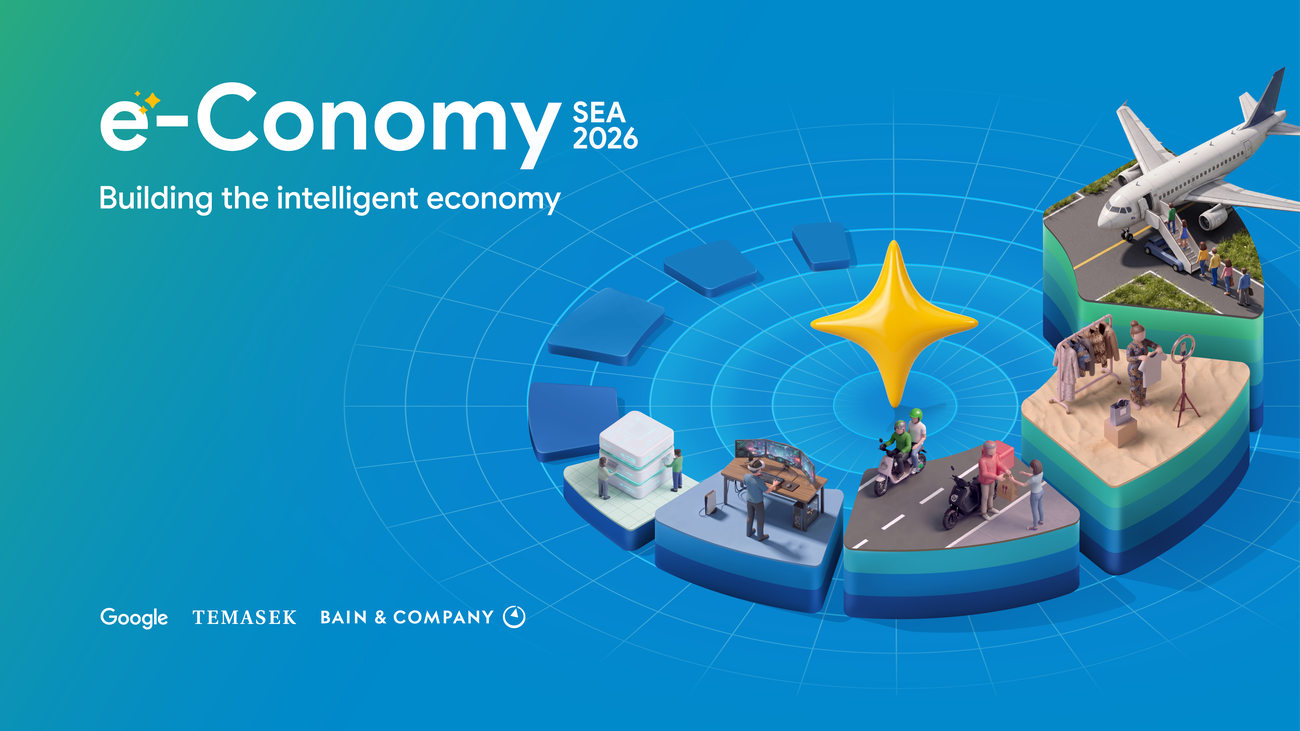
Southeast Asia’s digital economy to hit $368 billion in 2026 driven by widespread generative AI adoption and robust sector growth


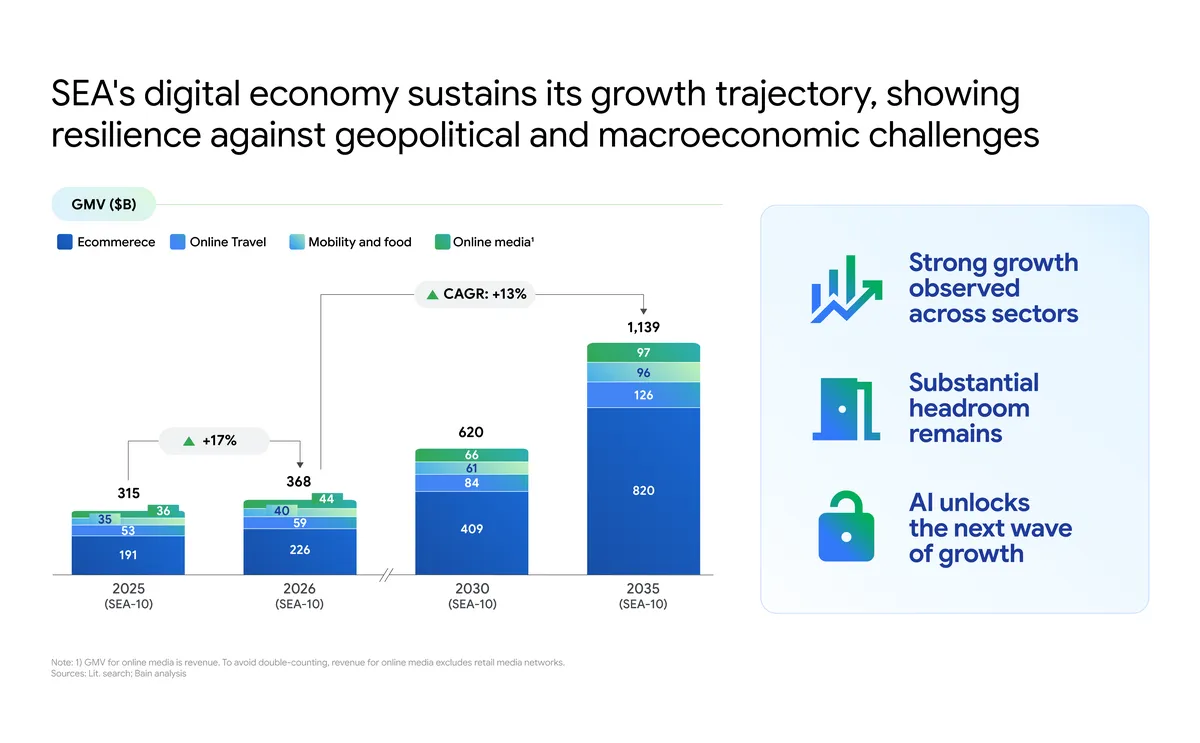
The digital economy of Southeast Asia is experiencing a profound structural transformation, catalyzed by the rapid deployment and mass adoption of generative artificial intelligence. According to the 11th edition of the annual e-Conomy SEA report—jointly published by Google, Temasek, and Bain & Company—the region’s Gross Merchandise Value (GMV) is projected to reach $368 billion in 2026. This represents a robust 17% year-on-year growth rate compared to the previous year, placing the market firmly on an accelerated trajectory to surpass $1 trillion by 2035.
Titled "Building the Intelligent Economy," the latest report highlights an unprecedented behavioral shift across the region. Generative AI has transitioned from an experimental novelty into an indispensable pillar of daily life, actively utilized by 243 million individuals, representing 58% of Southeast Asia’s working population. Notably, the rollout of generative AI tools has scaled at a velocity four times faster than the historical deployment of the mobile internet.
The economic implications of this technological leap are far-reaching. By adopting tokens as the emerging benchmark for the AI economy, analysts project that surging consumer and enterprise confidence in agentic commerce will spark a staggering 60-fold increase in regional AI utilization over the next half-decade. As businesses and consumers increasingly rely on automated systems to navigate complex transactions, Southeast Asia is cementing its position as one of the world’s most dynamic and digitally agile economic zones.
Macroeconomic Background and the Evolution of the e-Conomy SEA Series
To understand the magnitude of the $368 billion milestone, it is necessary to examine the historical trajectory of Southeast Asia’s digital landscape. Initiated over a decade ago, the e-Conomy SEA report series has mapped the region’s digital metamorphosis from nascent e-commerce marketplaces and ride-hailing startups into a sophisticated, multi-trillion-dollar ecosystem.
In its early years, growth was primarily fueled by expanding smartphone penetration, rising urbanization, and a youthful, digitally literate demographic across Indonesia, Malaysia, the Philippines, Singapore, Thailand, and Vietnam. As foundational digital infrastructure matured, the focus shifted toward financial inclusion, logistics optimization, and profitability.
By 2024 and 2025, macroeconomic headwinds—including global inflationary pressures and tightening venture capital funding—tested the resilience of the region’s tech sector. Yet, Southeast Asian enterprises adapted by pivoting toward sustainable unit economics and operational efficiency. The integration of advanced machine learning and, subsequently, generative AI provided the exact efficiency multipliers needed to reignite double-digit growth. The 2026 milestone of $368 billion, up from $315 billion in 2025, demonstrates that the region has successfully navigated cyclical economic challenges by embedding intelligence directly into its commercial foundations.
Sector-by-Sector Analysis: AI as a Catalyst for Broad-Based Growth
The report details how generative AI is not merely benefiting a single niche, but is sustaining and accelerating expansion across every major vertical of the digital economy.
E-commerce remains the undisputed anchor of the region’s digital ecosystem, accounting for $226 billion in GMV with an 18% year-on-year growth rate. The integration of multimodal discovery tools and sophisticated in-app assistants has fundamentally altered how consumers search for and purchase goods. Shoppers can now use conversational prompts and visual searches to navigate complex product landscapes. For merchants, these personalized AI-driven experiences yield an average 10% increase in conversion rates, with order volume uplifts soaring as high as 75% for early adopters.
The online travel sector has reached $59 billion in GMV, marking a 10% year-on-year increase. While traditional search engines remain the primary starting point for travel planning, generative AI has officially surpassed social media to become the second-most utilized tool for organizing complex, multi-destination itineraries. Travelers increasingly rely on AI to synthesize reviews, optimize flight and hotel combinations, and curate personalized local experiences in real time.
Meanwhile, online media has expanded to $44 billion in revenue, posting a 22% year-on-year expansion. Platforms are leveraging AI to hyper-personalize content feeds and connect audiences with contextually relevant advertisements. This technical refinement has driven a 10% to 20% increase in quality engagement, helping to propel commerce media into a flourishing $4 billion market.
Mobility and food delivery services have generated $40 billion in GMV, reflecting a steady 15% year-on-year growth. Consumers across major metropolitan areas benefit from predictive scheduling, smarter traffic routing, and AI-powered service offerings—such as intelligent ride-pooling—which reduce commuting times while maximizing driver earnings and asset utilization.

Finally, digital financial services continue to form the backbone of the region’s economic integration, processing $1,650 billion in Gross Transaction Value (GTV) with a 16% year-on-year increase. AI is playing a critical role in scaling secure financial infrastructure through real-time fraud detection algorithms, automated credit scoring that expands financial access to underbanked populations, and personalized wealth management recommendations. Notably, Singapore continues to serve as the regional vanguard for advanced digital wealth platforms, setting a benchmark for regulatory compliance and technological sophistication.
The Rise of Agentic Commerce and Consumer Trust
A central thesis of the 2026 report is the impending transition toward "agentic commerce"—an economic model where autonomous AI agents perform complex tasks, compare prices, and execute financial transactions on behalf of human users.
This evolution is underpinned by existing consumer habits. The data reveals that 72% of Southeast Asian digital users already rely on automated everyday features, such as dynamic price-tracking tools and automated alerts. This widespread familiarity has created fertile ground for advanced automation: 75% of surveyed users expressed a direct willingness to allow AI agents to autonomously manage purchasing workflows for them.
This high level of consumer readiness is rooted in profound regional optimism. A striking 62% of people in Southeast Asia view artificial intelligence as a net positive for society, reporting significantly greater trust in AI tools than they did in the preceding year. Key drivers of this trust include proven operational track records (cited by 56% of respondents), rising daily familiarity (55%), and demonstrable improvements in output accuracy and quality (53%).
However, industry experts and report authors emphasize that unlocking the full potential of agentic commerce requires addressing specific consumer apprehensions. To feel entirely secure delegating financial and purchasing decisions to autonomous systems, users demand robust guardrails. Specifically, 44% of consumers call for stringent data privacy safeguards, 36% request transparent disclosures regarding the operational limits of AI tools, and 30% emphasize the necessity of simple mechanisms to reverse agentic transactions if errors occur.
Strategic Implications and Necessary Ecosystem Adaptations
To support the report’s projection of a 60-fold increase in regional AI utilization by 2030, Southeast Asia’s broader digital ecosystem must undergo coordinated systemic evolution. Industry analysts, policymakers, and corporate leaders have identified four critical areas that require immediate strategic adaptation:
First, digital infrastructure and compute capacity must expand rapidly. The surging demand for token processing and real-time generative AI inference requires substantial investments in energy-efficient data centers, high-speed fiber-optic networks, and localized cloud computing architectures across emerging markets like Indonesia, Vietnam, and the Philippines.
Second, regulatory frameworks must mature to balance innovation with consumer protection. As agentic commerce blurs the lines between consumer and automated actor, policymakers must establish clear legal standards for liability, data governance, cross-border data flows, and intellectual property rights. Harmonizing these regulations across the Association of Southeast Asian Nations (ASEAN) member states will be vital to maintaining investor confidence and ensuring seamless regional trade.
Third, workforce development and digital literacy initiatives must be prioritized. While 58% of the working population actively uses generative AI, bridging the digital skills gap remains essential to prevent economic polarization. Educational institutions and corporate training programs must equip the workforce with advanced prompt engineering, data analytics, and AI oversight capabilities to ensure workers remain competitive in an intelligent economy.
Fourth, cybersecurity measures must scale proportionally with digital transaction values. As financial services and e-commerce platforms increasingly automate transactions via AI agents, sophisticated threat actors will target vulnerabilities in autonomous code. Financial institutions and technology firms must implement zero-trust architectures and advanced cryptographic defenses to safeguard consumer data and maintain systemic trust.
Broader Economic Impact and Future Outlook
The findings of the e-Conomy SEA 2026 report underscore Southeast Asia’s transition from a regional testing ground for digital applications into a global leader in applied artificial intelligence. With a combined population exceeding 680 million people—characterized by a young demographic profile and rapid urbanization—the region possesses the structural momentum required to achieve the projected $1.14 trillion digital economy valuation by 2035.
As businesses integrate generative intelligence into their core operations and consumers embrace autonomous digital assistants, Southeast Asia is redefining the boundaries of modern commerce. The coming decade will test the adaptability of the region’s policymakers, enterprises, and workforce, but the foundational economic indicators confirm that Southeast Asia is well-positioned to build and sustain a thriving intelligent economy.