LG Electronics USA to Suspend Smart TV Apps Utilizing Residential Proxy Nodes

LG Electronics USA announced this week a significant policy shift, declaring its intention to suspend any applications built for its smart TVs that transform user televisions into always-on residential proxy nodes. This decisive action follows a recent exposé by security researchers revealing a widespread integration of such proxy software development kits (SDKs) within LG’s webOS app store. The move signals a heightened awareness and proactive stance by the home appliance giant to address potential privacy and security concerns stemming from its connected devices.
The Discovery of Pervasive Proxy SDKs
The revelation that a substantial portion of applications available on LG’s smart TV platform were facilitating the rerouting of internet traffic through users’ televisions sent ripples through the cybersecurity community. Research conducted by the security firm Spur, published on July 2nd, highlighted the alarming prevalence of residential proxy SDKs. Spur’s investigation found that over 42 percent of games and other applications available for download on LG’s webOS store contained these SDKs. This means that a considerable number of LG smart TV users were unknowingly participating in a network where their device acted as a proxy for third-party internet traffic, potentially for extended periods and without explicit, ongoing consent.
The implications of this discovery are far-reaching. Residential proxy networks allow paying customers to route their internet traffic through the IP addresses of ordinary internet users. While legitimate uses exist for such services, including market research, competitive analysis, and content aggregation, the embedding of these SDKs within everyday consumer electronics like smart TVs raises significant privacy and security red flags. Critics argue that users are often unaware of the full extent of their participation, and the potential for misuse, such as masking illegal activities or enabling unauthorized access to local networks, is substantial.
Spur’s research also extended to other major smart TV operating systems, revealing that over a quarter of applications developed for Samsung’s Tizen OS exhibited similar residential proxy components. This suggests a broader industry trend rather than an isolated issue specific to LG. The findings were based on an examination of apps available for download, indicating that these proxy functionalities were not hidden but rather integrated into the core features or monetization strategies of the applications themselves.
LG’s Official Response and Policy Enforcement
In direct response to Spur’s findings, LG Electronics has articulated a clear and firm stance. John Taylor, Senior Vice President at LG, communicated to KrebsOnSecurity that the company is actively collaborating with app developers to eliminate the residential proxy functionality from their applications operating on the webOS platform. Taylor emphasized that this feature is not aligned with the intended use of LG smart TVs and that developers who fail to comply with this directive will face the suspension of their applications.
"A residential proxy network is not an intended use for LG smart TVs, and LG Electronics is working with developers to remove the residential proxy option from their apps on the webOS platform," Taylor stated. "If this option is not removed, these apps will be suspended."
Taylor further underscored LG’s commitment to preventing the proliferation of residential proxy networks within its smart TV ecosystem moving forward. He confirmed that the company’s review process for existing applications is already in progress. "As part of our ongoing efforts to enhance platform quality and the user experience, LG will continue to strengthen our evaluation process for developer-submitted apps, including those that incorporate residential proxy SDKs," he added in an emailed statement. This proactive approach signals a dedication to safeguarding user privacy and maintaining the integrity of the platform.
The Monetization Landscape of Residential Proxies
The integration of residential proxy SDKs into smart TV applications is often driven by developers seeking alternative revenue streams. Residential proxy providers typically offer financial compensation to developers for embedding their SDKs, which then transform the user’s device into a proxy node available for rent to paying customers. This model allows app creators to monetize their creations beyond traditional advertising or in-app purchases.
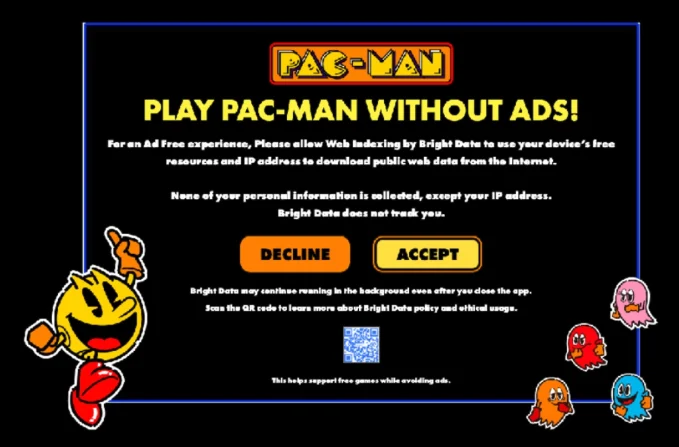
Spur’s research identified that these residential proxy SDKs were bundled with a surprisingly diverse range of applications. From classic games like Pac-Man to utility applications and even screensavers, the pervasive nature of these integrations highlights the widespread adoption of this monetization strategy. The image provided by Spur, depicting a Pac-Man smart TV app from Bright Data, illustrates this point clearly. Users of this particular application are presented with a choice: either view advertisements within the game or consent to allow their television to function as a residential proxy node. This scenario underscores the often opaque nature of user consent in such instances, where opting out of one form of monetization (ads) leads to participation in another potentially more privacy-impacting one.

Key Players and Their Stances
The report by Spur identified Bright Data as a dominant provider of proxy SDKs across both LG and Samsung smart TV platforms. In response to the allegations, Bright Data issued a statement asserting that its network operates on principles of consent and responsibility, adhering to the terms set by LG and Samsung.
"Every peer opts in through a dedicated screen and receives value in return; every customer is vetted, and our practices have now undergone a second independent audit by PwC," Bright Data stated. "We remain committed to an open, transparent internet where legitimate businesses, researchers, and institutions can responsibly access data that lives in the public domain."
Bright Data and other proxy providers mentioned in Spur’s report maintain that they implement stringent know-your-customer (KYC) processes to verify the legitimacy of their service users. These uses are frequently associated with content scraping activities undertaken by their clientele. Furthermore, these proxy companies assert that they employ technological safeguards designed to prevent customers of their proxy services from interacting with or controlling other devices connected to the proxy user’s local network. This is a critical point, as the potential for a proxy node to become an entry point into a user’s home network is a significant security concern.
Critical Analysis of Consent and Transparency
Despite assurances from proxy providers regarding consent and vetting, cybersecurity experts like Trevor Sutter from Spur raise crucial questions about the adequacy of current consent mechanisms. Spur argues that the fundamental issue lies not with the existence of residential proxy networks themselves, but with their widespread integration into devices that consumers do not typically perceive as computers and are ill-equipped to scrutinize.
"A one-time consent prompt buried in a TV app is not a substitute for meaningful transparency, ongoing control, and platform oversight," Sutter articulated. He further highlighted a critical vulnerability: "The risk is amplified when consent comes from individuals within the household who use the device but shouldn’t give consent, such as minors." This points to a significant ethical and practical challenge in obtaining truly informed and appropriate consent for such functionalities, especially in a shared-use environment like a household.
The act of embedding proxy SDKs within applications that are downloaded and managed by a platform provider like LG raises questions about the latter’s due diligence in vetting the applications it offers. While LG’s recent announcement is a positive step, it also prompts a re-examination of the entire app review and approval process for smart TV platforms. The potential for these SDKs to be exploited, even inadvertently, necessitates a robust and ongoing oversight mechanism.
Broader Implications for the Smart Home Ecosystem
LG’s proactive stance on residential proxy SDKs is a welcome development, but it arrives amidst a broader landscape of consumer technology where privacy concerns are increasingly at the forefront. The company has recently faced scrutiny for another partnership involving the bundling of McAfee security products through software drivers included in its high-end LCD monitors. As reported by the YouTube channel Gamers Nexus, certain LG LCD monitors were found to automatically install an application that promotes paid McAfee antivirus subscriptions via Windows Update, without explicit user approval prompts. This incident, while distinct from the smart TV app issue, underscores a recurring pattern of integrating third-party software through often opaque channels, raising questions about user control and consent across LG’s product lines.
The implications of widespread residential proxy usage in smart TVs extend beyond individual privacy. For network administrators and cybersecurity professionals, the presence of unknown proxy nodes within a network can create blind spots, complicate threat detection, and potentially serve as vectors for malicious activity. The ability of proxy service customers to interact with other devices on the proxy user’s local network, even if technologically mitigated by proxy providers, remains a persistent concern. This is particularly relevant in enterprise or sensitive network environments where maintaining network integrity and visibility is paramount.
Furthermore, the sheer volume of data that could potentially be routed through these proxy networks, combined with the fact that the originating IP addresses belong to unsuspecting consumers, could have broader implications for internet traffic analysis and the integrity of online data. If a significant portion of internet traffic is masked or rerouted through residential IP addresses, it can complicate efforts to track the origin of malicious activities and potentially skew legitimate data collection efforts.
The trend of embedding residential proxy SDKs in smart devices reflects a complex interplay between monetization strategies, evolving app store economies, and the growing demand for accessible data. However, as the capabilities and ubiquity of smart devices continue to expand, the imperative for robust security, transparent practices, and meaningful user consent becomes increasingly critical. LG’s decision to address the residential proxy issue head-on is a significant step, but it also serves as a catalyst for ongoing dialogue and action across the entire smart home and connected device industry to ensure that user privacy and security remain paramount. The industry must collectively move towards greater transparency and empower users with more granular control over how their devices interact with the wider internet.
Related posts: