A New Era for Apple Hardware
For years, rumors surrounding an Apple foldable device were treated with skepticism by industry analysts who pointed to Apple’s conservative approach to hardware innovation. Unlike competitors who rushed into the foldable market as early as 2019, Apple has historically prioritized polish and software-hardware synergy over "first-to-market" status. The iPhone Duo appears to be the culmination of this strategy, featuring a proprietary hinge mechanism and a custom-engineered display layer designed to withstand the rigors of daily folding.
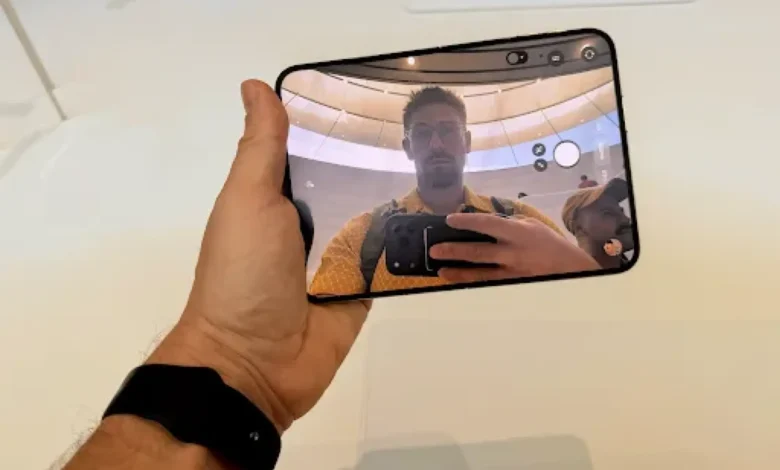
The device features a 7.6-inch interior OLED display that utilizes an adaptive refresh rate, shifting seamlessly as the device transitions from its compact, folded state to its expanded, tablet-like configuration. Early demonstrations by on-the-ground journalists, including Mashable’s Senior Editor Stan Schroeder, confirm that the software transitions—dubbed "Fluid Continuity" by Apple—are remarkably snappy, with applications resizing and reformatting in milliseconds.

Technical Specifications and Design Nuances
The design philosophy of the iPhone Duo is characterized by its exceptionally thin profile. When folded, the device maintains a slimness that mimics traditional smartphones, avoiding the "brick-like" sensation associated with many first-generation foldable devices from other manufacturers. However, the engineering reality of a folding display remains a point of technical debate.
While Apple’s keynote presentation showcased a seemingly flawless, crease-free surface, in-person observations paint a more nuanced picture. When held at an angle under harsh indoor lighting at Apple Park, a faint vertical indentation is visible where the hinge meets the screen. This is a common physical limitation of current flexible display technology. Gizmodo’s Ray Wong noted that while the crease is nearly invisible when viewing content head-on, it becomes apparent under specific lighting conditions. Despite this, the consensus among early testers is that the crease is significantly less intrusive than that of the earliest foldable devices from competitors, suggesting that Apple’s material science team has made substantial strides in display durability.
The Ecosystem and User Experience
The true value proposition of the iPhone Duo lies in its software. Apple has introduced a specialized version of iOS designed specifically for the folding form factor. This includes "Dual-View" multitasking, which allows users to run two distinct applications side-by-side or expand a single application across the full 7.6-inch canvas.

Prominent tech creator Max Weinbach, who was among the first to handle the device, highlighted the under-display camera technology as a standout feature. Unlike the prominent notches or punch-holes found on traditional iPhones, the Duo’s inner display creates an immersive, uninterrupted visual experience. "I wasn’t expecting the under-display camera to be this refined," Weinbach remarked, noting that the color accuracy and clarity surpassed his initial expectations for the technology.
Content creators like Justine Ezarik (iJustine) showcased the device’s versatility, particularly in media consumption and content creation. By partially folding the device—a state referred to as "Flex Mode"—users can utilize the bottom half of the screen as a trackpad or a control panel, while the top half displays media or camera viewfinders. This functionality mimics the behavior of a mini-laptop, positioning the iPhone Duo not just as a phone, but as a productivity tool for the mobile professional.
Industry Reactions and Market Implications
The launch of the iPhone Duo has sent ripples through the mobile industry. Competitors who have spent years establishing themselves in the foldable space are now facing a reality where Apple, despite its late entry, brings an unparalleled level of brand loyalty and ecosystem integration.

Market analysts at Ziff Davis suggest that the $1,999 price point places the iPhone Duo firmly in the "ultra-premium" segment. While this may limit immediate mass-market adoption, it signals a long-term strategy to define the high-end tier of the smartphone market. The presence of the iPhone Duo at this price point also forces a competitive response from rivals, potentially driving further innovation in hinge durability and battery efficiency across the industry.
Not all feedback has been universally positive. Some early critics have compared the device to the Microsoft Surface Duo or the Nintendo DS, questioning whether the split-screen functionality will be supported by third-party developers effectively enough to justify the price. Furthermore, there remains a lingering question regarding the long-term longevity of the display’s flexible polymer coating compared to traditional tempered glass screens.
A Chronology of the Foldable Transition
- Early 2024: Patents surface describing a "hinge-assisted display mechanism," marking the first concrete evidence of Apple’s R&D focus on foldables.
- Late 2025: Supply chain reports confirm that Apple has secured long-term contracts for flexible OLED panels with high-durability substrates.
- August 2026: Apple officially announces the "Surprise and Shine" event, with industry insiders correctly predicting the reveal of the "iPhone Duo."
- September 9, 2026: Official unveiling of the iPhone Duo at Apple Park.
- October 23, 2026: Scheduled date for retail availability and customer shipping.
The Path Forward
As the industry looks toward the October release, the focus will shift from first impressions to sustained performance testing. The "hinge fatigue" factor—how the device handles thousands of folds over months of use—will be the next major hurdle for Apple to clear in the eyes of the public.

For the average consumer, the iPhone Duo represents a turning point. It is no longer a question of if foldables are a viable form factor, but rather how they will reshape our relationship with mobile computing. With the integration of advanced AI processing chips and the expansive display, Apple is banking on the idea that users are ready to move beyond the static, glass-slab design that has dominated the industry since 2007.
Whether the iPhone Duo will achieve the same cultural ubiquity as its predecessors remains to be seen. However, if the buzz surrounding its debut is any indication, the shift toward foldable technology has officially reached the mainstream, and the market is prepared to pay a premium for the privilege of being part of this new chapter in technology. As consumers prepare for the October 23 launch, the device stands as a testament to the persistent pursuit of the "infinite screen," pushing the boundaries of what is physically possible in a device that fits in the palm of a hand.