Navigating the Complex Landscape of European E-Commerce Returns: Challenges, Strategies, and the Path Forward

The contemporary e-commerce transaction extends far beyond the digital checkout and the subsequent financial settlement of a shopping cart. For online merchants operating across Europe, the fulfillment loop is increasingly defined by what happens after delivery. Product returns have evolved from an operational afterthought into a critical pillar of the modern retail ecosystem. As online shopping continues to reshape consumer habits, merchants face the intricate task of balancing consumer demands for frictionless return policies against the stark realities of spiraling logistical costs, regulatory complexities, and mounting environmental pressures.
Overview of E-Commerce Returns in the European Market
Across the European Union and its broader economic sphere, return rates have established a formidable presence, though their characteristics vary drastically by geographic market and retail sector. Industry data indicates that the average return rate for online purchases across Europe hovers persistently between 30% and 40%. However, individual national statistics reveal an even more pronounced reliance on the practice.
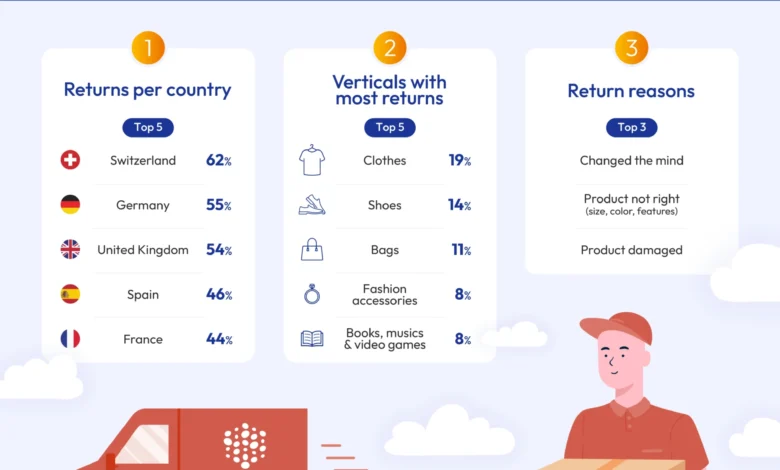
According to market research compiled by Statista, Switzerland recorded the highest return rate per online buyer in Europe at 62% in 2023. Germany closely trailed with 55%, while the United Kingdom completed the continental podium with 54% of online purchases being sent back to retailers. These figures reflect deeply ingrained consumer expectations regarding post-purchase flexibility, which have been cultivated by years of aggressive competition among major online marketplaces.
The financial and operational repercussions of these high return volumes are profound. From a strict profitability standpoint, returns impose heavy financial burdens on retailers. These include direct processing fees, labor costs associated with inspection and restocking, and the inevitable revenue loss incurred when returned merchandise must be resold as open-box or second-hand items at significantly reduced prices. Conversely, from the perspective of customer retention, a seamless return policy remains a vital trust-building mechanism. Consumers frequently cite the ease of returning an item as a primary determinant when deciding whether to patronize an unfamiliar online storefront.
Sectors Most Impacted by Return Volumes
While nearly every retail vertical experiences some level of product reversal, certain industries bear the brunt of consumer indecision and sizing discrepancies. The fashion and apparel sector consistently reports the highest return rates, driven by the inherently subjective nature of personal style, fabric expectations, and inconsistent sizing standards across different apparel brands. Footwear and accessories follow closely behind, where fit and color accuracy are paramount.
Beyond fashion, consumer electronics and household goods also generate substantial return volumes, typically averaging around 6% of total online sales within their respective categories. Unlike apparel, where returns are often driven by preference, electronics and home goods are frequently sent back due to technical incompatibility, manufacturing defects, or operational complexity that frustrates the end-user.
The Root Causes of Consumer Returns
To effectively mitigate return rates, merchants must first understand the underlying motivations driving consumer behavior. Industry analysts categorize the primary triggers for returns into several distinct consumer trends:
- Bracketing: A growing phenomenon where consumers purchase multiple sizes or variations of the same product—such as three different sizes of a jacket—with the explicit intention of keeping only the one that fits best and returning the rest.
- Expectation Mismatches: Discrepancies between digital product representations (photography, descriptions) and the physical item delivered to the consumer’s doorstep.
- Impulse Purchasing: E-commerce platforms designed for frictionless checkout can inadvertently encourage hasty buying decisions, leading to immediate buyer’s remorse upon delivery.
- Gifting Culture: Items purchased as gifts for third parties that ultimately do not meet the recipient’s preferences or needs.
Multi-Faceted Challenges for European Retailers
The management of European e-commerce returns presents a complex matrix of logistical, regulatory, financial, and ecological hurdles that demand strategic intervention from retail leadership.
Logistical Complexities and Cross-Border Friction
Managing reverse logistics requires a highly robust infrastructure capable of handling unpredictable product flows efficiently. This complexity is exponentially magnified in cross-border commerce. E-commerce merchants operating within the European single market must contend with varying national laws, localized consumer protection rights, and intricate customs regulations that govern international shipments outside the EU customs union, such as post-Brexit trade with the United Kingdom.
Furthermore, businesses must navigate divergent consumer protection directives across member states, particularly regarding statutory cooling-off periods, refund timelines, and liability for return shipping costs. Failure to navigate this fragmented regulatory landscape accurately can expose companies to legal disputes, regulatory fines, and severe reputational damage.
Financial Pressures and Profitability Margins
The economic toll of reverse logistics cannot be overstated. Retailers must absorb the costs of inbound transit, warehouse labor for sorting and grading, refurbishment, and inventory re-entry. In response to these escalating expenses, a growing number of major fashion and general merchandise retailers have abandoned the model of universally free returns, opting instead to introduce nominal restocking fees or return charges. Companies must delicately calibrate these financial policies to protect their bottom lines without alienating their customer base.
The Mounting Ecological Crisis
In addition to financial and logistical strain, e-commerce returns carry a severe environmental footprint. The secondary transportation required to move returned items back through the supply chain generates substantial carbon dioxide emissions. Furthermore, the process relies heavily on single-use packaging materials, such as plastic mailers, tape, and bubble wrap.
Environmental audits have also highlighted the alarming practice of product disposal. When the cost of inspecting, repackaging, and restocking a returned item exceeds its residual market value, some merchants have historically resorted to discarding or destroying surplus goods—a practice that has drawn sharp criticism from environmental regulators and sustainability advocates across Europe.
Managing Customer Expectations in a High-Expectation Era
Modern consumers demand return processes that are simple, fast, and entirely transparent. Research indicates that shoppers frequently evaluate a retailer’s return policy prior to completing their initial purchase. Delays in processing refunds or a lack of accessible drop-off points for parcels are primary drivers of consumer frustration. When return experiences fail to meet these elevated expectations, brand loyalty quickly erodes, leading to lost future sales and negative public reviews.
Strategic Solutions for Optimizing E-Commerce Returns
Faced with mounting pressures, e-commerce enterprises are actively deploying advanced strategies to optimize their return operations, transform cost centers into manageable processes, and align commercial goals with sustainability mandates.
Designing User-Friendly Yet Controlled Return Policies
Merchants are increasingly replacing ambiguous return guidelines with transparent, accessible policies. Providing prepaid return labels within the original packaging, offering extended return windows during peak holiday seasons, and partnering with local convenience store networks as drop-off points help bridge the gap between consumer convenience and operational control. Clear sizing charts, high-definition video demonstrations, and augmented reality (AR) fitting tools are also being deployed proactively at the point of sale to reduce unnecessary returns before they occur.
Leveraging Advanced Technology and Data Analytics
Technology plays an indispensable role in modern reverse logistics. Retailers are investing in sophisticated return management software (RMS) platforms that automate the authorization process, generate real-time tracking data, and integrate seamlessly with warehouse management systems (WMS). These platforms provide actionable data analytics, allowing merchants to identify defective product lines, trace high-return items back to specific suppliers, and refine digital product descriptions to accurately reflect customer expectations.
Implementing Sustainable and Circular Strategies
In response to regulatory tightening and consumer demand for corporate responsibility, businesses are adopting circular economy principles. This includes utilizing biodegradable, compostable, or reusable packaging materials that customers can easily utilize for return transit. Additionally, companies are optimizing transportation networks through batch shipping—consolidating returned goods to minimize the frequency of vehicle dispatch—and establishing dedicated refurbishment channels to ensure returned items are promptly resold as certified pre-owned goods or directed into textile recycling streams.
Conclusion
The landscape of e-commerce returns in Europe remains a defining challenge for online retailers. While the practice of returning goods is an unavoidable reality of digital commerce, it is no longer an insurmountable operational drain. By implementing data-driven analytics, user-friendly policies, cutting-edge technological solutions, and sustainable logistical frameworks, European merchants can successfully navigate regulatory complexities. Ultimately, forward-thinking enterprises can transform the management of returns from a costly administrative burden into a strategic differentiator that fosters long-term customer loyalty and environmental stewardship.