Navigating the Landscape of E-Commerce Returns in Europe: Challenges, Trends, and Strategic Optimization for Global Merchants

The modern e-commerce lifecycle no longer concludes when a customer clicks the "pay" button or when a parcel arrives at a doorstep. In the contemporary European digital marketplace, the return process has evolved from a back-office logistical necessity into a pivotal stage of the consumer journey. For e-commerce merchants operating across the continent, returns are an inescapable reality that dictates brand loyalty, operational profitability, and environmental footprint. As the European e-commerce sector continues to mature, understanding the nuances of "reverse logistics" has become as critical as the initial sale itself.
In Europe, the phenomenon of returning goods is deeply ingrained in consumer culture, though its manifestation varies significantly across national borders. While the convenience of online shopping has driven unprecedented growth, it has simultaneously fostered a "try-before-you-keep" mentality. This article provides a comprehensive analysis of the European returns landscape, examining the statistical realities, the logistical and regulatory hurdles, and the strategic frameworks merchants are adopting to mitigate costs while maintaining customer satisfaction.
The Statistical Reality of European Returns
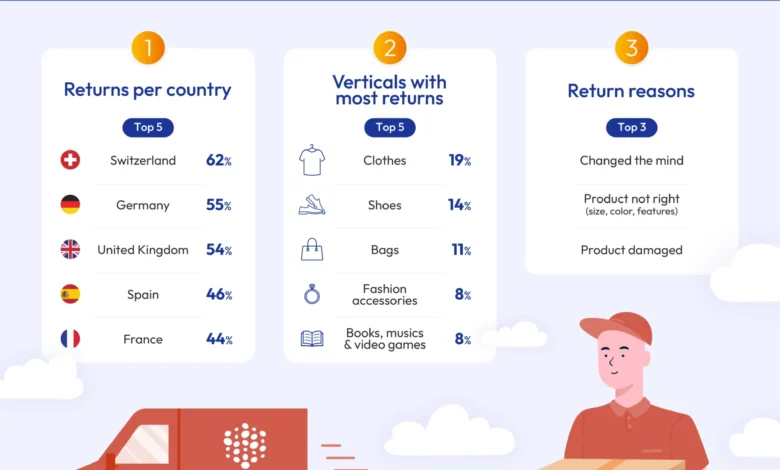
Recent industry data reveals that the average return rate in Europe fluctuates between 30% and 40% of all online purchases. However, these figures mask a highly fragmented landscape where national consumer habits create vastly different operational requirements for retailers. According to 2023 data from Statista and various logistics monitors, Switzerland currently leads the continent with a staggering 62% return rate per online buyer. Germany follows closely at 55%, with the United Kingdom ranking third at 54%.
These high rates in DACH (Germany, Austria, Switzerland) regions are often attributed to the historical popularity of "open invoice" payment methods, where consumers only pay for what they keep, effectively encouraging high-volume ordering with the intent to return. In contrast, Southern European markets such as Italy and Spain typically see lower return rates, often below 25%, partly due to different payment preferences and a more traditional approach to fashion and retail.
Sector-Specific Impacts and Consumer Behavior
The burden of returns is not distributed equally across all retail sectors. The fashion and apparel industry remains the most heavily impacted, with some high-street brands reporting return rates as high as 50% for specific categories like evening wear or footwear. The subjective nature of style, coupled with the inherent difficulty of standardizing sizes across different international brands, makes clothing a high-risk category for reverse logistics.
Statista’s 12-month trailing data highlights the following breakdown of returned goods in major markets like France and Germany:
- Clothing and Apparel: 15% to 18% of all returns.
- Shoes and Footwear: 10% to 12%.
- Consumer Electronics: 6%.
- Household Items and Appliances: 6%.
A significant driver of these numbers is the "bracketing" trend. Bracketing refers to the consumer practice of purchasing the same item in multiple sizes, colors, or styles with the explicit intention of returning the versions that do not fit or appeal. While this mimics the fitting-room experience of a physical store, it places an immense financial and logistical strain on the merchant, who must absorb the costs of shipping, inspection, and restocking.
The Multi-Faceted Challenges of Reverse Logistics
Addressing the volume of returns requires more than just a warehouse space; it requires a sophisticated logistical infrastructure. For European merchants, these challenges are categorized into four primary domains:
1. Logistical and Cross-Border Complexity
Europe’s geographical and political fragmentation adds layers of complexity to returns. For a merchant based in the Netherlands selling to a customer in Poland, the return journey involves international transit, varying carrier networks, and the need for end-to-end traceability. Cross-border returns are particularly difficult because they often require local consolidation hubs to manage costs. Without a local return address, shipping costs can quickly exceed the value of the item being returned.
2. Regulatory and Legal Frameworks
The European Union’s Consumer Rights Directive provides a robust safety net for shoppers, including a mandatory 14-day "cooling-off" period during which consumers can return most goods for any reason. However, the interpretation of these laws can vary. Post-Brexit, the United Kingdom has moved into a separate regulatory orbit, introducing customs declarations and VAT complexities for goods moving between the UK and the EU. Merchants must navigate these "Rules of Origin" and "Export/Import Declarations" to ensure that returned goods do not incur double taxation or get stalled at customs borders.
3. The Financial Burden
Returns are a significant "profit killer." The costs include:
- Outbound and Inbound Shipping: Often subsidized or fully covered by the merchant.
- Processing and Inspection: Labor-intensive checks to ensure the item is not damaged.
- Refurbishment: Cleaning or repackaging goods for resale.
- Inventory Depreciation: The loss in value, especially for seasonal fashion or fast-moving electronics.
In response, major retailers like Zara, H&M, and Boohoo have recently pivoted away from "free returns," introducing nominal fees for mail-in returns to recoup costs and discourage abusive consumer behavior.
4. The Environmental Imperative
The ecological impact of returns has become a central concern for both regulators and consumers. Traditional return cycles contribute significantly to carbon emissions through additional transportation legs. Furthermore, the "waste" aspect is alarming; the European Environmental Bureau (EEB) has frequently raised concerns about the destruction of unsold or returned goods. In response, the EU is moving toward stricter "Right to Repair" laws and potential bans on the destruction of functional textile and electronic returns, forcing merchants to find secondary markets or recycling solutions.
Strategic Optimization: Turning Returns into Opportunities
To survive in this high-return environment, e-commerce leaders are moving away from reactive management toward proactive optimization. Several key strategies have emerged as industry best practices:
Implementing User-Friendly and Transparent Policies
Clarity is the foundation of trust. Merchants are now utilizing "Return Portals" where customers can easily generate prepaid labels, choose drop-off points, and track their refund status. By offering extended return windows (e.g., 30 or 60 days), some brands have paradoxically found that return rates decrease, as the "urgency" to return an item subsides, and the consumer becomes more likely to keep the product.
Leveraging Advanced Technology and AI
Technology is being deployed to stop returns before they happen. Virtual fitting rooms, AI-driven size recommendations based on previous purchases, and high-definition 360-degree product videos are becoming standard tools to bridge the "expectation-reality gap." On the backend, automated warehouse systems can process returns in minutes, triggering instant refunds—a move that significantly boosts customer lifetime value (CLV).
Data-Driven Decision Making
By analyzing return data, merchants can identify "toxic" products or serial returners. If a specific dress has a 70% return rate due to "too small" feedback, the merchant can update the product description in real-time to advise customers to "size up." Data also allows for the identification of fraudulent behavior, such as "wardrobing," where a customer wears an item once for an event and then attempts to return it.
Adoption of Circular Economy Models
To mitigate environmental impact, forward-thinking European brands are integrating "re-commerce" into their platforms. Instead of sending returned items back to a central warehouse, some companies are experimenting with peer-to-peer returns or directing returns to local "outlet" sections of their websites. This reduces the carbon footprint and recovers value from items that might otherwise be liquidated.
Chronology of the Return Evolution in Europe
The current state of European returns is the result of a two-decade evolution:
- 2000–2010: The "Growth Era." E-commerce was nascent; free returns were introduced as a marketing tool to build consumer trust in online shopping.
- 2011–2018: The "Expectation Era." Amazon’s expansion across Europe normalized next-day delivery and frictionless returns, forcing all competitors to follow suit.
- 2019–2021: The "Pandemic Surge." Lockdowns led to a massive spike in e-commerce volume and, consequently, a logistical crisis in return processing.
- 2022–Present: The "Correction Era." Rising fuel costs and sustainability mandates have led to the return of "paid returns" and a focus on operational efficiency over pure volume.
Implications for the Future of European Retail
As we look toward the mid-2020s, the management of returns will likely become a primary differentiator in the European market. Analysts suggest that we are moving toward a "hybrid" model where high-loyalty customers (members of VIP programs) may still enjoy free returns, while casual shoppers pay a fee.
Furthermore, the "Local-to-Local" return model is expected to grow. By using local shops or automated lockers (like InPost or DHL Packstations) as return hubs, merchants can drastically reduce the "last-mile" costs of reverse logistics.
In conclusion, while returns are an inherent challenge of the e-commerce business model, they are not merely a cost center. A well-executed return strategy is a powerful tool for customer retention. In a market as competitive as Europe, the ability to handle a return with speed, transparency, and environmental responsibility can be the factor that turns a one-time buyer into a lifelong brand advocate. Merchants who fail to optimize this "last stage" of the journey risk not only their margins but also their reputation in an increasingly conscious consumer landscape.