Large language models (LLMs) are fundamentally designed to predict the next probable token in a sequence. While this architecture has enabled a revolution in generative text, it presents a significant hurdle for complex problem-solving. When left to their own devices, these models tend to favor immediate, fluent, and direct responses, a behavior that often leads to logical lapses in tasks requiring multi-step reasoning. To bridge this gap between fluid generation and rigorous cognition, researchers have developed frameworks such as Chain of Thought (CoT) and Tree of Thoughts (ToT). These methodologies, which have gained prominence over the last two years, are now the bedrock of sophisticated AI agent systems capable of autonomous planning and execution.
The Evolution of Model Reasoning: From Linear to Branching
The shift toward structured reasoning represents a pivotal moment in the development of artificial intelligence. Historically, LLMs struggled with tasks that required "system two" thinking—a psychological term for slow, deliberate, and logical reasoning. Early benchmarks, such as the GSM8K math dataset, revealed that models frequently failed at basic word problems not because they lacked the knowledge, but because they lacked the architecture to decompose the problem into logical segments.
The introduction of Chain of Thought in 2022 by researchers at Google Brain marked the first major breakthrough. By prompting the model to "think step-by-step," researchers discovered that models could significantly improve their accuracy on complex reasoning tasks. This was followed by the 2023 proposal of Tree of Thoughts by researchers at Princeton and Google DeepMind, which introduced a more deliberate, exploratory approach to the problem-solving process.
Chain of Thought: The Linear Foundation
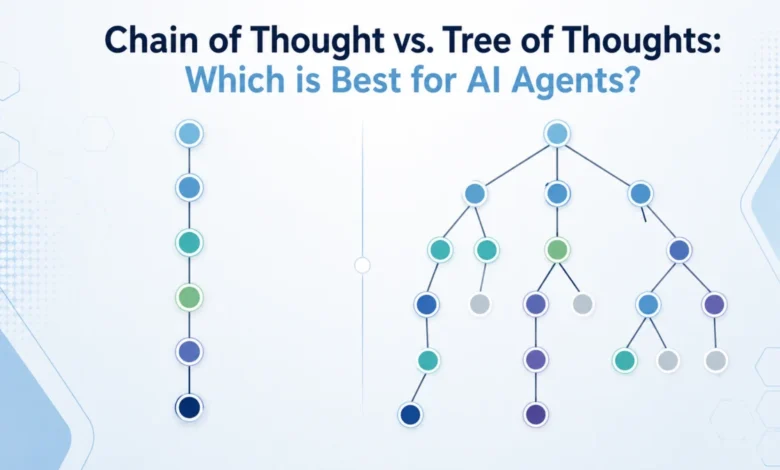
Chain of Thought functions as a scaffold for the model’s internal monologue. By forcing the output to include intermediate reasoning steps, the model essentially externalizes its logic, allowing for both the model and the user to verify the path taken to reach a conclusion.
From a technical standpoint, CoT operates in a linear fashion. If an agent is tasked with scheduling a meeting across multiple time zones, a CoT-enabled agent will systematically list the current time in each location, adjust for daylight savings, check the availability of the participants, and then output the final time.
Strengths and Limitations:
- Efficiency: CoT is computationally inexpensive compared to more complex search strategies. It requires only a single pass of token generation.
- Transparency: Because the logic is laid out, developers can perform "traceability analysis" to identify where an agent went wrong.
- Linear Fragility: The primary weakness of CoT is its inability to course-correct. If a model makes a minor error in the first step of a ten-step mathematical equation, that error is carried through to the final result. In the field of AI safety, this is known as "compounding error propagation."
Tree of Thoughts: Exploratory Reasoning
Tree of Thoughts (ToT) introduces a paradigm shift by moving away from a single linear path toward a branching structure. In ToT, the model generates multiple potential "thought" paths simultaneously. An evaluator—either a separate model or the same model with a specific heuristic—scores these paths based on their probability of leading to a correct solution.
This approach mimics the search algorithms used in traditional AI, such as A* or Monte Carlo Tree Search. If a particular branch of logic appears to be leading to an incorrect outcome, the agent can "prune" that branch and backtrack to an earlier, more promising node in the tree.
The Computational Trade-off:
- Resource Intensity: ToT can be 10 to 50 times more expensive than CoT. Each branch requires additional token generation and evaluation calls, which directly impacts API latency and infrastructure costs.
- Success Rate: In high-stakes environments—such as automated code generation, complex scientific hypothesis testing, or long-term tactical planning—ToT significantly outperforms CoT by reducing the frequency of dead-end solutions.
Comparative Data and Industry Application
Recent internal benchmarks from various AI research labs suggest that while CoT is the optimal choice for 80% of routine tasks, ToT is becoming the industry standard for "reasoning-heavy" agents.
For instance, in software engineering workflows where an agent must write, test, and debug code, simple linear reasoning often fails because the first attempt at a solution rarely accounts for all edge cases. Agents using ToT demonstrate a 30-40% increase in success rates for complex debugging tasks by simulating different implementation strategies before committing to a final code snippet.
The Role of AI Agents in Decision-Making
The distinction between these two frameworks becomes critical when deploying AI agents into real-world production environments. An agent is more than a chatbot; it is a system that can invoke tools, access external databases, and perform actions.
In a logistics automation scenario, an agent might be tasked with re-routing a shipping container after a port strike.
- Using CoT: The agent might quickly identify the closest alternate port and issue a command. If that port is also at capacity, the agent fails.
- Using ToT: The agent would evaluate three potential alternate ports, check the real-time congestion data for each, simulate the delivery delay for each, and select the optimal path that minimizes both time and cost.
This level of autonomous decision-making necessitates a robust reasoning framework. Industry leaders, including firms specializing in autonomous enterprise software, are now deploying hybrid models. These systems use CoT for "low-stakes" requests (e.g., email drafting, basic data retrieval) and automatically escalate to ToT when the task complexity or potential cost of failure exceeds a predefined threshold.
Analysis of Future Implications
The trajectory of these reasoning frameworks suggests that the next generation of LLMs will likely move toward "system-integrated" reasoning. Rather than relying on external prompting techniques like CoT or ToT, future architectures may embed these capabilities directly into the model’s decoding process.
However, the current dependency on these techniques highlights a broader limitation: models still struggle with self-reflection. Even with ToT, the model’s ability to evaluate its own branches is only as good as its training data. If a model is fundamentally biased or lacks the necessary context, both CoT and ToT will merely "reason" their way into a more sophisticated but still incorrect conclusion.
The ongoing challenge for developers is to balance the "cost of thought" with the "value of accuracy." As compute power becomes more accessible, we expect to see a rise in "Reasoning-as-a-Service" architectures, where agentic systems dynamically allocate computational resources to solve problems. In this future, the choice between Chain of Thought and Tree of Thoughts will not be a static configuration, but a fluid, adaptive setting determined by the difficulty of the problem at hand.
Summary of Key Considerations
As organizations integrate these agents into their workflows, the decision-making criteria should be clear:
- Complexity: Does the task require multiple perspectives or a single, logical progression?
- Cost Sensitivity: Can the system absorb the latency and financial cost of multiple model calls?
- Risk Tolerance: What are the consequences of an error? If the cost of failure is high, the investment in a ToT-based architecture is not just a preference—it is a business necessity.
By understanding the distinct mechanics of Chain of Thought and Tree of Thoughts, businesses can better navigate the landscape of AI agent deployment, ensuring that their systems are not only fast and efficient but also reliable and logically sound.