The Critical Divide Between AI Mentions and Citations and How to Optimize Your Brand Visibility

If you have been tracking your brand’s presence in AI-generated answers, you have likely noticed a frustrating paradox: your brand name appears frequently, yet that visibility fails to translate into measurable website traffic. This phenomenon is rooted in the fundamental distinction between an AEO (Answer Engine Optimization) mention and an AEO citation. For marketing teams and digital strategists, misinterpreting the difference between these two metrics results in a distorted view of brand performance and a significant missed opportunity for conversion.
The Evolution of Search and the AEO Paradigm Shift
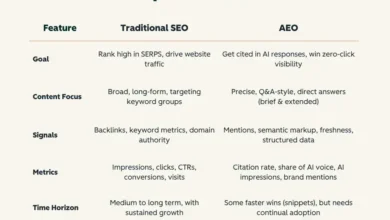
The landscape of search has undergone a tectonic shift since 2023, transitioning from a traditional index of blue links to an ecosystem of synthesized answers. This transition, often referred to as Generative Engine Optimization (GEO), has forced brands to pivot from traditional SEO—which prioritizes ranking for keywords—to AEO, which prioritizes inclusion in AI-generated summaries.
Historically, search engine optimization was a game of authority and relevance defined by backlink profiles and content depth. Today, the game is defined by the AI model’s internal knowledge graph and its ability to extract precise, trustworthy information to answer user queries in real-time. As search giants like Google, OpenAI, and Perplexity refine their algorithms, the visibility of a brand is no longer binary. It is now categorized into two distinct states: the mention and the citation.
Understanding the Anatomy of AI Visibility
An AEO mention occurs when an AI engine references a brand, product, or company within its generated narrative. While this provides brand recognition and helps establish entity authority within the AI’s model, it is effectively a dead end for the user. There is no hyperlink, no call to action, and no path for the reader to navigate to the brand’s website. From an analytics perspective, a mention is invisible.
Conversely, an AEO citation represents a functional, attributed source. This manifests as a footnote, a source card, or an explicit “Learn more” link. A citation serves as an invitation for the user to verify information or explore deeper, providing a direct pipeline of referral traffic.
Recent research underscores the volatility of this environment. Data from The Digital Bloom indicates that the overlap between organic top-10 search results and AI Overview citations dropped from approximately 76% in mid-2025 to a range of 17% to 54% by early 2026. This decline confirms that AI visibility is decoupling from traditional organic ranking. A page may rank first on Google for a specific keyword but fail to earn a citation in the corresponding AI Overview, necessitating a dedicated, separate strategy for AI-driven discovery.
The Economic and Analytical Implications
The gap between a mention and a citation is essentially a revenue gap. Because mentions do not generate click-throughs, they cannot be measured in standard web analytics platforms like GA4 or Adobe Analytics. Consequently, brands that ignore this distinction often underestimate their total reach.
Furthermore, research from Workshop Digital suggests that AI-referred traffic carries higher conversion intent. Because users interacting with AI tools have already engaged with a synthesized summary of their inquiry, they arrive at a website with a higher degree of qualification and intent than a user who clicked a generic link from a search engine result page (SERP).
However, measuring this traffic remains a technical hurdle. Studies from MeasureU indicate that roughly 22% of ChatGPT-originated sessions are misclassified by default GA4 configurations, often landing in the “unassigned” or “direct” traffic buckets. To combat this, digital teams are increasingly implementing custom channel groupings, specifically defining AI sources—such as chatgpt.com, perplexity.ai, and gemini.google.com—to ensure these sessions are properly attributed to the AI Search channel.
Strategic Framework for Closing the Attribution Gap
To transform passive brand mentions into active citations, organizations must adopt a rigorous, five-pillar approach to content engineering.
First, brands must clarify their entity footprint. AI engines rely on consistent data points across the web. If a brand’s description, product list, and category alignment differ across its website, social media, and third-party directories, the AI model struggles to form a coherent entity profile. Standardizing this language creates a stronger “semantic triple,” which is essential for the engine to associate the brand with specific solutions.
Second, content must be structured for “answer-first” consumption. Modern AI models prioritize content that provides a direct, declarative answer to a query. Content that buries the lead under layers of context-setting is rarely cited. Teams should identify the core questions their target audience asks and place the concise, definitive answer at the beginning of the content block.
Third, the implementation of validated structured data (schema) is no longer optional. Schema markup for organizations, products, and FAQ pages provides the machine-readable signals that AI engines require to map content components. When schema is accurate and matches the visible text, it significantly increases the likelihood of being pulled as a source.
Fourth, E-E-A-T (Experience, Expertise, Authoritativeness, and Trustworthiness) remains the bedrock of AI content evaluation. Despite the shift in technology, the underlying goal of AI engines remains the provision of trustworthy information. Brands that include author bylines, cite original data, and provide transparent credentials for their contributors are rewarded with higher citation rates.
Finally, an iterative refresh cadence is required. The AI search environment is dynamic; a page that is cited today may be supplanted by a competitor’s content tomorrow. Content teams should establish a three-to-six-month review cycle for high-performing pages, ensuring that statistics, examples, and recommendations remain current.
Benchmarking Against the Competitive Landscape
To maintain dominance in the AI search space, companies must look beyond their own data and perform regular competitive benchmarking. This involves building a “share-of-model” report, which tracks how often a brand appears in AI answers compared to its top three to five competitors.
By monitoring these metrics, organizations can identify asymmetries in the market. For instance, if a competitor has a high mention rate but a low citation rate, they have successfully built brand awareness but lack the authoritative content to capture the traffic. This represents a strategic window of opportunity for a firm to refine its content structure and outflank the competitor on the same queries.
Limitations and the Importance of Long-Term Trends
It is essential for stakeholders to recognize the limitations of current AEO measurement. AI engines are highly personalized; the answer generated for one user may differ from the answer generated for another based on location, search history, and device. Therefore, a single manual spot-check is anecdotal at best.
Reliable AEO data must be derived from trends over time rather than isolated snapshots. A minimum of eight weeks of consistent, weekly data collection is necessary to identify legitimate patterns. When reporting to executive leadership, teams should focus on the direction of these trends—such as a 15% increase in citation rates following a site-wide schema implementation—rather than attempting to attribute precise, granular revenue figures that may be skewed by attribution leakage.
The Future of Search Attribution
As AI continues to integrate into the daily search experience, the distinction between mentions and citations will likely become a primary focus of digital marketing budgets. The goal is no longer just to be present in the conversation, but to be the definitive source of truth that the AI model relies upon.
While the technical challenges of measurement and attribution remain, the path forward is clear: success in the AI era requires a shift toward entity-based marketing, structured data, and a commitment to high-intent, answer-first content creation. By focusing on the conversion of mentions into citations, brands can ensure that their visibility in the era of AI results in the only metric that truly matters: sustainable growth.