The Evolution of Semantic Search
Traditional database systems have long relied on keyword-based indexing, such as BM25 or TF-IDF, which function by matching exact strings or linguistic stems. While effective for structured data or known terminology, these systems struggle with nuance, context, and synonymy. If a user searches for "a cellular energy source," a keyword-based system might fail to retrieve a document discussing "mitochondria" if the word "energy" is missing or if the phrasing differs.
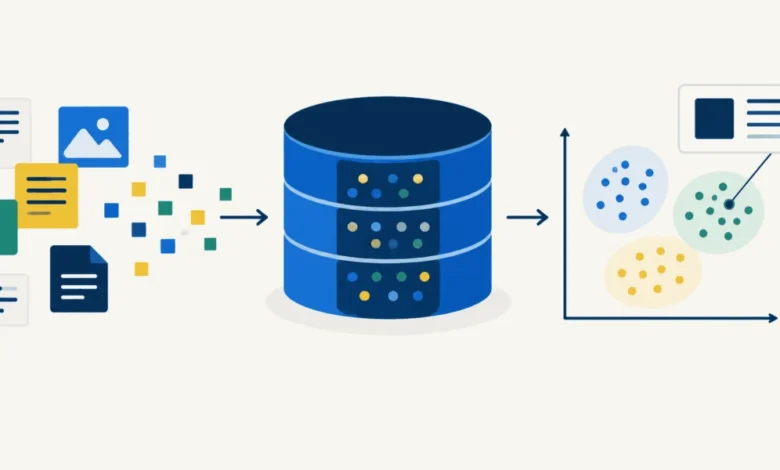
Vector databases represent a paradigm shift in data retrieval. They function by transforming unstructured data—text, images, or audio—into high-dimensional vectors, also known as embeddings. These vectors act as coordinates in a multi-dimensional space, where the distance between points reflects the semantic similarity between the concepts they represent. When a user submits a query, the database converts that query into the same vector space and performs a mathematical operation, typically a dot product or cosine similarity calculation, to identify the nearest neighbors.
Setting the Foundation: Infrastructure and Environment
To construct a functional vector database, the implementation requires a structured environment. The prerequisite stack involves Python, NumPy for efficient matrix operations, and the sentence-transformers library, which provides the pre-trained models necessary to convert natural language into mathematical representations.
The implementation process begins with establishing a clean workspace. By utilizing a modular approach—where the document corpus, metadata, and the core database logic are separated into distinct files—developers ensure that the system remains maintainable. The VectorDB class serves as the central engine, responsible for the ingestion of documents, the generation of embeddings, and the execution of similarity searches. A critical component of this setup is the implementation of "guard rails." Without rigorous input validation—such as ensuring that document lists and metadata entries are perfectly aligned—a database is susceptible to silent corruption, where vectors lose their correlation with the source text.
The Mechanics of Indexing and Storage
Once the environment is configured, the indexing process commences. Upon loading a pre-trained transformer model, the system iterates through the document corpus to generate fixed-size vectors. A notable characteristic of this architecture is the predictability of memory usage. Regardless of the length of the source document, the embedding model outputs a fixed-dimension vector (e.g., 384 dimensions). This standardization allows for highly efficient storage and lightning-fast comparisons, as the index size is primarily a function of the number of documents rather than the volume of text.
The storage layer must be robust enough to handle persistence. In a production-grade implementation, the vectors are stored in a binary format (such as .npy files) to ensure fast read-write performance, while the associated text and metadata are stored in JSON format for human readability and ease of retrieval. A critical security and integrity feature is the strict coupling of the model version with the index. Because embeddings are unique to the specific model that generated them, attempting to query a database with a different model version results in "confident nonsense"—a state where results are returned but are mathematically and semantically irrelevant.
Querying and Semantic Relevance
The transition from keyword matching to semantic retrieval is best illustrated through testing. In a standard query—for example, asking "what keeps a cell supplied with energy?"—the vector database successfully identifies documents mentioning "mitochondria" even if the query did not contain that word. This is because the embedding model has been trained on massive datasets to recognize that "mitochondria" and "cell energy" share a high degree of semantic overlap.
This capability introduces the necessity of metadata filtering. In real-world applications, semantic similarity is not always sufficient. A document about a comic book character possessing "mitochondria-rich muscles" might be a high-similarity match for a biology question, but it is factually incorrect for the user’s intent. By implementing a metadata-filtering layer, the system can partition the search space, ensuring that queries are restricted to specific topics or categories before the ranking phase occurs. This "pre-filter" approach is essential for accuracy, as it prevents the system from returning irrelevant results that simply happen to reside in the same vector neighborhood.
Scaling for Enterprise Demands
The final phase of development involves addressing the computational challenges of scale. While a small corpus of 25 documents can be searched in near-zero time, managing millions of entries requires careful attention to the "scan and rank" workflow.
The performance of a vector search is dictated by the complexity of calculating the dot product across the entire dataset. For smaller collections, a "flat index"—where every document is compared against the query—is sufficient. However, as the dataset grows into the hundreds of thousands or millions, the latency increases. The following performance data illustrates the shift as the corpus expands:
| Documents | Memory (MB) | Scan Time (ms) | Rank Time (ms) |
|---|---|---|---|
| 1,000 | 1.5 | 0.01 | 0.04 |
| 10,000 | 14.6 | 0.36 | 0.55 |
| 100,000 | 146.5 | 3.73 | 8.90 |
As the table indicates, the linear increase in memory and computation time remains manageable for moderate scales. For massive datasets, developers typically move toward Approximate Nearest Neighbor (ANN) algorithms, such as HNSW (Hierarchical Navigable Small World) or IVF (Inverted File Index), which trade a marginal amount of precision for a massive gain in speed by not scanning every single vector.
Implications and Future Directions
The simplicity of building a vector database from scratch underscores a significant trend in the tech industry: the commoditization of complex infrastructure. While companies like Pinecone, Milvus, and Weaviate provide sophisticated, managed solutions, the core logic relies on the same fundamental principles of linear algebra and machine learning explored in this 10-step exercise.
For organizations integrating AI into their workflows, the implications are profound. Vector databases enable "Retrieval-Augmented Generation" (RAG), a technique where an LLM is provided with relevant, retrieved context to reduce hallucinations and improve factual accuracy. By building a database from scratch, developers gain the diagnostic skills required to debug issues in RAG pipelines, such as poor embedding quality, incorrect metadata filtering, or performance bottlenecks in the retrieval phase.
Ultimately, the mastery of vector databases is not about learning to manage a specific platform, but about understanding the relationship between natural language and numerical space. Whether for small-scale internal tools or massive, distributed search engines, the underlying math—the dot product, the normalization of vectors, and the matrix multiplication—remains the bedrock of modern information retrieval. As the ecosystem continues to evolve, those who understand these building blocks will be better positioned to architect the next generation of intelligent, context-aware applications.