Designing reliable memory systems for AI agents has become the central challenge for engineers moving beyond prototype-level LLM applications. While early AI implementations relied on stateless interactions—where each prompt was treated as a discrete event—the push toward autonomous agents requires persistent memory. Without it, agents are forced to operate in a "perpetual present," unable to learn from past errors or maintain context across long-running workflows. However, the transition from stateless to stateful architecture is fraught with technical pitfalls that can lead to catastrophic system failures, ranging from data corruption to sophisticated memory-poisoning attacks.
The Evolution of Agentic Memory
In the early days of generative AI, the "context window" was the primary limiting factor. Developers focused on maximizing the number of tokens an LLM could ingest to provide a semblance of continuity. By 2024, it became clear that simply increasing window size was an inefficient and expensive strategy. The industry began pivoting toward "External Memory Layers," which function similarly to a computer’s hierarchy of cache, RAM, and disk storage.
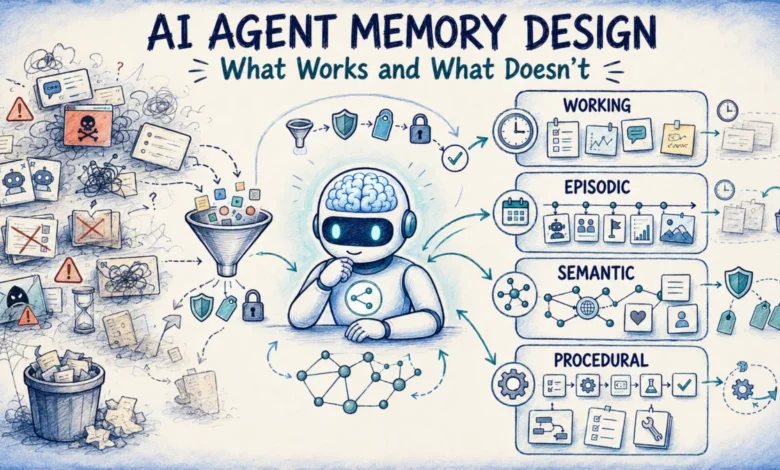
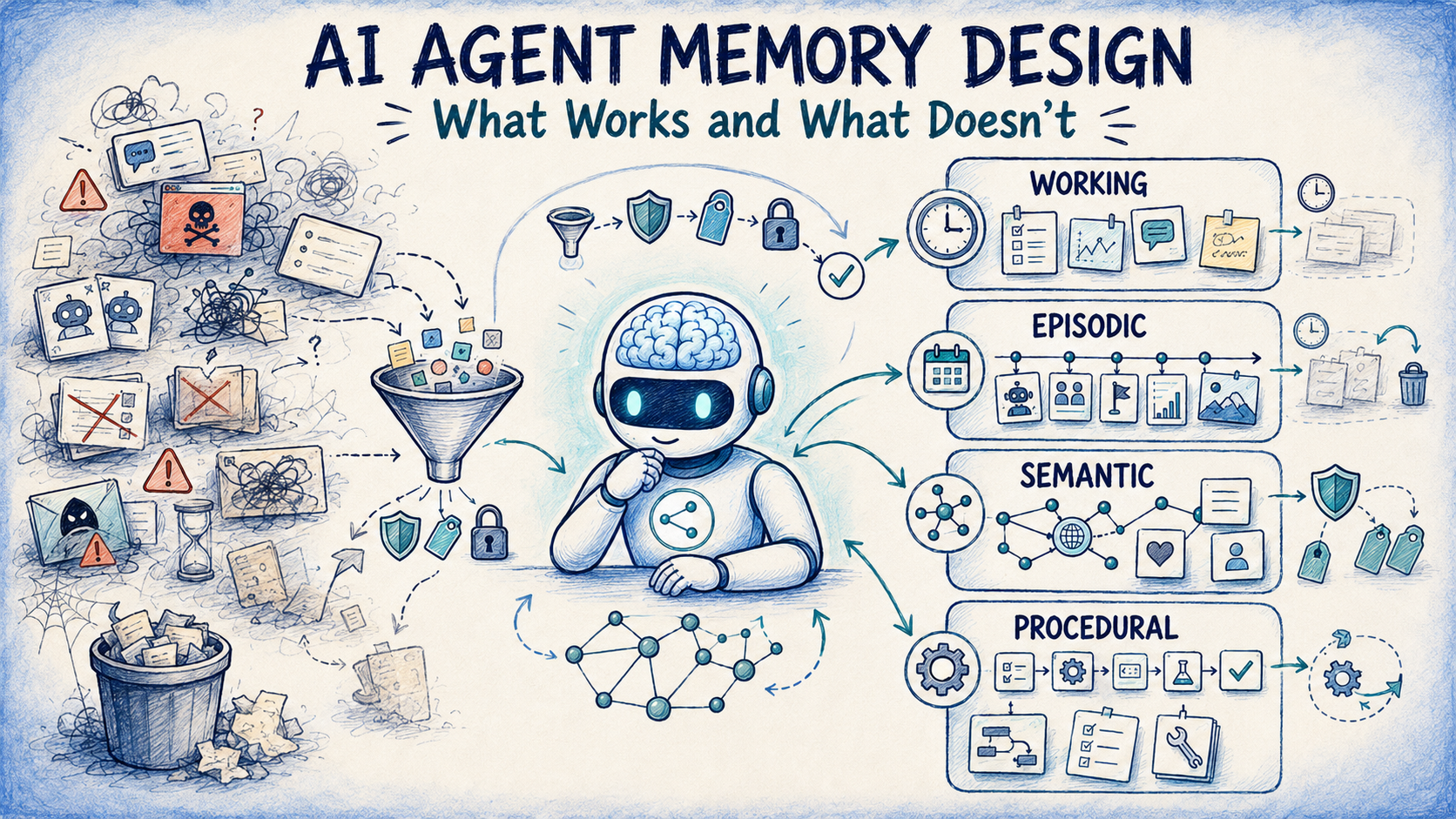
Current research into agentic systems suggests that effective memory must be categorized into four distinct types: Episodic (past experiences), Semantic (factual knowledge), Procedural (learned operational patterns), and Working (transient task-state data). Engineering teams that attempt to collapse these categories into a single monolithic database—typically a vector store—frequently encounter "retrieval noise," where the agent struggles to distinguish between a general fact and a critical instruction.
Architectural Failures: The Myth of the Universal Vector Store
The most prevalent architectural mistake in modern AI development is the reliance on a single vector database to handle all memory requirements. While vector search is highly effective for semantic similarity, it is fundamentally ill-equipped for structural data management.
When an agent stores a user preference alongside a raw log of a failed API call, the vector database treats both entries as high-dimensional points. If the agent later searches for "how to format this report," it may retrieve the failed API log simply because the keywords align, leading to the re-execution of a broken process. Furthermore, as these databases grow, the signal-to-noise ratio degrades. Analysts have observed that after exceeding 10,000 entries, naive vector retrieval often results in "hallucination amplification," where the model retrieves irrelevant or outdated information that steers the agent away from its intended goal.
Establishing Provenance and Trust
A critical, yet often overlooked, component of resilient memory is provenance tracking. In complex, multi-agent systems, information is constantly being generated and exchanged. Without a clear trail of origin, it becomes impossible to debug the source of a systemic error.
Industry standards now dictate that every memory entry must include a metadata header. This header should specify:
- The Agent ID: Which specific agent created the entry.
- The Tool Chain: The function or API used to gather the data.
- The Trust Level: A quantitative score (0.0 to 1.0) indicating the reliability of the source.
By assigning a trust level, developers can implement "Sanitization Gates." For instance, data scraped from an unverified third-party website is assigned a low trust score. Before this data is promoted to long-term storage, the system should run a validation check to ensure no "prompt injection" or hidden instructions are embedded within the text. Recent studies, including the 2025 MemoryGraft attack simulations, have demonstrated that without these gates, malicious actors can influence an agent’s future behavior by seeding its memory with semantically disguised instructions.
The Problem with Compression and Summarization
To manage costs and token limits, many developers implement automated summarization pipelines. The logic is straightforward: as an interaction progresses, the agent generates a summary of the session to save for later use. However, this creates a "detail erosion" effect.
In a professional setting, such as a legal or financial agent, missing a single specific clause or numerical constraint can invalidate an entire task. When an agent compresses a complex conversation into a summary, it inevitably discards the nuances that make that information actionable. A more robust approach involves "Typed Extraction." Instead of asking an LLM to "summarize the conversation," developers are moving toward structured extraction, where the model is prompted to fill out a Pydantic-based schema. This ensures that only verified, high-confidence facts are stored, effectively preventing the "compounding hallucination" loop where an agent cites its own previous errors as ground truth.
Strategic Maintenance and Lifecycle Management
Memory without maintenance is effectively technical debt. Unbounded growth in a memory store leads to increased latency and spiraling cloud costs. Organizations that have successfully scaled agentic systems implement rigorous lifecycle routines:
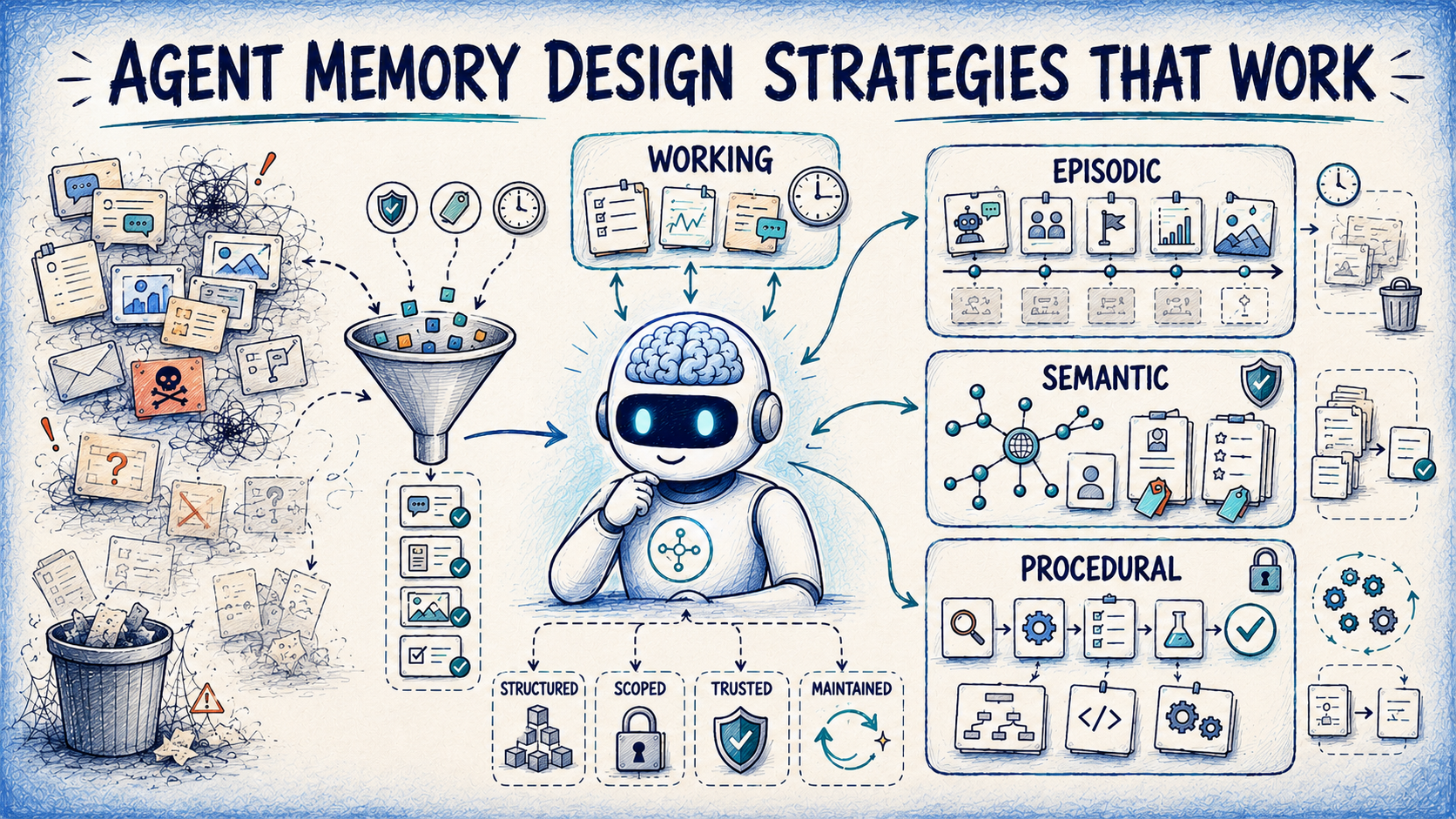
- Time-to-Live (TTL) Policies: Transient working memory is purged after a set duration, such as 36 hours, preventing stale data from affecting future, unrelated tasks.
- Confidence Decay: For facts that are time-sensitive, systems apply a decay function to the confidence score, eventually triggering a re-verification request to the user or an authoritative data source.
- Deduplication Cycles: Periodically running batch jobs to identify and merge redundant facts, which reduces the computational burden on the retrieval layer.
Multi-Agent Scoping: Preventing Context Pollution
In multi-agent environments, the danger of "context pollution" is high. If a research agent, a writing agent, and a code-execution agent share a flat memory namespace, the research agent’s scratchpad notes may appear in the writing agent’s context, leading to incoherent outputs.
The industry consensus is shifting toward "Scoped Memory Namespaces." In this architecture, each agent is granted read/write access only to its specific scope, with a central "Orchestrator" managing a shared, read-only layer of validated facts. This isolation ensures that if one agent malfunctions, the contamination is contained within its own namespace, allowing the system to maintain operational integrity.
Data-Driven Best Practices
Research into production-level AI agents highlights that the most successful systems prioritize write-time quality over read-time volume. The following table summarizes the divergence between common failures and proven strategies:
| Strategy | Recommended Approach | Common Pitfall |
|---|---|---|
| Storage Architecture | Multi-layer (Working, Episodic, Semantic, Procedural) | Single, flat vector database |
| Fact Compression | Schema-driven extraction | Free-form LLM summarization |
| Retrieval Cadence | Per-decision point | Once at task initialization |
| Memory Security | Trust-level filtering & Sanitization | Implicit trust in all stored content |
| Maintenance | TTL-based expiration & Deduplication | Unchecked storage growth |
Broader Implications for AI Autonomy
The design of memory systems is not merely a technical concern; it is a fundamental requirement for the maturation of autonomous AI. As agents move from performing simple query-response tasks to managing multi-step, enterprise-grade workflows, the reliability of their "recollections" becomes as important as the model’s inherent intelligence.
The current trend toward "structured memory" suggests a broader industry shift: we are moving away from the "black box" approach of letting the model figure out what to store, toward a more controlled, software-engineered approach. This transition will likely define the next generation of AI development. By treating memory as a managed database resource rather than an extension of the LLM’s context window, engineers can mitigate the risk of systemic failure, reduce the incidence of hallucination, and create agents that exhibit genuine, long-term continuity.
As we look toward the future of agentic systems, the emphasis on provenance, scoping, and rigorous write-time validation will be the baseline for any system intended for high-stakes environments. The goal is no longer just to make agents "smarter," but to make them more accountable, consistent, and predictable in their decision-making processes.