The Rise of Local-First Agentic Workflows
The architectural shift toward local-first AI is driven by two primary factors: the rapid optimization of open-weight models and the maturation of local model serving engines. Historically, running sophisticated models locally was reserved for enterprise-grade hardware due to the extreme memory and computational requirements. However, the introduction of efficient quantization techniques has allowed high-reasoning models, such as the Llama and Gemma variants, to operate on consumer-grade workstations.
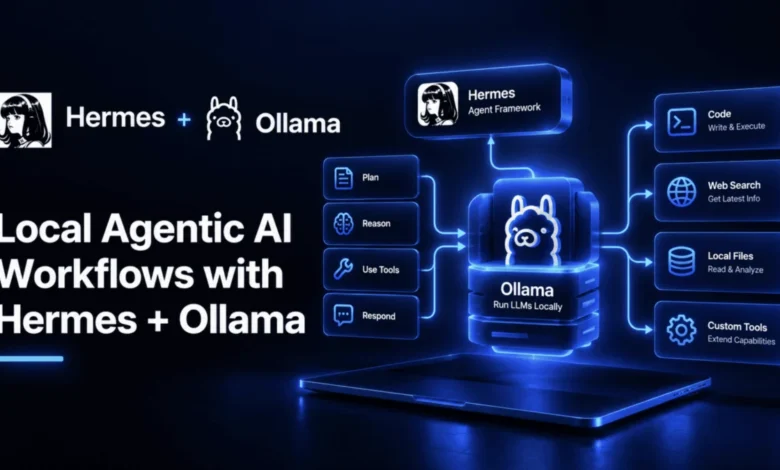
Hermes Agent, currently in version 0.21.1, represents a significant leap in this category. Unlike static chatbots, Hermes is designed as an agentic framework, meaning it possesses the autonomous capability to execute terminal commands, modify files, perform web searches, and interact with various digital environments. The software operates under the MIT license, encouraging transparency and modularity. Its architecture is built around three core pillars: persistent memory, which allows the agent to build a historical context of user projects; a messaging gateway, which bridges the agent to external platforms like Slack, Discord, and Telegram; and a sandboxed execution environment that protects the host system by isolating the agent’s actions within Docker, SSH, or local sub-processes.
The Role of Ollama in Model Orchestration
Ollama serves as the foundational layer for this workflow, acting as the engine that manages the lifecycle of local language models. It simplifies the often-daunting task of model deployment by providing a streamlined CLI and a REST API that mirrors the OpenAI standard. This compatibility is critical; by exposing a local endpoint at /v1/chat/completions, Ollama allows agentic frameworks like Hermes to treat a locally running model as if it were a remote, cloud-based service.
The division of labor between the two tools is precise. Ollama manages the inference engine—handling memory allocation, model weights, and compute acceleration—while Hermes manages the logic of the agent, including tool calling, planning, and task execution. This decoupling allows users to swap models depending on the specific requirements of a task without reconfiguring the entire agentic pipeline.
Hardware Prerequisites and Deployment Constraints
The feasibility of this setup depends largely on the hardware capabilities of the host machine. While CPU-only execution is technically possible, it is often insufficient for real-time interaction. For optimal performance, a dedicated NVIDIA GPU with at least 8GB of VRAM is recommended.
| Component | Minimum Specification | Recommended Specification |
|---|---|---|
| RAM | 8 GB | 32 GB or higher |
| Storage | 5 GB | 30 GB+ (for multiple models) |
| CPU | 4 Cores | 8+ Cores |
| GPU | N/A | NVIDIA GPU (8GB+ VRAM) |
The trade-off between model size and speed is a central consideration for users. A 31B parameter model, such as a specialized Gemma variant, offers superior reasoning and tool-use capabilities but requires significant VRAM to maintain acceptable latency. Conversely, smaller models (3B to 9B parameters) provide rapid, snappy responses suitable for general-purpose chat, though they often lack the sophisticated logic required for complex file manipulation or multi-step coding tasks.
Step-by-Step Implementation: Establishing the Local Environment
To deploy this workflow, the user must first initialize the Ollama environment. Installation is initiated through the official shell script provided by the Ollama project. Once the service is running, the user confirms the listener by querying the local API, which returns a list of installed models.
Selecting the appropriate model is the most consequential decision in the deployment. For an agentic assistant that requires file-system interaction, a model must support "tool calling." Models without this capability, regardless of their conversational prowess, will fail when tasked with executing shell commands or reading directories. Therefore, models such as the 31B parameter variants are prioritized for their ability to interpret and execute complex tool-based instructions.
Once the model is pulled and verified, the user must configure Hermes. The configuration file, located at ~/.hermes/config.yaml, defines the interface between the agent and the Ollama endpoint. By setting the provider to "custom" and the base URL to http://localhost:11434/v1, the user bridges the two systems.
Optimization Strategies for Production-Grade Local Agents
To ensure the system remains performant for long-term use, several optimizations are recommended:
- Context Window Expansion: Default context limits in many LLMs are insufficient for complex agentic tasks. By creating a custom
Modelfilein Ollama, users can extend the context window to 64,000 tokens. This allows the agent to hold multiple files and extensive documentation in its immediate memory, preventing the "forgetfulness" often observed in shorter-context models. - Persistent Model Loading: By default, Ollama unloads models to free up system resources. To maintain a "ready-to-use" state—particularly if the agent is integrated with a Telegram bot—users can use the
keep_aliveparameter in the API to prevent the model from being cleared from memory for up to 24 hours. - GPU Layer Offloading: Ollama natively supports partial or full layer offloading to NVIDIA GPUs. Even if the entire model does not fit in VRAM, offloading a portion of the layers significantly accelerates token generation speed, transforming the experience from a sluggish, multi-second wait to a near-instantaneous response.
Expanding Reach: The Telegram Gateway
A sophisticated feature of the Hermes Agent is its ability to act as a bridge to mobile platforms. By registering a bot via Telegram’s BotFather, users can route the local agent’s capabilities to their mobile devices. This enables a powerful hybrid use case: the agent performs heavy lifting on a stationary desktop computer, while the user provides instructions and receives summaries via a smartphone while away from their workspace. This setup maintains the "local-first" principle, as all traffic remains encrypted between the user’s device and the host machine, bypassing public cloud AI providers entirely.
Implications for Data Sovereignty and Privacy
The broader implication of moving to local-first agentic AI is the mitigation of data privacy risks. In a standard cloud-AI workflow, every input—including sensitive source code, personal financial data, or internal business documents—is transmitted to third-party servers. While service-level agreements often promise data security, the risk of data leakage or unauthorized access to training logs remains a significant concern for enterprises and privacy-conscious developers.
By running the entire stack locally, the attack surface is limited to the user’s local network. The use of sandboxed environments ensures that even if an agent is tricked into executing a malicious command, the impact is confined to an isolated container rather than the host operating system. Furthermore, this approach allows for the implementation of a "fallback" system, where a local model handles the vast majority of routine tasks at zero cost, while a high-tier cloud model is only invoked for specific, highly complex queries that exceed the capabilities of the local hardware.
Conclusion
The integration of Hermes Agent and Ollama marks a significant step toward the democratization of advanced AI workflows. By providing a pathway for users to operate complex, autonomous agents on their own hardware, the industry is shifting away from the "one-size-fits-all" cloud model toward a more personalized, secure, and sustainable future. This workflow demonstrates that high-performance, agentic AI does not necessarily require a recurring subscription fee or the surrender of data ownership; it requires only the correct combination of open-source tools and a baseline level of hardware investment. As these technologies continue to mature, the barrier to entry for local, private, and powerful AI agents will only continue to decrease, setting a new standard for individual and enterprise computing.