Data processing architectures have reached a critical inflection point as the volume of enterprise log data continues to expand exponentially. When software engineers design systems to parse telemetry, financial logs, or user activity reports, the standard practice of loading datasets into memory—often referred to as "eager evaluation"—frequently leads to catastrophic system failures. A common scenario involves a script that functions perfectly during development, only to collapse under the weight of a multi-gigabyte log file. This phenomenon, characterized by the MemoryError exception in Python, is a direct result of attempting to store an entire dataset in RAM, a strategy that is increasingly unsustainable in the era of Big Data.
The Anatomy of a Memory Failure
The underlying cause of these failures is often the reliance on list comprehensions and standard file reading methods like readlines(). In a typical pipeline, a developer might open a log file, parse it into a list of records, filter that list for errors, and then filter it again for high-latency events. If each step of this pipeline creates a new list in memory, the system must allocate space for every record across multiple intermediate structures.
For instance, a 9 GB log file processed via [parse(line) for line in f] will immediately attempt to allocate roughly 9 GB of RAM. If the system is running in a resource-constrained container, such as a Kubernetes pod with a 4 GB memory limit, the process is terminated by the kernel long before the parsing logic can even begin. This is not a failure of the algorithm’s logic, but a failure of data handling strategy.
Chronology of Data Processing Evolution
The transition from eager to lazy processing marks a significant shift in computational strategy. Historically, computing environments prioritized raw speed over memory optimization. However, as the gap between processor speed and memory capacity widened, the need for memory-efficient streaming became paramount. Python has provided the mechanisms for this shift—specifically iterators and generators—for over two decades, yet their adoption in production data pipelines remains inconsistent.
The "iterator protocol," defined by the __iter__ and __next__ methods, acts as the bedrock for this streaming architecture. By utilizing these protocols, developers can treat massive datasets as a series of individual events. Instead of pulling the entire file into memory, an iterator acts as a cursor, holding only a tiny buffer of the file’s contents. When the system calls next(), the iterator provides a single record, processes it, and then discards it, allowing for the garbage collector to reclaim the memory before the next record is pulled.
The Mechanics of Lazy Evaluation
The primary advantage of a generator function—marked by the yield keyword—is its ability to suspend state. When a function hits a yield statement, it does not terminate; rather, it saves its local variables, the instruction pointer, and the internal evaluation stack. This "suspension" allows the pipeline to advance one step at a time.
From a structural perspective, this transforms a monolithic script into a series of modular stages:
- The Source: A file iterator that reads the data from the disk in small, buffered chunks.
- The Transformer: A generator function that parses raw lines into structured dictionaries or objects.
- The Filter: A generator expression that discards irrelevant data without ever creating an intermediate collection.
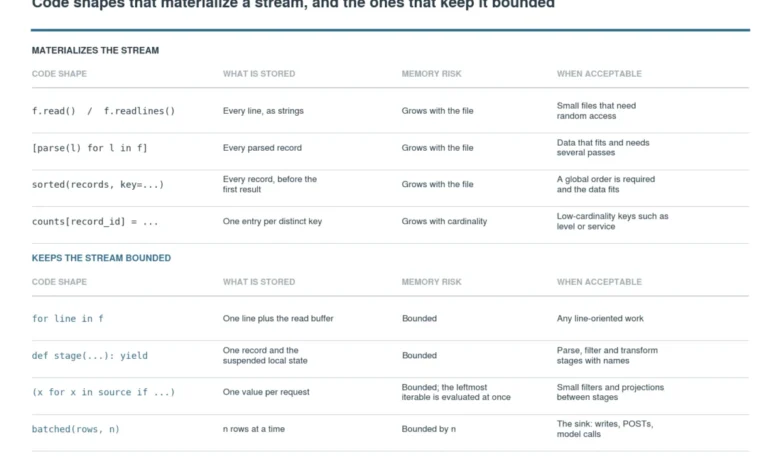
- The Sink: A bounded output, such as a file writer or database insertion point, that materializes the results only in small, manageable batches.
Data-Driven Performance Gains
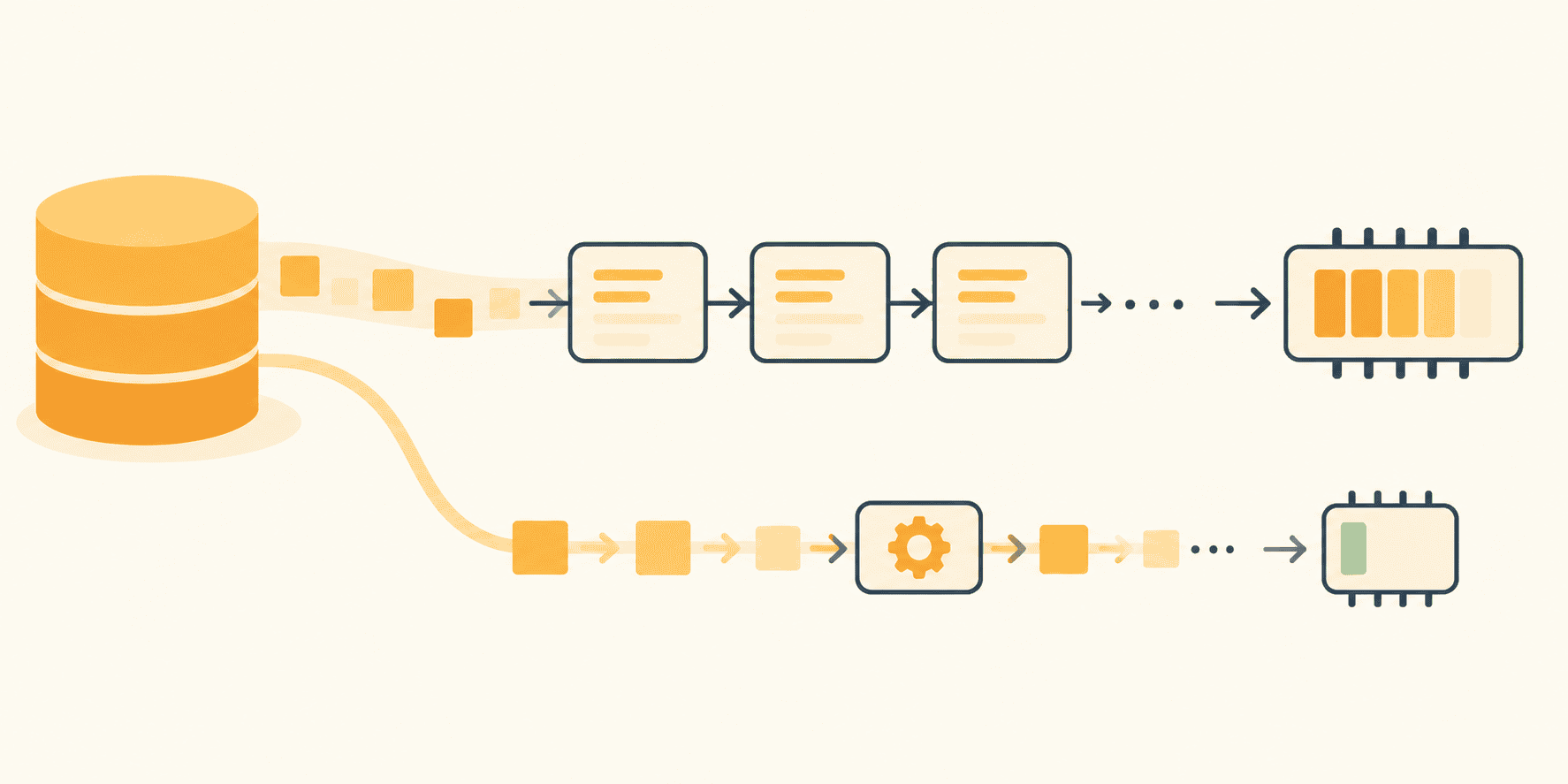
Comparative analysis of memory usage between eager and lazy pipelines reveals staggering disparities. In a controlled test involving a 200,000-line log file (approximately 17 MB), an eager pipeline relying on list materialization peaked at 198 MB of RAM usage. In contrast, a streaming pipeline utilizing generators and itertools.batched() peaked at approximately 0.4 MB.
This difference is not merely marginal; it is the difference between a system that scales linearly with file size and one that remains constant regardless of whether the file contains one thousand or one billion records. This efficiency allows developers to process multi-terabyte files on modest hardware, effectively decoupling software performance from physical hardware constraints.
Addressing the "Materialization Trap"
Despite the benefits of streaming, many developers accidentally re-introduce memory bugs by introducing "eager" operations within their pipelines. The most common offenders include:
list()calls: Converting a generator into a list for debugging or sorting purposes.sorted(): This function inherently requires the entire dataset to be present in memory to determine the order, effectively acting as a bottleneck that forces the system to load everything at once.- Aggregations: Functions like
dict()accumulation or complex grouping operations that grow in size relative to the number of distinct keys in the dataset.
To mitigate these risks, industry best practices suggest that developers should "measure, don’t guess." Utilizing tools like tracemalloc allows engineers to monitor peak memory consumption during the execution of a process. By tracking the peak memory, teams can identify exactly where a stream is being materialized and take corrective action.

Broader Implications for Machine Learning
The implications of these patterns extend far beyond simple log parsing. In the context of modern machine learning, these streaming techniques are essential for data preprocessing. When preparing datasets for Large Language Model (LLM) training or fine-tuning, developers frequently encounter datasets that exceed available RAM.
A streaming approach ensures that training data can be tokenized, cleaned, and shuffled on-the-fly. This allows for the training of models on datasets that are physically stored on disk, rather than being confined to the memory limits of a GPU or RAM-heavy node. Furthermore, by using standardized interfaces like itertools.batched(), developers can ensure that their data pipelines are not only memory-efficient but also highly readable and maintainable.
Strategic Recommendations
For organizations managing large-scale data workflows, the shift toward lazy evaluation is a strategic necessity. The following guidelines summarize the approach for building robust pipelines:
- Prioritize Iteration: Always use file iterators directly before implementing custom logic.
- Modularize with Generators: Use generator functions to isolate parsing, filtering, and transformation logic.
- Use Generator Expressions: Employ generator expressions for simple, one-line transformations to keep the memory footprint low.
- Batch at the Boundary: Only materialize data at the final destination (the "sink"), and always in fixed-size batches to prevent memory spikes.
- Continuous Benchmarking: Integrate memory profiling into CI/CD pipelines to ensure that performance regressions are caught before they reach production.
Ultimately, memory efficiency is not about avoiding data; it is about managing the flow of data. By treating every data point as a transient event rather than a static object, developers can build resilient, scalable systems capable of handling the demands of modern data-intensive applications. As the industry continues to push the boundaries of data size, the mastery of Python’s lazy evaluation primitives will remain an essential skill for software engineers and data scientists alike.