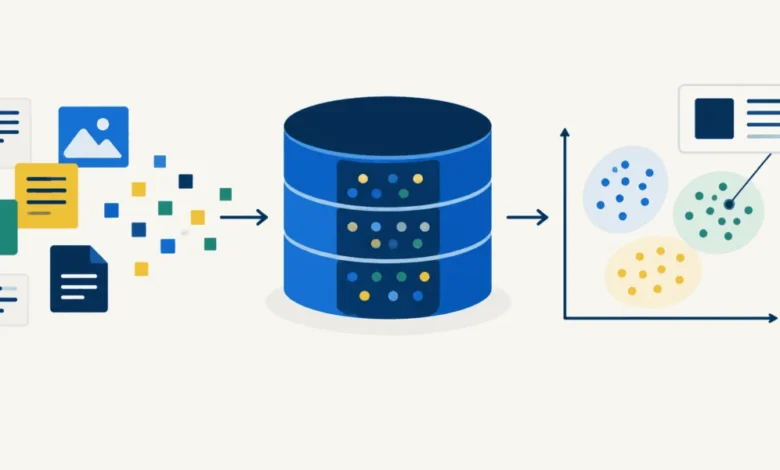
The rapid evolution of generative artificial intelligence and large language models has brought vector databases to the forefront of modern software architecture. Unlike traditional relational databases that rely on exact keyword matches or structured queries, vector databases utilize high-dimensional mathematical representations to facilitate semantic search. By transforming unstructured data—such as text, images, or audio—into sequences of numbers known as embeddings, these systems enable computers to interpret context, nuance, and meaning. Understanding the mechanics of these databases is no longer reserved for advanced machine learning researchers; it is a fundamental skill for developers looking to integrate AI into scalable applications.
The Mechanism of Semantic Retrieval
At the heart of a vector database is the conversion of raw data into vector embeddings. These embeddings are arrays of floating-point numbers that capture the latent semantic relationships between objects. When a user executes a query, the system converts the input into a similar vector. The database then calculates the "distance" or similarity between the query vector and the pre-indexed document vectors.
Cosine similarity is the industry standard for this measurement. By normalizing vectors to a length of one, the dot product between a query and a document vector serves as a direct measurement of their semantic closeness. This process allows a system to identify that "mitochondria" and "cellular energy" are related concepts, even if they share no common keywords. This transition from keyword-based retrieval to meaning-based retrieval marks a paradigm shift in how information is indexed and accessed globally.
Constructing an Index: A Ten-Step Implementation
Building a functional vector database from the ground up provides insight into the efficiency and limitations of current search technologies. The process begins with the establishment of a robust environment. By leveraging NumPy for matrix operations and Sentence-Transformers for the creation of embeddings, developers can simulate a production-grade environment without the need for high-end graphical processing units or expensive cloud-based APIs.
- Environmental Initialization: The foundation requires a structured workspace where the document corpus, metadata, and core vector logic are decoupled. Proper initialization involves defining helper functions for display and data formatting, ensuring that the system can handle search results predictably.
- Indexing Operations: The primary function of the database is to ingest documents. Each document is passed through an embedding model, resulting in a fixed-size vector. Regardless of whether a document is a single sentence or a multi-page report, it is reduced to a consistent dimension—typically 384 or 768—ensuring predictable storage requirements.
- Semantic Search Execution: Once the index is populated, searching involves converting the input string into a vector and performing a dot product against the stored matrix. This reveals the power of semantic matching, as the system effectively ranks documents by relevance based on their mathematical position in high-dimensional space.
- Contextual Retrieval: The primary strength of this model is its ability to handle queries that share no overlapping vocabulary with the source documents. This capability is essential for modern search engines and chatbots, which must interpret the intent behind ambiguous user queries.
- Score Calibration: Every search result is assigned a score representing its relevance. In practical implementations, developers must establish a "relevance floor" to filter out low-confidence results, ensuring that users receive only the most pertinent information.
- Metadata Filtering: Real-world applications require more than just similarity; they require constraints. Metadata filtering allows users to restrict searches to specific categories, such as "bio" or "music." This pre-filtering step is crucial for performance, as it narrows the search space before the computationally expensive ranking occurs.
- Constraint Optimization: When filters result in a set smaller than the requested number of items, the system must handle this gracefully. By design, modern vector databases prioritize accuracy over arbitrary padding, returning only the valid subset of data that meets both semantic and categorical criteria.
- Data Integrity and Guard Rails: Because vector databases rely on maintaining a strict relationship between raw text, metadata, and the associated vector, input validation is paramount. Guard rails must be implemented to prevent data corruption during the addition of new records.
- Persistence and Scalability: Efficient storage is achieved by separating the index into distinct files: one for the raw data (usually JSON) and another for the numeric vectors (typically binary NPY files). This separation allows for rapid loading and ensures that the model used for embedding remains consistent, preventing "model drift."
- Performance Benchmarking: As the number of documents grows, the computational cost of linear scanning increases. However, due to the efficiency of modern linear algebra libraries, scanning hundreds of thousands of vectors remains remarkably fast, often completing in milliseconds.
The Broader Implications for Enterprise Data
The transition to vector-based storage is not merely an academic exercise; it is an economic necessity for enterprises managing massive, unstructured datasets. Traditional databases, while excellent for transactional data, struggle to provide the context required for AI-driven applications. Vector databases provide the missing link, allowing companies to implement Retrieval-Augmented Generation (RAG). By grounding LLMs in a company’s specific documentation, businesses can reduce hallucinations and ensure that AI responses are accurate, relevant, and based on proprietary, up-to-date information.
Chronology of Vector Database Development
The rise of vector databases tracks closely with the development of Transformer architectures, starting with the introduction of Word2Vec in 2013. The subsequent release of BERT in 2018 fundamentally changed natural language processing, making high-quality sentence embeddings accessible to developers. By 2020, the first dedicated vector database companies began to emerge, aiming to solve the "last mile" problem of AI: how to efficiently store and search billions of high-dimensional vectors. Today, these databases are considered a standard component of the modern technology stack, sitting alongside traditional SQL and NoSQL solutions.
Supporting Data and Performance Analysis
Recent performance benchmarks indicate that the cost of searching a vector index scales linearly with the number of documents. For a corpus of 100,000 documents, a simple linear scan using modern hardware can identify top matches in under 10 milliseconds. For larger datasets reaching into the millions, approximate nearest neighbor (ANN) algorithms, such as HNSW (Hierarchical Navigable Small World), are typically employed. These algorithms trade a negligible amount of precision for a significant increase in search speed, making them the backbone of global-scale search engines.
Official Perspectives and Future Trends
Industry experts note that the "managed" vector databases offered by major cloud providers are essentially wrappers around the same core principles demonstrated in these ten steps. The value proposition of these managed services lies not in the core mathematics, but in their ability to handle horizontal scaling, high availability, and the complex engineering required to maintain synchronization across distributed clusters.
Looking forward, the integration of vector databases with graph databases—a combination often referred to as "GraphRAG"—promises to improve retrieval by capturing both the semantic meaning of data and the relationships between entities. As the demand for more intelligent, context-aware systems grows, the importance of these foundational indexing structures will only increase.
Conclusion
The implementation of a vector database from scratch serves to demystify one of the most transformative technologies of the current era. By stripping away the complexity of distributed systems and focusing on the underlying linear algebra, developers can appreciate the elegance of the vector-based approach. Whether managing a small internal knowledge base or a global search index, the principles remain the same: vectorize, store, and calculate similarity. As the industry matures, the focus will likely shift from the mechanics of search to the quality of the embeddings themselves, but the fundamental architecture of the vector database will remain a cornerstone of artificial intelligence for years to come.