Global Law Enforcement Operation "PowerOFF" Dismantles Major DDoS-for-Hire Infrastructure, Arrests Suspects

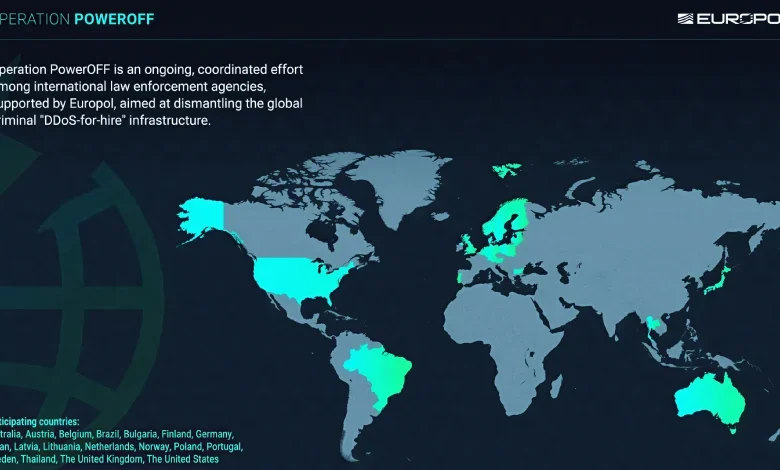
An extensive international law enforcement operation, codenamed "Operation PowerOFF," has successfully dismantled a significant portion of the global distributed denial-of-service (DDoS) for-hire market, leading to the seizure of 53 illicit domains and the arrest of four individuals. This coordinated effort, involving 21 countries, targeted the technical infrastructure supporting "booter" services, which are platforms that allow cybercriminals with minimal technical expertise to launch large-scale DDoS attacks. The operation also yielded access to databases containing over three million criminal user accounts, signaling a major blow against a pervasive form of cybercrime.
The scope of Operation PowerOFF is substantial, with authorities identifying more than 75,000 individuals who utilized these services. In addition to the domain seizures and arrests, law enforcement agencies are actively engaged in a multi-pronged approach to deter future criminal activity. This includes issuing warning emails and letters to identified users of these illicit services and executing 25 search warrants. The international collaboration underscores the global nature of cybercrime and the necessity of cross-border cooperation to combat it effectively.
Europol, a key player in coordinating the operation, highlighted the significant threat posed by DDoS-for-hire services. These platforms, often referred to as "booters" or "stressers," have democratized the ability to launch disruptive cyberattacks, making them accessible to a wide range of malicious actors. "Booter services allow users to launch DDoS attacks against targeted websites, servers, or networks," Europol stated in a press release. "Their infrastructure is made up of servers, databases, and other technical components that make DDoS-for-hire activities possible. By seizing these infrastructures, authorities were able to hinder these criminal operations and prevent further damage to victims."

The impact of these attacks can be severe, ranging from temporary service disruptions to prolonged outages that can cripple businesses, government services, and critical infrastructure. The motivations behind these attacks are diverse, encompassing financial gain through extortion, competitive sabotage, hacktivism driven by ideological or political agendas, and even simple vandalism or mischief. Some operators of these services have been known to disguise their illicit offerings as legitimate "stress-testing" tools to evade detection and prosecution.
A Timeline of Disruption: Operation PowerOFF Unfolds
While the full chronology of Operation PowerOFF is still emerging, the recent announcement signifies a culmination of months, if not years, of intelligence gathering and collaborative enforcement actions. The date of the announcement, April 17, 2026, suggests that the operational phase of dismantling the targeted infrastructure and making arrests occurred in the preceding weeks and months.
The involvement of 21 countries points to a complex planning and execution phase, likely initiated by a core group of agencies and gradually expanding to include nations with critical intelligence or jurisdictional reach. The countries participating in this significant crackdown include Australia, Austria, Belgium, Brazil, Bulgaria, Denmark, Estonia, Finland, Germany, Japan, Latvia, Lithuania, Luxembourg, the Netherlands, Poland, Portugal, Sweden, Thailand, the U.K., and the U.S. This broad coalition highlights the transnational nature of the threat and the necessity of global cooperation.
The timing of Operation PowerOFF also places it within a broader context of law enforcement efforts against DDoS-for-hire services. In August 2025, for instance, the U.S. government announced the takedown of the RapperBot botnet, which had been used to launch large-scale disruptive attacks across over 80 countries since at least 2021. This earlier action, while distinct, demonstrates a sustained commitment by authorities to disrupt the ecosystem that facilitates such attacks.

The Mechanics of DDoS-for-Hire and Their Impact
DDoS-for-hire services operate on a subscription or pay-per-attack model, offering various attack vectors and durations. Users typically pay a fee to access these services, which then leverage vast networks of compromised devices, known as botnets, to flood a target’s network with an overwhelming volume of malicious traffic. This deluge of data can consume a target’s bandwidth and processing power, rendering their online services inaccessible to legitimate users.
The accessibility and relative anonymity offered by these platforms have made them a popular tool for cybercriminals. Individuals with limited technical skills can easily access sophisticated attack capabilities, lowering the barrier to entry for engaging in cyber warfare. This democratization of attack tools has amplified the threat landscape, making it more challenging for organizations to defend against sophisticated and coordinated assaults.
Europol has identified DDoS-for-hire as one of the "most prolific and easily accessible trends in cybercrime." The agency’s statement further elaborates on the diverse motivations behind these attacks: "This ranges from simple curiosity and financial gain through extortion to hacktivism driven by ideological reasons and disruption of competitors’ services." The ability of these services to inflict significant damage on businesses, impacting revenue, reputation, and operational continuity, makes them a persistent concern for cybersecurity professionals and law enforcement alike.
A Global Network of Enforcement: The Role of Key Agencies
The success of Operation PowerOFF is a testament to the coordinated efforts of numerous law enforcement agencies worldwide. Europol’s central role in facilitating information sharing, operational planning, and coordinating cross-border actions has been crucial. The agency acts as a nexus, connecting national police forces and intelligence agencies to form a united front against transnational cyber threats.

In a parallel announcement, the U.S. Department of Justice (DoJ) detailed its involvement in disrupting some of the world’s leading DDoS Internet of Things (IoT) botnet services. This underscores the critical role of the U.S. in combating these threats, particularly concerning the exploitation of vulnerable IoT devices to build powerful botnets. The DoJ’s commitment to holding DDoS botnet administrators responsible and seizing illegal websites highlights a proactive approach to dismantling the entire supply chain of these criminal operations.
The U.S. authorities, under court-authorized actions, seized services associated with eight DDoS-for-hire domains. Notable among these were "Vac Stresser" and "Mythical Stress," services that boasted the capability to launch thousands of DDoS attacks daily. The DoJ also initiated an advertising campaign aimed at deterring potential cybercriminals searching for DDoS services within the U.S. and globally, while simultaneously raising public awareness about the illegality of such attacks.
The seizure banners now displayed on the targeted websites serve as a stark warning: "DDoS attacks are illegal. For years law enforcement agencies around the world have seized booter databases, arrested administrators, and collected information relating to the operation of these services, including information on the customers of these services. Anyone operating or utilizing DDoS services is subject to investigation, prosecution, and other law enforcement action." This clear messaging aims to deter both the providers and the users of these illicit services.
The Broader Implications: A Shifting Landscape for Cybercrime
Operation PowerOFF represents a significant victory for international law enforcement and a setback for the cybercriminal underworld that profits from DDoS-for-hire schemes. The disruption of these services not only incapacitates current operations but also sends a strong message to potential new entrants and users that such activities will not be tolerated.

The seizure of databases containing over three million criminal user accounts is particularly significant. This intelligence trove could form the basis for future investigations, leading to further arrests and prosecutions. It also provides law enforcement with invaluable insights into the networks, methodologies, and user bases of these criminal enterprises, enabling them to anticipate and counter future threats more effectively.
However, the fight against DDoS-for-hire services is an ongoing battle. The adaptable nature of cybercriminals means that as one set of services is dismantled, new ones may emerge. The continuous evolution of attack techniques and the exploitation of new technologies, such as the ever-expanding landscape of IoT devices, present persistent challenges.
The operation also highlights the importance of proactive cybersecurity measures for organizations. Beyond law enforcement actions, businesses and individuals must invest in robust network defenses, including traffic filtering, rate limiting, and distributed denial-of-service protection services. Educating employees about phishing attempts and social engineering tactics, which can be used to gain access to credentials or compromise systems, is also vital.
The success of Operation PowerOFF is a clear indicator that international cooperation is paramount in combating sophisticated cybercrime. The shared intelligence, synchronized enforcement actions, and unified messaging across multiple jurisdictions demonstrate a mature and effective approach to tackling global threats. As cybercrime continues to evolve, such collaborative efforts will remain the cornerstone of maintaining a secure digital environment for individuals, businesses, and governments worldwide. The long-term impact of this operation will be measured not only by the immediate disruption it causes but also by its deterrent effect and the intelligence it yields for future cybersecurity initiatives.