WhatsApp Patches Critical Security Flaws Exploited in Targeted Scam Campaigns and Exposure Risks

Meta-owned messaging giant WhatsApp has released critical security updates to address multiple vulnerabilities across its platform, including a high-profile bug on Android that was actively weaponized by malicious actors to bolster credibility in fraudulent scam campaigns. The discovery highlights the evolving tactics employed by cybercriminals, who increasingly leverage legitimate platform features—such as business-oriented ad integrations—to deceive unsuspecting users and mask malicious infrastructure.
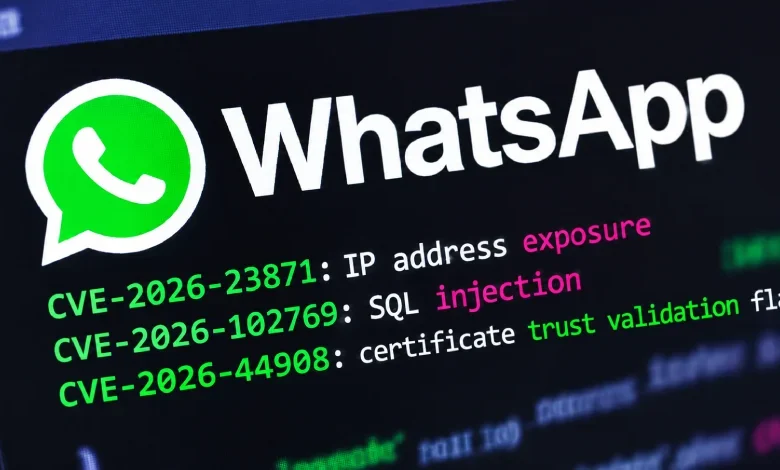
The disclosure covers a trio of security vulnerabilities tracked under distinct identifiers, with the most pressing issue residing in the Android ecosystem. Security researchers and platform administrators are urging the global user base of over two billion people to apply the latest software updates immediately to mitigate potential exposure to information leakage and advanced side-channel attacks.
Anatomy of CVE-2026-23871: The Click-to-WhatsApp Ad-Reply Flaw
The primary vulnerability drawing industry attention has been cataloged as CVE-2026-23871. Affecting both standard WhatsApp for Android and WhatsApp Business for Android prior to version 2.26.17.4, this security defect stems from the incomplete validation of external ad-reply URLs processed within the application.
The flaw manifests when a targeted user receives a crafted "Click to WhatsApp" ad-reply message. If an attacker leverages an attacker-controlled URL to send multimedia content embedded within the message thread, the vulnerability forces the victim’s device to expose its Internet Protocol (IP) address back to the malicious server upon the rendering and display of the message. While an IP address exposure alone does not grant an attacker remote code execution or direct access to device storage, it can be utilized for precise geolocation tracking, network mapping, and tailoring subsequent social engineering attacks.
According to technical briefings provided by Meta, internal investigators discovered the vulnerability while actively investigating and dismantling a broader malicious scam infrastructure. A WhatsApp spokesperson revealed to cybersecurity researchers that the threat actors utilized this flaw not for traditional malware deployment, but to grant their fraudulent outreach an aura of operational legitimacy. By manipulating ad-reply mechanics, scammers made their deceptive messages appear as if they originated from verified advertising channels, thereby disarming the skepticism of targeted individuals.
Although the exact scale of the targeted campaign remains undisclosed, Meta’s swift intervention underscores the continuous cat-and-mouse game between platform security teams and cybercriminals adapting commercial marketing features for malicious ends.

Uncovering Timing Side Channels: CVE-2026-102769
In addition to the ad-reply flaw, WhatsApp’s security advisory detailed a second issue designated as CVE-2026-102769. This vulnerability involves a complex timing-based side channel capable of leaking a single bit of information regarding a user’s chat database status.
The security defect is triggered under specific conditions when a target user is online and receives a meticulously crafted malicious message designed to induce an application crash. By meticulously measuring the delivery receipt timing following the induced crash, an attacker can extract a binary data point—effectively answering a "yes or no" query regarding the state or contents of the user’s local chat history.
Despite the sophisticated nature of this attack vector, WhatsApp confirmed there
is currently no telemetry or forensic evidence indicating that CVE-2026-102769 has been exploited in the wild prior to its patch. The discovery of such subtle cryptographic and timing-based vulnerabilities highlights the microscopic scrutiny required to secure modern end-to-end encrypted messaging applications against advanced analytical threats.
Hardware Root of Trust and Infrastructure Integrity: CVE-2026-44908
The third vulnerability addressed in the recent security bulletin, tracked as CVE-2026-44908, targeted backend architectural integrity rather than direct end-user endpoints. A successful exploitation of this flaw could have potentially allowed a bad actor operating with an internal footing within Meta’s infrastructure to bypass the established hardware root of trust.
The vector relied on introducing a Versioned Chip Endorsement Key (VCEK) certificate that lacked a valid signature from the original hardware manufacturer’s key. However, WhatsApp’s defensive architecture successfully neutralized this risk through transparency protocols. Meta noted that any such unauthorized VCEK certificate would inherently require publication to the third-party binary transparency ledger utilized by WhatsApp Private Processing.
Verification audits of the ledger confirmed that every published VCEK certificate correctly chains back to the legitimate hardware root of trust. This architectural safeguard provided definitive cryptographic proof that the vulnerability was never successfully weaponized within production environments.

The Evolution of Mobile Messaging Threats
The latest security disclosures arrive at a time when consumer-facing messaging applications remain prime targets for sophisticated threat actors. Because platforms like WhatsApp serve as the primary communications backbone for billions of personal and professional interactions worldwide, they are subjected to constant probing by both financially motivated cybercriminals and advanced persistent threat (APT) groups.
Historically, vulnerabilities in messaging software centered around buffer overflows, remote code execution via malicious media files, or manipulation of cryptographic handshakes. However, the exploitation of CVE-2026-23871 demonstrates a concerning shift toward abusing legitimate business automation and advertising features—such as Click-to-WhatsApp ads—to lower the psychological barriers of victims. By blending malicious intent with the seamless user experience of digital commerce and targeted advertising, attackers create highly convincing narratives that bypass human intuition.
Industry Response, Mitigation, and Best Practices
In response to these discoveries, WhatsApp’s engineering and threat intelligence teams have accelerated patch deployment cycles across the Google Play Store and enterprise distribution channels. The identification of CVE-2026-23871 by internal researchers emphasizes the growing importance of proactive threat hunting, where platform operators actively search for infrastructure abuse rather than solely relying on external bug bounty reports.
Cybersecurity authorities and enterprise IT administrators strongly advise all users of WhatsApp and WhatsApp Business on Android to verify their application version. Devices running any build prior to 2.26.17.4 are vulnerable to the ad-reply IP exposure flaw and should be updated immediately through official application stores.
Furthermore, security analysts recommend that organizations implement comprehensive mobile device management (MDM) policies, encourage automated app updates, and educate employees on the subtle indicators of social engineering, even when communications appear to leverage official platform templates or business integrations. As messaging ecosystems continue to expand their commercial footprints, the defense of user privacy will depend heavily on the rapid identification of systemic edge-case vulnerabilities and the transparent communication of emerging digital threats.