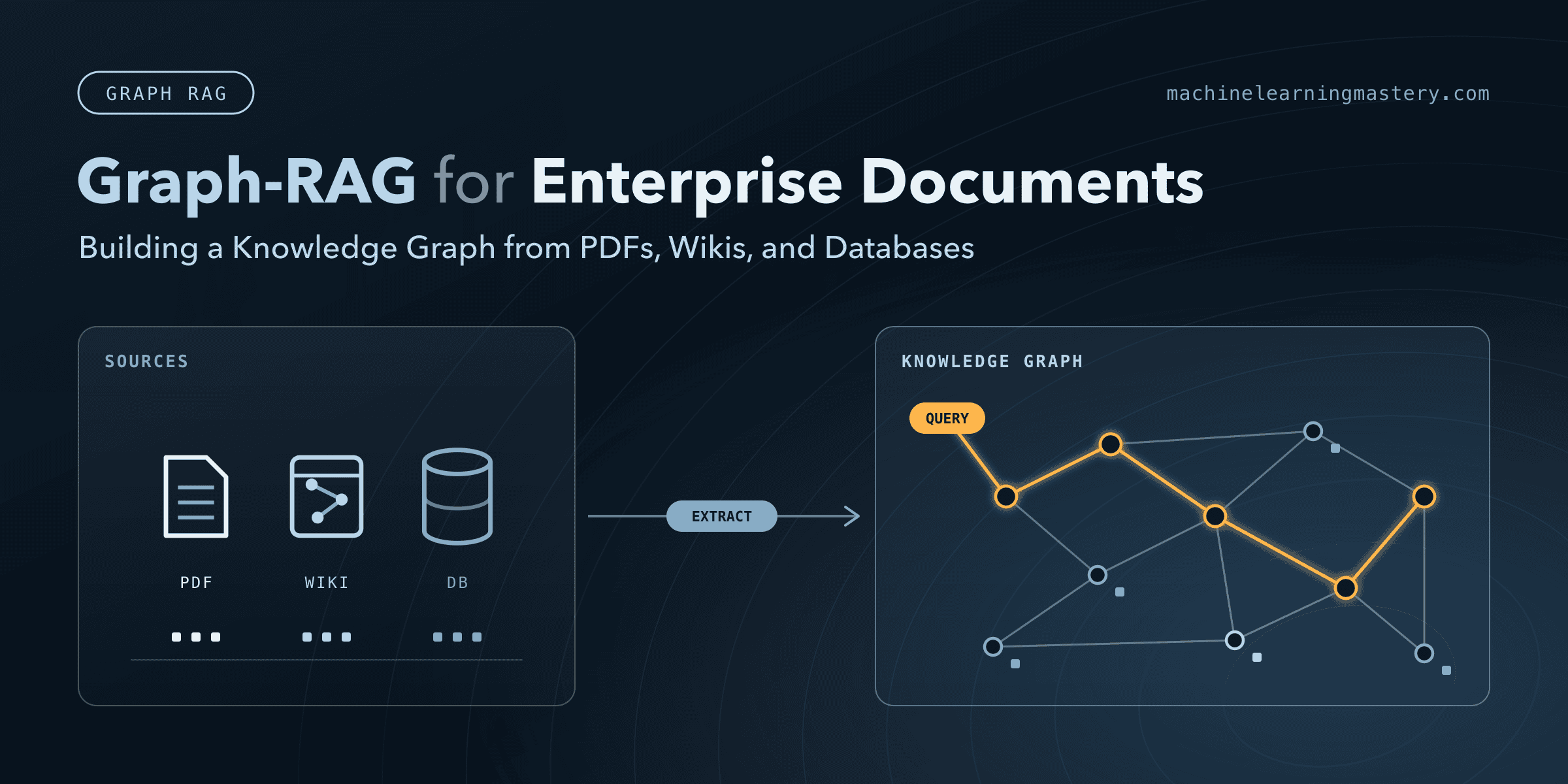
Graph-RAG for Enterprise Documents: Building a Knowledge Graph from PDFs, Wikis, and Databases

In the modern enterprise, the "single source of truth" is often a myth. Organizations frequently struggle with a fragmented information landscape where critical operational data is siloed across dynamic databases, aging internal wiki pages, and vast, unstructured repositories of PDF documentation. When an automated AI assistant is tasked with querying these disparate sources, the lack of a prioritization logic often leads to catastrophic failure. If a system treats a four-month-old wiki entry with the same authority as a live, real-time database record, the resulting "hallucination" is not merely an error—it is an operational liability.
The challenge of reconciling conflicting information is the primary hurdle in deploying reliable Retrieval-Augmented Generation (RAG) systems. Recent industry analysis from IDC, sponsored by Neo4j, highlights that enterprises grounding generative AI in graph-based context can reduce hallucination rates by an average of 44 percent. For organizations in highly regulated sectors, such as life sciences, these improvements have been even more dramatic, with some firms observing a reduction in error rates from 40 percent down to as low as 2 percent. To bridge this gap, engineers are increasingly turning toward deterministic, multi-tiered Graph-RAG architectures.
The Problem of Data Conflict in AI Assistants
Consider a high-stakes scenario: an engineer is paged at 11:00 p.m. regarding a critical failure in a payments-service infrastructure. The engineer queries an internal AI assistant for the current on-call contact. The assistant scans three sources: the service registry database, the internal wiki, and a collection of incident postmortem PDFs.
In many standard RAG implementations, the assistant retrieves snippets from all three, embeds them into a vector space, and generates a response. If the wiki contains outdated contact information and the database contains the correct, current row, the model may inadvertently synthesize the two, providing the user with a stale or incorrect name. This conflict arises because traditional vector search treats semantic similarity as the primary metric for truth, ignoring the metadata-driven hierarchy of data reliability.
A Three-Tiered Architectural Solution
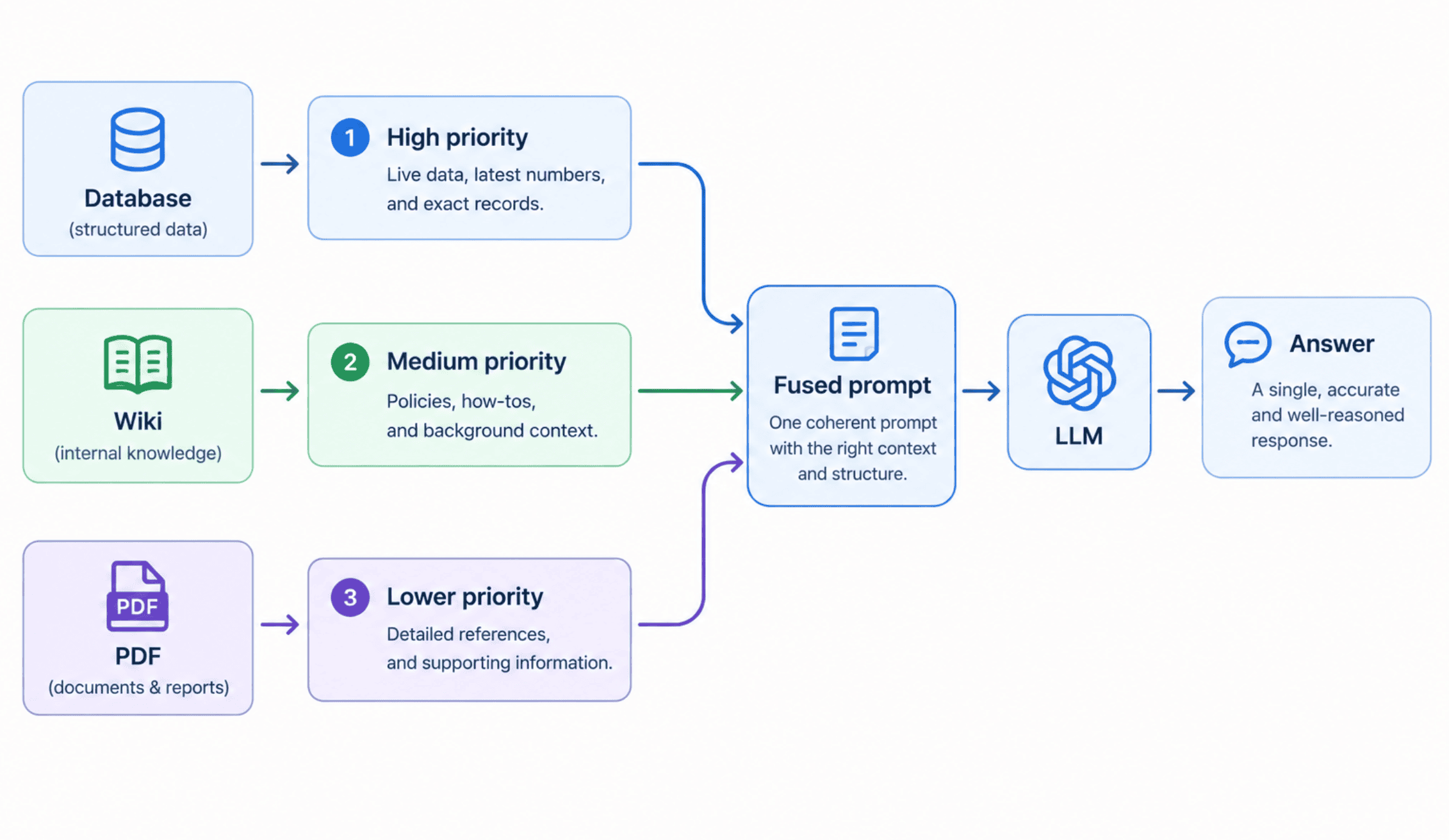
To solve this, developers are adopting a deterministic, three-tiered retrieval strategy that prioritizes data based on its volatility and structure. By categorizing data sources into distinct tiers, organizations can enforce a strict hierarchy that guides the Large Language Model (LLM) during the generation phase.
The first tier, the Configuration Management Database (CMDB), acts as the absolute authority. This tier contains structured data—the "ground truth"—such as current on-call schedules, system statuses, and service versions. Because this data is queried in real-time from a production database (e.g., PostgreSQL or SQLite), it is inherently current.
The second tier consists of internal wikis and technical documentation. While these sources provide valuable context, they are prone to "documentation drift," where the information remains accurate for a time but eventually contradicts the live state of the system. In the hierarchy, this tier is treated as secondary.
The third tier is the unstructured repository, typically consisting of PDFs, whitepapers, and postmortem reports. This layer provides deep narrative context that structured databases cannot capture. While vital for understanding the "why" behind an incident, these documents are relegated to the final tier of authority.
Implementing the Technical Framework
The construction of such a system requires a Subject-Predicate-Object-Context (SPOC) quad-store approach. Unlike simple key-value pairs, the SPOC model allows for the inclusion of "context" as a fourth variable. This metadata tag—marking a fact as originating from "cmdb," "wiki," or "pdf"—is essential for the system’s reasoning process.
Technically, the process begins with data ingestion. For the CMDB, scripts extract raw rows and transform them into relational quads. For the wiki, developers use regex-based parsing to extract key-value pairs from markdown files, acknowledging that these sources require regular updates. The final tier, the PDF repository, utilizes libraries like pdfplumber to extract text, which is then chunked into 500-character segments and indexed in a vector database such as ChromaDB.
The breakthrough in this architecture occurs during the retrieval and prompting phase. Rather than relying on a complex routing algorithm, which can introduce its own errors, developers embed explicit "Priority Rules" directly into the system prompt. By instructing the model to treat the CMDB as the overriding authority and to ignore conflicting information from the wiki, the system forces a deterministic outcome. The prompt serves as a guardrail, ensuring that the model does not attempt to "average out" conflicting facts, which is a common failure mode in standard generative models.
Implications for Enterprise Operations
The shift toward deterministic, multi-tiered RAG is a significant departure from the "black-box" approaches that characterized early LLM implementations. By forcing the model to adhere to an explicit data hierarchy, companies gain two critical advantages: explainability and predictability.
When an AI provides an answer, the metadata associated with the chosen tier allows auditors to trace the information back to its source. If an error occurs, the organization can identify exactly where the data degradation happened—whether it was an outdated wiki entry or a misconfigured database query. Furthermore, this approach eliminates the need for expensive, iterative fine-tuning. The logic resides in the data pipeline and the system prompt, both of which are easier to maintain and update than the underlying weights of an LLM.
Strategic Challenges and Future Outlook
Despite the technical benefits, this architecture is not without challenges. One of the primary risks is "stale-data propagation." If the ingestion jobs—which re-index the wiki and PDF documents—fail to run, the system becomes reliant on outdated information. Organizations must therefore implement robust monitoring for these pipelines to ensure that the "Priority 2" and "Priority 3" layers remain refreshed.
Furthermore, access control represents a significant hurdle. In a secure enterprise environment, permissions must be applied at the point of retrieval. A user who is not authorized to view specific financial PDFs should not have that data included in the system prompt. Relying on the LLM to filter data based on user authorization is considered a security anti-pattern; instead, developers must ensure that the retrieval function itself is identity-aware.
As businesses scale these systems, the transition from local storage (like SQLite) to robust, graph-native databases like Neo4j or ArangoDB becomes inevitable. These platforms provide advanced traversal capabilities, allowing the AI to understand complex relationships between services, teams, and infrastructure components that go beyond simple point-in-time facts.
Ultimately, the development of this three-tiered approach signals a maturation in how enterprises interact with generative AI. It replaces the naive hope that an LLM can "reason" its way through contradictory information with a disciplined, architectural framework that values the reliability of the source above all else. For the enterprise, where the cost of a hallucinated, incorrect response is measured in lost productivity or operational risk, this transition from general-purpose AI to deterministic knowledge retrieval is the most viable path forward. The goal is no longer just to have an assistant that can talk, but to have one that can be trusted to provide the right answer, every time, regardless of the noise in the background.