Building a Multi-Modal RAG Pipeline in Python to Retrieve and Reason Over Text and Images in Complex Documents

The modern digital landscape is increasingly dominated by unstructured, complex data. While Retrieval-Augmented Generation (RAG) has emerged as the standard architecture for grounding Large Language Models (LLMs) in private or domain-specific data, traditional implementations often fail when faced with documents that prioritize visual communication. Financial reports, technical manuals, and academic research papers frequently rely on embedded charts, data tables, and intricate diagrams to convey critical information. In these instances, conventional text-based chunking mechanisms often fragment tables, discard images entirely, and destroy the structural context, leading to incomplete or inaccurate responses from AI systems.
To address this deficiency, developers are transitioning toward multi-modal RAG pipelines, which treat visual elements as first-class citizens alongside textual data. This architectural shift represents a significant evolution in how organizations process high-density documents, moving beyond simple keyword search to a sophisticated, vision-capable retrieval framework.
The Evolution of Retrieval-Augmented Generation
Historically, RAG systems were designed to handle text-heavy corpuses. By breaking documents into manageable segments and vectorizing them, these systems could provide context to models like GPT-4, Llama 3, or Claude 3. However, the rise of "Visual RAG" is a direct response to the limitations of text-only embedding models. According to recent industry benchmarks, as much as 40% of the information in enterprise-grade PDF documents is contained within non-textual elements.
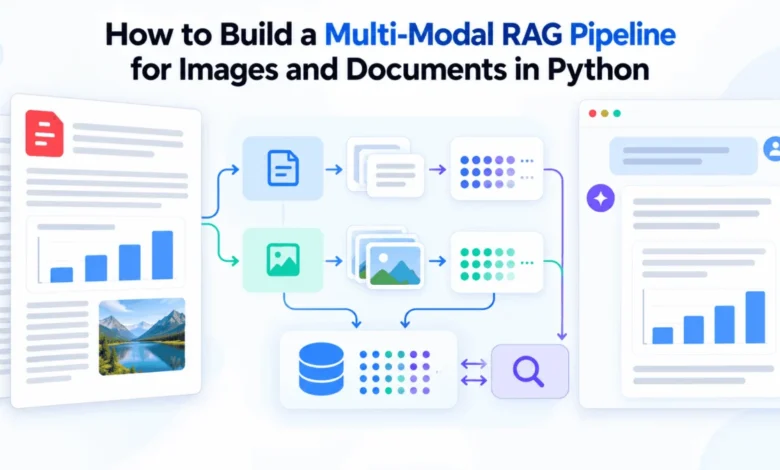
When a standard pipeline ignores a table or a heat map, it misses the "ground truth" of the document. Multi-modal RAG systems rectify this by implementing a secondary indexing path: while text is embedded normally, images are processed by vision-capable models to generate descriptive summaries. These summaries serve as the searchable proxy in a vector database, allowing the system to locate relevant visual evidence in response to a user query.
Technical Infrastructure and Implementation
Building a production-ready multi-modal pipeline requires a specific stack capable of handling heavy document processing. The current industry standard for this task utilizes the LangChain orchestration framework, the Unstructured library for document parsing, and high-performance vector databases such as ChromaDB or Pinecone.
The development process follows a strict four-stage chronology:
- Document Partitioning: Utilizing the
unstructuredlibrary, the pipeline decomposes a PDF into its constituent elements. Unlike a simple text scraper, this tool classifies elements as "Composite" (paragraphs) or "Image" (tables, graphs, or schematics). - Semantic Summarization: Each extracted image is sent to a Vision-Language Model (VLM), typically GPT-4o, with a specific instruction to generate a detailed, searchable description.
- Multi-Vector Storage: A
MultiVectorRetrieveris employed to manage two distinct stores: a vector store containing embeddings of both text chunks and image summaries, and a document store containing the actual raw data (the original images and text snippets). - Multimodal Retrieval and Synthesis: Upon a user query, the retriever identifies the most relevant text chunks and image summaries simultaneously. The system then compiles these pieces of evidence and feeds them into the generative model to synthesize a final answer.
Prerequisites for Deployment
For developers looking to integrate this pipeline, the following environmental configuration is essential. The process requires a robust Python environment and specific system dependencies, most notably poppler-utils, which enables the rendering of PDF pages into images for downstream analysis.
pip install langchain langchain-openai unstructured[pdf] chromadb pillow
apt-get install -y poppler-utils
Following installation, the environment must be authenticated with the appropriate API credentials. Given the reliance on GPT-4o for both summarization and final generation, organizations must account for the computational costs associated with high-frequency API calls, particularly when processing documents with hundreds of pages and thousands of embedded images.
Chronology of Data Processing
The efficiency of the pipeline hinges on how it handles the "parse-summarize-store" lifecycle. In the initial parsing phase, defining the chunking_strategy is paramount. Setting a strategy of "by_title" ensures that the semantic hierarchy of the document—such as headers leading into paragraphs and tables—is preserved. This prevents the loss of context that often occurs in naive sliding-window chunking.
In the second stage, the summarization of images creates a searchable index. Because vector databases cannot "see" an image, the quality of the VLM-generated description is the deciding factor in retrieval accuracy. A well-constructed prompt—"Describe this image in detail for use in a search system"—is sufficient to capture the nuance of a complex line chart or a financial table, ensuring that the vector embedding accurately reflects the visual content.
Challenges and System Performance
While the architecture provides a clear path forward, it is not without challenges. One significant hurdle is "retrieval latency." Because the system must invoke an LLM to generate summaries during the indexing phase, the time-to-index for large document repositories can be substantial. Furthermore, the reliance on an external API for vision capabilities introduces a dependency on external uptime and connectivity.
Some organizations have begun exploring alternative approaches, such as the use of ColPali, an emerging vision-based embedding model. Unlike the pipeline described here, which uses a two-step "summarize then embed" process, ColPali embeds document pages directly as images. This eliminates the need for complex parsing, though it requires significantly more GPU VRAM and specialized infrastructure, making it a "heavy" alternative to the API-driven approach.
Broader Impact and Industry Implications
The adoption of multi-modal RAG is transforming sectors that rely on high-stakes document analysis. In the legal sector, this technology allows attorneys to instantly query thousands of pages of case files that include evidence photos, handwritten notes, and scanned exhibits. In the financial services industry, analysts can query long-form annual reports to extract specific data points from quarterly earnings tables that were previously locked in static PDFs.
The implications for business productivity are profound. By reducing the time spent manually reviewing documents, companies can achieve a higher degree of accuracy in their decision-making processes. Moreover, because these systems provide the source evidence alongside the answer, they support the "Explainable AI" mandate, allowing users to verify the machine’s reasoning by clicking on the cited images or text blocks.
Future Directions
As this technology matures, we expect to see an increase in "local-first" multi-modal RAG. As open-source models like Llama 3.2 (Vision) and various CLIP-based embedding models improve in performance, the requirement for cloud-based APIs will decrease. This shift will allow companies with strict data privacy and residency requirements—such as those in the healthcare or defense sectors—to deploy these pipelines entirely on-premises or within private cloud environments.
Ultimately, the move toward multi-modal RAG marks the end of the "text-only" era of LLMs. By aligning the way machines read with the way humans perceive information—as a rich mixture of prose and visual data—the industry is moving closer to creating truly intelligent assistants capable of handling the full breadth of human record-keeping. The technical implementation described here provides the foundational framework for any organization seeking to unlock the latent value trapped within their visual data assets.
Related posts: