The landscape of generative artificial intelligence is undergoing a significant paradigm shift as researchers move beyond the standard autoregressive framework that has defined the era of Large Language Models (LLMs). While models like GPT-4 and Claude have dominated the industry by predicting the next token in a sequence—a process known as autoregressive generation—a new class of architecture, the Diffusion Language Model, is challenging the necessity of this serial approach. By treating text generation as an iterative refinement process rather than a linear prediction task, these models offer potential breakthroughs in inference speed and structural coherence.
The Evolution of Diffusion: From Pixels to Prose
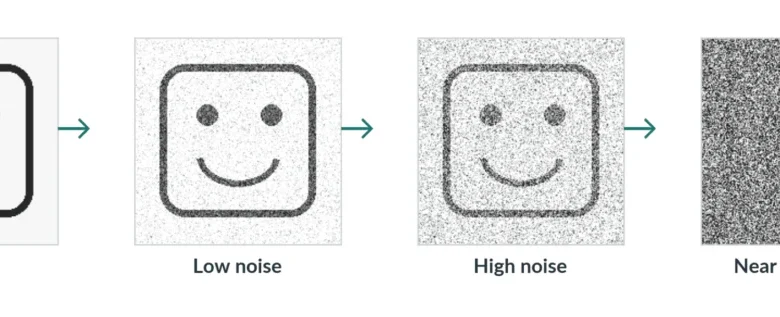
The conceptual foundation for this shift lies in Denoising Diffusion Probabilistic Models (DDPMs), a framework popularized around 2020 by researchers like Jonathan Ho and colleagues. Initially, these models were exclusively applied to continuous data, such as images and audio. The mechanism is elegant: by progressively adding Gaussian noise to an image until it becomes unrecognizable, and then training a neural network to reverse that process, the model learns to "denoise" random data into meaningful visual content.
Applying this to text has proven historically difficult. Unlike pixels, which exist on a continuous spectrum where a slight adjustment creates a visually similar result, language is inherently discrete. A token in a vocabulary is an index; adding "noise" to an index does not result in a "slightly different" word, but rather a completely unrelated one. However, the emergence of masked language modeling techniques—inspired by the training objectives of BERT—provided the missing link. By replacing tokens with a mask rather than adding mathematical noise, researchers have successfully adapted diffusion principles to text.
Chronology of Recent Advancements
The transition of diffusion models from theoretical interest to viable language tools has been rapid, marked by several key releases between 2025 and 2026:
- 2025 – The Rise of LLaDA and Mercury: The community saw a flurry of activity as projects like LLaDA and Mercury began demonstrating that diffusion-based transformers could generate coherent, multi-paragraph text. These models shifted the focus from "what is the next word" to "how do we refine a block of text."
- 2025 – Gemini Diffusion: Google’s integration of diffusion techniques into the Gemini ecosystem signaled that major players were taking the architecture seriously, investigating whether diffusion could mitigate the latency issues inherent in long-form generation.
- 2026 – DiffusionGemma: Building on its open-weights strategy, Google released DiffusionGemma, providing researchers with a robust platform to test the limits of non-autoregressive text generation at scale.
Autoregressive Models vs. Diffusion: A Structural Comparison
To understand the difference, one must look at the mathematical objective of each. Autoregressive models rely on conditional probability: $p(x) = prod_i=1^N p(x_i mid x1, dots, xi-1)$. This creates a rigid dependency; the model cannot predict the tenth word of a sentence until it has generated the first nine. This is the "serial dependency problem," which necessitates sequential execution, effectively capping the speed of generation regardless of how much parallel hardware (GPUs/TPUs) is available.
Diffusion models, conversely, operate on a canvas of masked tokens. In a single forward pass, the model can look at the entire sequence simultaneously. Instead of calculating a single path, it estimates the probability distribution for every position in the sequence at once. By iteratively refining these predictions—deciding which tokens are "confident" and which remain "masked"—the model builds the final output globally.
| Feature | Autoregressive (GPT) | Diffusion Language Model |
|---|---|---|
| Generation Order | Left-to-Right (Serial) | Parallel/Global Refinement |
| Dependency | High (each token needs the last) | Low (tokens updated simultaneously) |
| Computation | Token-by-token | Iterative denoising rounds |
| Primary Strength | Contextual continuity | Speed and structural planning |
The Mechanics of Denoising at Inference
The inference process in a diffusion-based language model is a multi-step cycle. Initially, the system is provided with a sequence of tokens where the majority are replaced by [MASK]. The model then performs three distinct actions:
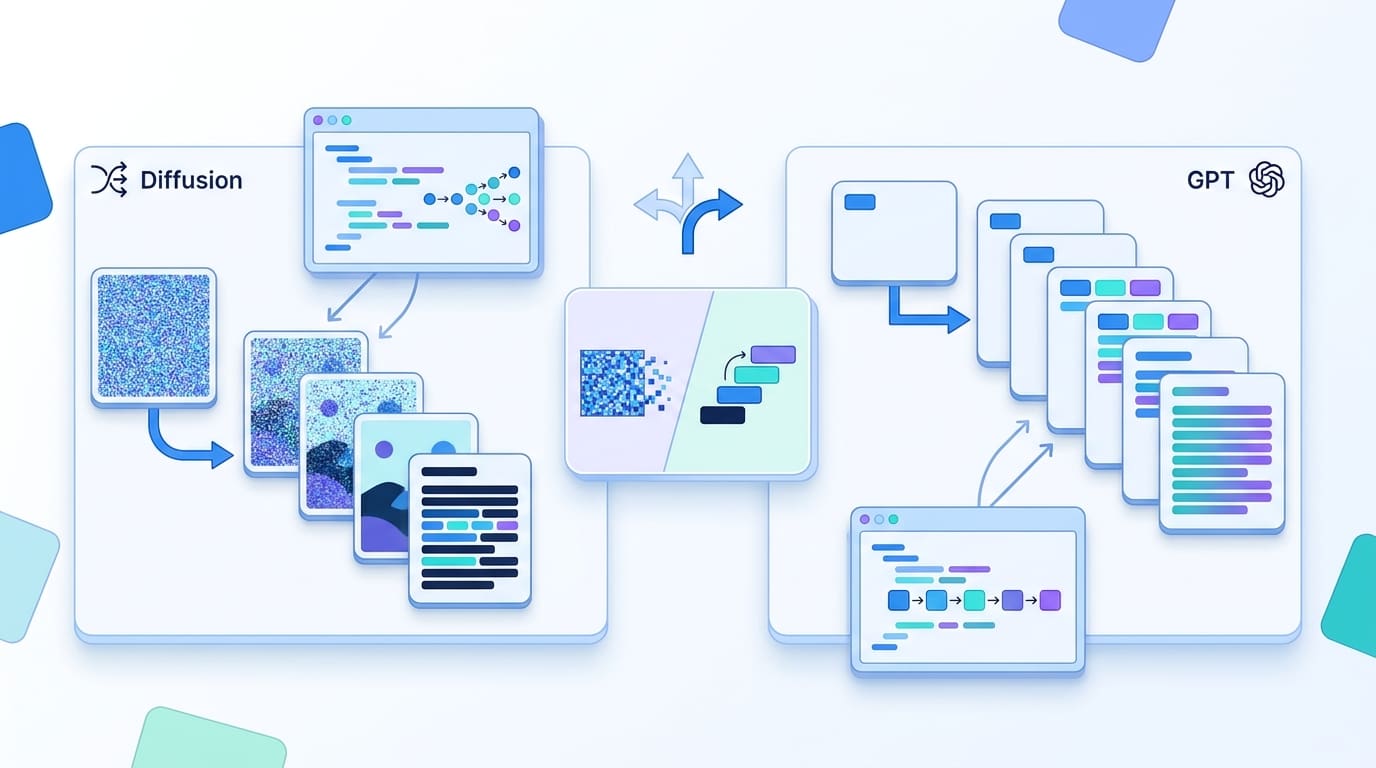
- Distribution Mapping: It calculates the probability distribution of potential tokens for all masked positions.
- Confidence Assessment: The model evaluates which predictions it is most certain about.
- Commitment and Revision: High-confidence tokens are revealed, while uncertain positions remain masked for the next iteration.
Advanced samplers even allow for "remasking," where the model corrects earlier mistakes as the broader context of the sentence becomes clear. This capability allows the model to "change its mind" about an early word if the latter half of the sentence makes the original choice grammatically or logically incorrect—a luxury that standard autoregressive models do not possess.
Strategic Implications and Challenges
The primary motivation for this architectural shift is the promise of accelerated inference. In traditional LLMs, the "bottleneck" is the memory bandwidth required to fetch weights for every single token generated. If a model could generate a whole sentence in four or five parallel passes, the effective throughput could increase significantly.
However, several challenges remain. First, training stability for diffusion models is notoriously difficult compared to the well-understood objective of next-token prediction. Second, there is the "quality vs. speed" trade-off; while diffusion models are fast, they occasionally struggle with the high-level semantic nuance that autoregressive models have mastered through years of fine-tuning.
Industry analysts suggest that the future is likely not a total replacement of GPT-style architectures, but rather a hybrid approach. It is increasingly probable that future AI systems will use diffusion models for structural planning—outlining the skeleton of a document or code—and then use traditional autoregressive decoding for the fine-grained, high-fidelity execution of the text.
Broader Impact on AI Infrastructure
The research community is currently debating the necessity of autoregression. If a model can effectively generate text through parallel refinement, the reliance on high-latency sequential hardware could decrease. This has massive implications for data centers and edge computing. If inference time can be reduced by 50% or more, the accessibility of sophisticated AI tools on mobile devices and local machines increases exponentially.
As companies continue to integrate these models into production, the focus will shift to finding the "sweet spot" of denoising steps. Too few steps result in garbled, incoherent text; too many steps negate the speed benefits of the architecture. Current benchmarks are focusing on optimizing the "rejection sampling" and "classifier-free guidance" techniques borrowed from the image generation domain to ensure that text quality remains competitive with the industry standard.
In conclusion, while the transition from autoregressive to diffusion-based text generation is still in its nascent stages, the progress made by projects like DiffusionGemma and LLaDA marks a pivotal moment. By decoupling the generation process from strict left-to-right dependency, researchers are unlocking new ways to distribute computational effort, setting the stage for a new generation of faster, more flexible, and potentially more robust language models. The question of whether we need to generate one token at a time has moved from a theoretical curiosity to a central engineering challenge for the next decade of AI development.
Related posts: