Google Labs Introduces Tabletop: A New Real-Time Collaborative Workspace for Group Planning and Decision-Making

Coordination among groups for social, recreational, and logistical activities has historically presented distinct organizational challenges. Whether managing a family vacation itinerary, organizing a recreational sports league, or planning a neighborhood gathering, the process typically involves fragmented communication channels, endless email threads, and multiple disparate software tools. Recognizing this persistent friction in collaborative planning, Google Labs has officially introduced Tabletop, an experimental digital workspace designed to centralize group coordination, planning, and real-time decision-making into a single, interactive environment.
Unveiled today as part of Google’s ongoing incubator for experimental technologies, Tabletop aims to streamline how groups compile information, allocate tasks, and reach consensus. By blending document-style collaboration with custom interactive widgets—such as dynamic trip itineraries, automated polls, and tournament brackets—the platform seeks to replace the disjointed ecosystem of spreadsheets, chat apps, and specialized event-planning websites that users currently rely on for group projects.
Main Facts and Core Functionality of the Tabletop Experiment
At its foundational level, Tabletop functions as a shared digital canvas where multiple participants can contribute simultaneously, mirroring the collaborative document editing experience popularized by products like Google Docs. Users begin by establishing a centralized space tailored to their specific collaborative objective. Within this space, participants can aggregate a wide variety of digital assets, including hyperlinks, uploaded files, and free-form text ideas.
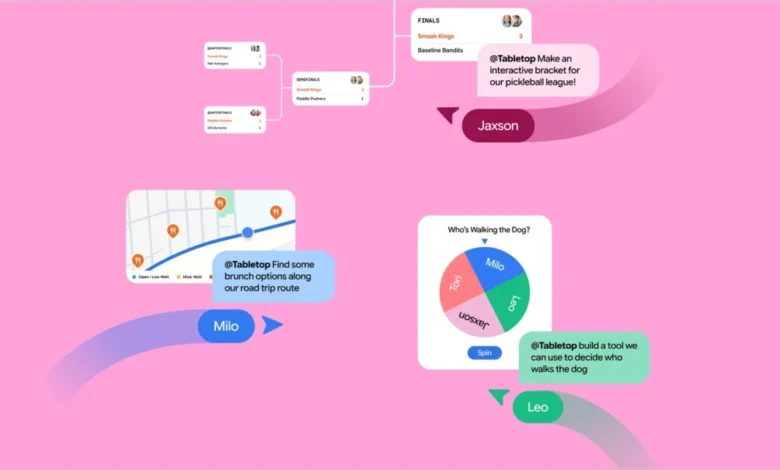
The platform distinguishes itself through the integration of generative AI and structured templates. Users can either select from a pre-configured starter template or utilize a conversational prompt feature by tagging "@tabletop." This functionality allows the system to automatically synthesize the raw inputs—such as a list of restaurant recommendations or travel dates—into structured, functional utilities. For instance, the system can generate custom interactive trip itineraries, automated dinner polls to gauge group preferences, integrated expense-splitting calculators, or multi-round tournament brackets for recreational leagues.
Once the collaborative space is initialized, the host can distribute an invitation link directly through external messaging applications or group chats. Invited participants can then access the workspace concurrently, enabling real-time brainstorming, voting, and editing without the need for version control management or cumbersome file-sharing permissions.
Background Context and the Evolution of Google Labs
To understand the strategic positioning of Tabletop, it is necessary to examine the current operational mandate of Google Labs. As a division within the broader Alphabet ecosystem, Google Labs functions as an internal incubator dedicated to prototyping early-stage technologies, testing user-facing concepts, and evaluating the viability of nascent artificial intelligence and collaborative tools before integrating them into flagship product lines.
In recent years, Google Labs has served as the testing ground for several high-profile initiatives, particularly following the acceleration of generative artificial intelligence development. Projects emerging from Labs often leverage large language models and machine learning infrastructure to automate complex, multi-step workflows. Tabletop follows in this tradition by applying conversational AI capabilities not merely to text generation, but to the orchestration of human group dynamics and logistical organization.
The development of Tabletop addresses a well-documented behavioral trend: the fragmentation of personal coordination. As modern consumers juggle increasingly busy schedules, group coordination has become heavily reliant on digital intermediaries. Traditional productivity software, while effective for enterprise environments, is frequently perceived as too rigid or formal for casual social planning. Conversely, consumer messaging platforms lack the structured data management capabilities required to finalize complex logistics, such as tracking expenses across a dozen travelers or scheduling multi-week sports tournaments. Tabletop occupies the conceptual middle ground between unstructured chat applications and enterprise-grade project management software.
Chronology of Development and Rollout Strategy
The rollout of Tabletop adheres to a controlled deployment model typical of early-stage Google Labs experiments. Rather than launching as a globally available, stable commercial product, the platform is initially being introduced to a targeted demographic under restricted access conditions.
As of today’s announcement, Tabletop is rolling out exclusively within the United States. Furthermore, participation is restricted to individuals aged 18 and older. To manage server capacity and gather qualitative user feedback during the initial testing phase, Google has implemented a waitlist mechanism. Interested users must register their interest at the dedicated portal located at labs.google/tabletop.
This phased chronology allows the engineering and product teams to monitor server performance, evaluate the efficacy of the generative AI prompting features, and iterate on user interface designs based on real-world usage patterns. Historically, successful Google Labs experiments—such as NotebookLM or various generative imaging tools—gradually transition from closed waitlists to wider public availability, and eventually, in some cases, deep integration into core Google productivity suites like Google Workspace. While Google has not yet released a definitive timeline for a broader international rollout or a general public release, the waitlist approach indicates an iterative development cycle focused on community-driven refinement.
Supporting Data and the Market Landscape for Group Productivity
The introduction of Tabletop arrives in a crowded and highly competitive market for digital collaboration and productivity tools. While enterprise-focused platforms such as Microsoft Teams, Slack, and Notion dominate the corporate sphere, the consumer and informal group planning market remains largely decentralized.
Industry data consistently highlights the reliance of modern consumers on multi-tool workflows. According to digital usage studies, the average consumer utilizes between three and five distinct applications to plan a single group event—typically combining a messaging app for communication, a shared document or spreadsheet for data collection, a specialized payment app for expense tracking, and a web browser for research. This operational friction often leads to communication silos, overlooked details, and planning fatigue among organizers.
By consolidating these functions into a single, real-time collaborative workspace, Tabletop targets the growing demand for frictionless digital organization. The market for consumer productivity and event-planning applications has seen steady investment, driven by demographic shifts toward shared experiences, group travel, and community-organized recreational activities. Although specific financial projections for Tabletop have not been disclosed by Alphabet, the project underscores the company’s broader corporate strategy to embed generative AI assistants into everyday consumer workflows, thereby increasing user retention across its broader ecosystem of web services.
Analysis of Implications and Industry Outlook
The launch of Tabletop carries several significant implications for the future of consumer software, collaborative technology, and the practical application of generative artificial intelligence.
First, Tabletop represents a shift in how AI is positioned for everyday consumers. While much of the public discourse surrounding generative AI has focused on text generation, coding assistance, and image creation, Tabletop demonstrates the utility of AI as an organizational facilitator. By translating unstructured human input—such as a chaotic email chain of vacation ideas—into structured, actionable database objects like itineraries and poll widgets, the tool bridges the gap between human brainstorming and digital execution. This capability highlights a growing industry trend: moving AI from a solitary chat interface into collaborative, multi-user environments where teams or groups can interact with the intelligence simultaneously.
Second, the product poses strategic questions regarding the future boundaries between consumer and enterprise software. Tools that facilitate real-time collaboration have traditionally been developed with corporate workflows in mind. By tailoring these capabilities to casual, social, and domestic use cases—such as potlucks, recreational sports leagues, and family trips—Google is exploring how professional-grade synchronization technology can be adapted for informal communities. If successful, this approach could redefine user expectations for how personal projects are organized, lowering the barrier to entry for complex logistical planning.
However, the experiment also faces notable challenges. Chief among these is user adoption and habit formation. Consumers are notoriously resistant to downloading or registering for new platforms for casual events if established habits—such as using a group chat or a standard messaging app thread—feel sufficient. To overcome this inertia, Tabletop must demonstrate a clear, undeniable reduction in planning friction that justifies the act of creating a dedicated digital space and inviting participants to join via a separate link.
Furthermore, privacy and data management considerations will remain under scrutiny. As users aggregate personal links, uploaded files, and logistical details within experimental workspaces, maintaining robust data security and clear privacy protocols will be essential for building and sustaining user trust.
Conclusion and Next Steps for Prospective Users
Google Labs has positioned Tabletop as an agile, experimental solution to an age-old organizational problem. By synthesizing real-time document collaboration, structured interactive widgets, and generative AI prompting into a unified platform, the project offers a compelling glimpse into the future of group coordination.
As the platform initiates its U.S. rollout via the waitlist system, industry observers will closely monitor user feedback, feature iterations, and the pace at which Google scales the experiment. For individuals and communities seeking to alleviate the complexities of group planning, Tabletop offers a newly opened avenue to centralize their efforts. Prospective users who meet the eligibility criteria can request access and monitor further updates by visiting the official registration portal at labs.google/tabletop.