How a Family Guy Cutaway Gag About a New Orleans Marching Band Became a Viral TikTok Phenomenon

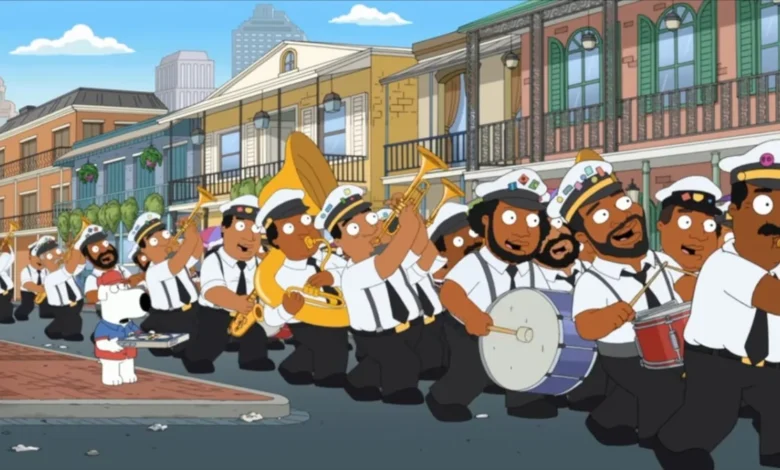
The intersection of classic television animation and contemporary social media algorithms has once again yielded a viral internet trend, centering on a musical moment from the long-running Fox animated sitcom Family Guy. The soundbite and accompanying concept known as We Are All Just Blocking the Street has emerged as one of the most prominent meme formats across TikTok and Instagram Reels. Originating from a 2017 episode, the bit features a quintessential New Orleans second line marching band cheerfully obstructing a thoroughfare while a visibly exasperated Brian Griffin attempts to deliver a pizza. Nearly a decade after its initial broadcast, the scene has been thoroughly recontextualized by digital creators, transforming into a universal audio-visual shorthand for everyday bottlenecks, crowded urban environments, and the minor exasperations of shared public spaces.
The Genesis in The Peter Principal
To understand the current digital phenomenon, one must look back to the spring of 2017. On April 30 of that year, the Fox network broadcast the eighteenth episode of Family Guy’s fifteenth season, titled The Peter Principal. Written by Alex Carter and directed by John Holmquist, the episode followed typical narrative arcs for the series, interspersed with the show’s signature cutaway gags—brief, self-contained comedic asides designed to illustrate a character’s point or provide a surreal non-sequitur.
In this particular sequence, the show’s resident anthropomorphic dog, Brian Griffin, finds himself thrust into a classic comedic predicament. While attempting to carry out a straightforward pizza delivery, his path is abruptly halted by a boisterous New Orleans second line marching band. Complete with traditional brass instruments, snare drums, and an infectious, swinging rhythm, the musicians casually parade down the asphalt. Rather than apologizing or clearing a path, the band members cheerfully serenade the blocked roadway, explicitly singing about the fact that they are obstructing traffic and impeding pedestrians. Brian’s subsequent reaction—a mix of bewilderment, mounting impatience, and utter helplessness—served as the emotional anchor for the gag, establishing a dynamic between an inconvenienced individual and an oblivious, joyful crowd.
The Chronology of a Revival
While the episode remained a standard entry in the Family Guy syndication catalog for years, its transition into a modern internet meme followed a precise timeline of digital curation and algorithmic amplification during the late summer and early autumn of 2026.
The revival began modestly on July 17, 2026, when TikTok user @chaoscriterion uploaded a clean screen recording of the scene. Rather than generating immediate global traction, the clip quietly accumulated algorithmic momentum over the course of two months, pulling in over 98,000 likes as users began saving the audio for future use. The distinct, catchy refrain of the marching band song proved to be an ideal earworm for short-form video platforms, where reusable audios frequently serve as the foundational currency for trends.
The tipping point occurred in mid-September 2026. On September 15, content creator @littledillthetenorboy published a video pairing the Family Guy audio with footage of a real-world marching band, a juxtaposition that resonated strongly with musicians and students. The post quickly went viral, crossing the coveted threshold of one million views in just six days. This deployment opened the floodgates for a wave of associative humor, prompting creators to apply the audio to a wide array of analogous real-world scenarios.
By September 17, the meme had crossed platforms to Instagram Reels, where user repostbate utilized the format to address academic life. With the caption reading, How people walk in the hallways when you only have 59 seconds to get to class, the post captured a universal student grievance, securing upwards of 38,000 likes in four days. The following days saw exponential growth in diverse verticals, ranging from travel commentary and gaming culture to pet ownership and urban lifestyle observations.
A Spectrum of Relatable Adaptations
The longevity and versatility of the We Are All Just Blocking the Street trend lie in its adaptability as a satirical lens for modern spatial friction. On September 19, TikTok creator @karoline.io leveraged the audio to comment on the realities of urban demographics, captioning her video How it feels living in a tourist town. The post struck a chord with residents of major metropolitan and vacation destinations, generating over two million views in under 48 hours and cementing the audio as the definitive anthem for pedestrian congestion.
The trend also permeated niche digital subcultures. On September 20, animation creator @v1trealis adapted the audio into a custom animation inspired by the popular Roblox horror game Doors, garnering over 168,000 views in a single day and demonstrating the meme’s ability to transcend live-action settings into digital artistic expressions.
Further iterations appeared across diverse daily scenarios. Dog owners utilized the audio to showcase pets lingering awkwardly in doorways or pathways; travelers at major transit hubs like Miami International Airport applied the sound to TSA queues and baggage claim blockages; and cat owners shared footage of felines intentionally darting underfoot during feeding times. In each instance, the core comedic premise remained consistent: acknowledging the collective, often absurd frustration of navigating spaces shared with oblivious crowds, wandering tourists, or meandering peers.
Broader Cultural Implications and Sociological Resonance
The rapid ascent of the Family Guy marching band meme offers a compelling case study in the mechanics of modern digital folklore. Cultural analysts note that viral trends built around shared public annoyances often serve a therapeutic function for internet users. By translating universal minor grievances—such as slow-moving crowds, hallway bottlenecks, and tourist-heavy sidewalks—into a standardized comedic format, communities on TikTok and Instagram are able to collectively process the daily frictions of densely populated modern life.
Furthermore, the trend highlights the evolving relationship between legacy television properties and streaming-era digital culture. Networks and studios increasingly rely on organic, user-generated resurgences to re-engage younger demographics who consume media primarily through fragmented, short-form clips rather than traditional broadcast schedules. While neither Fox nor the creators of Family Guy engineered the September 2026 revival, the cultural footprint of the series is continually sustained and updated by the creative labor of its audience.
As search interest and platform engagement surrounding the soundbite stabilize, the marching band’s cheerful declaration has secured its place in the pantheon of memorable internet audio formats. What began as a thirty-second television gag in a 2017 cartoon has successfully transformed into a lasting cultural touchstone, proving that no matter how advanced our cities or how efficient our schedules become, humanity will always find a way to block the street—and someone will be there to sing about it.