Navigating the Complex Landscape of European E-Commerce Returns: Challenges, Logistics, and Optimization Strategies

The evolution of digital commerce across the European continent has fundamentally transformed consumer expectations, shifting the finish line of a transaction far beyond the initial payment of a digital shopping cart. Today, the returns process stands as an equally critical pillar of the modern retail ecosystem. As online shopping continues to anchor itself in daily European consumer habits, managing merchandise send-backs has graduated from a minor administrative afterthought to a high-stakes operational priority for merchants aiming to protect their margins while preserving customer loyalty.
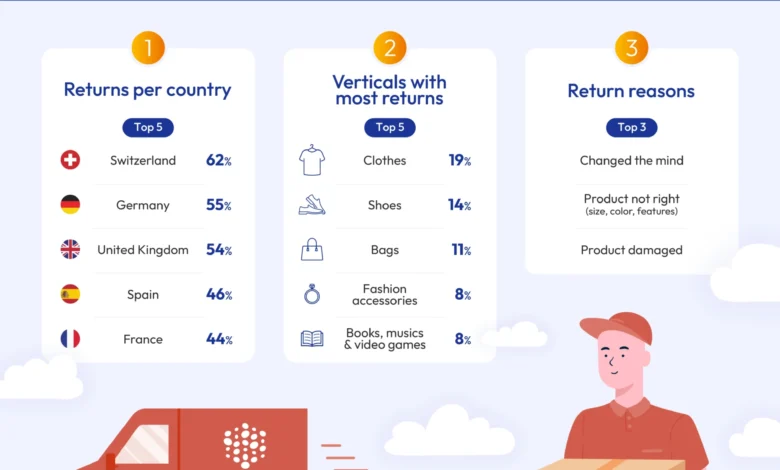
Across the European Union and its broader economic partners, return rates have stabilized at substantial levels, generally hovering between 30% and 40% across all sectors. However, these averages obscure a deeply fragmented landscape where consumer behavior, regulatory frameworks, and market expectations vary dramatically from one country to another. Recent industry data compiled by research firms such as Statista illustrate the sheer scale of the phenomenon: in Switzerland, the average return rate per online buyer reaches an impressive 62%, closely followed by Germany at 55%, and the United Kingdom at 54%.
This geographic variance is driven by a complex interplay of cultural expectations, statutory consumer rights, and retail policies. In markets with deeply ingrained "try-before-you-buy" shopping cultures—such as the DACH region (Germany, Austria, and Switzerland)—generous, frictionless return policies have long been utilized by retailers as powerful conversion tools. Yet, the long-term economic and environmental sustainability of this approach is facing an unprecedented reassessment.
The Chronology and Evolution of Modern Reverse Logistics
To understand the current state of European e-commerce returns, one must trace the trajectory of online retail over the past two decades. In the early 2000s, the primary focus of digital merchants was customer acquisition and the elimination of friction at checkout. Returns were viewed primarily as a cost of doing business, handled manually with minimal tracking or data analysis.
By the 2010s, as marketplace giants and fast-fashion heavyweights popularized free, unconditional returns, consumer expectations shifted permanently. A seamless return policy became a baseline prerequisite for building trust, particularly for cross-border shoppers navigating unfamiliar digital storefronts.
However, the period following the global pandemic ushered in a new era characterized by economic headwinds, supply chain volatility, and an acute awareness of environmental impact. By 2023 and 2024, the financial toll of escalating return volumes—compounded by inflation and rising fuel costs—forced a major strategic pivot. Retailers across Europe began rolling back universal free returns, introducing restocking fees, and cracking down on abusive consumer habits such as "bracketing," a practice where shoppers purchase multiple sizes or variants of an item with the explicit intent of returning the majority.
Sector-Specific Vulnerabilities and Consumer Motivation
While nearly every retail category experiences some level of product send-backs, the fashion and apparel sector remains the hardest hit. Driven by subjective style preferences, inconsistent sizing standards across international brands, and the tactile nature of textiles, clothing and footwear frequently record return rates exceeding 50%. Conversely, consumer electronics and household goods face lower overall return volumes—typically hovering around 6%—yet carry a disproportionately higher financial and operational burden due to testing requirements, potential manufacturing defects, and the complex refurbishment processes required before items can be safely resold.
Consumer psychology research consistently highlights several primary drivers behind product returns. Incorrect sizing or fit remains the single largest catalyst, particularly in cross-border trade where sizing conventions differ significantly between nations. Other leading causes include items failing to match their online photographic representations, unexpected delivery delays that render purchases obsolete, and product damages incurred during transit. Furthermore, the modern phenomenon of bracketing significantly distorts inventory forecasting, leaving merchants with temporarily immobilized stock that loses value rapidly in fast-moving consumer categories.
The Multi-Faceted Challenges Confronting European Retailers
For merchants operating within or exporting to European markets, managing reverse logistics involves navigating a labyrinth of logistical, regulatory, financial, and ecological hurdles.

Logistically, reverse flows require an infrastructure entirely distinct from traditional outbound supply chains. Unlike predictable bulk shipments from warehouses to consumers, returns arrive unpredictably, often unannounced, in fragmented parcels from diverse geographic origins. This complexity multiplies exponentially in cross-border trade, where shipments must traverse national borders, clear customs, and adhere to varying documentation standards.
Regulatory compliance presents another formidable barrier. The European Union boasts robust consumer protection frameworks—most notably the Consumer Rights Directive—which grants online shoppers a statutory 14-day cooling-off period to withdraw from a purchase without justification. However, the interpretation and enforcement of these directives, alongside local tax laws, VAT reclamation rules, and recycling mandates, differ subtly across member states. Retailers must carefully maneuver these legal nuances to avoid costly compliance disputes and reputational damage.
Financially, the true cost of a return extends far beyond the price of return shipping. Merchants must absorb the expenses associated with parcel reception, manual inspection, grading, repackaging, and restocking. In many instances, returned goods cannot be reintroduced into the primary inventory as new, forcing retailers to liquidate merchandise through secondary channels at steep discounts or write them off entirely.
Ecological pressures have emerged as an equally pressing concern for corporate leadership and policymakers alike. The exponential growth of e-commerce returns has accelerated carbon emissions stemming from redundant transport loops. Furthermore, the reliance on single-use plastics, bubble wrap, and non-recyclable corrugated boxes generates immense packaging waste. Public scrutiny over the disposal of unsold or returned goods—some of which historically faced destruction rather than recycling—has catalyzed stricter environmental accountability frameworks across Europe.
Strategic Solutions for Optimizing Return Management
Faced with these mounting pressures, successful e-commerce enterprises are pivoting away from passive acceptance toward proactive, data-driven optimization strategies. Industry analysts and supply chain experts recommend a multifaceted approach to mitigating return volumes while protecting customer satisfaction:
First, merchants are investing heavily in advanced technological solutions for automated return management. Modern digital portals streamline the consumer experience by enabling self-service returns, generating prepaid digital or physical labels instantly, and providing real-time tracking visibility. Concurrently, integration with warehouse management systems allows businesses to accelerate the reintegration of returned stock back into active inventory, minimizing holding times.
Second, data analytics has become an indispensable diagnostic tool. By systematically categorizing the root causes of returns—whether tracking chronic sizing issues with a specific apparel supplier or identifying recurring quality control flaws in an electronics line—merchants can implement targeted preventative measures. Providing hyper-detailed size charts, high-definition video product displays, and interactive fitting assistants helps align consumer expectations prior to purchase, directly suppressing preventable return requests.
Third, forward-thinking brands are championing ecological sustainability throughout the reverse logistics chain. This includes educating consumers on the environmental impact of unnecessary returns, adopting biodegradable or compostable packaging materials designed for two-way use, and consolidating return shipments through batch transport protocols to reduce the carbon footprint per parcel.
Fact-Based Analysis of Future Implications
The future of European e-commerce returns will likely be defined by a delicate equilibrium between consumer convenience and fiscal responsibility. As the era of universal, unconditional free returns draws to a close, retailers are educating consumers through transparent, tiered return policies that incentivize mindful purchasing.
Ultimately, organizations that treat reverse logistics not as a cost center, but as a strategic touchpoint for customer engagement and operational refinement, will be best positioned to thrive. By leveraging predictive data analytics, localized return networks, and sustainable supply chain practices, European merchants can successfully transform the complex challenge of e-commerce returns into a sustainable driver of long-term brand loyalty and competitive differentiation.