Navigating the Complex Landscape of E-Commerce Returns Across Europe: Challenges, Costs, and Strategic Solutions

The contemporary digital marketplace has redefined the consumer journey, establishing that the online sales process does not terminate at the virtual checkout. Instead, product returns have evolved into an indispensable phase of the retail lifecycle. Across Europe, the management of returned merchandise dictates a delicate balance between preserving consumer trust and safeguarding operational profitability. As return volumes surge across the continent, merchants face a complex matrix of logistical hurdles, stringent cross-border regulations, and mounting environmental pressures that demand strategic innovation.
The Scale of the European Return Economy
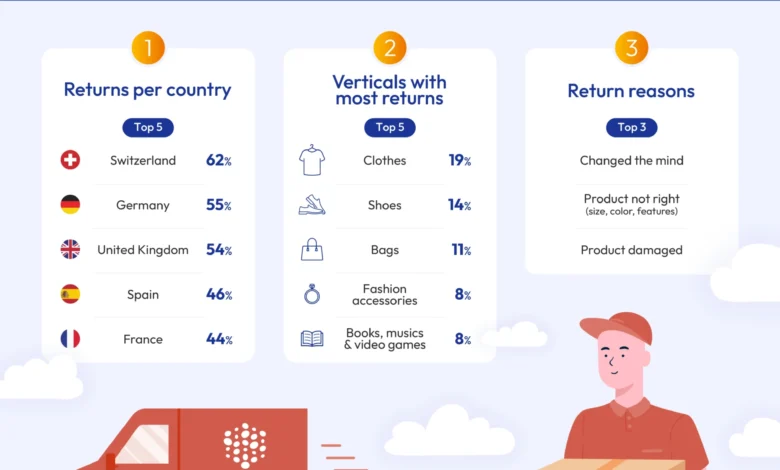
Recent industry analytics indicate that the baseline return rate for online purchases across Europe fluctuates persistently between 30% and 40%. However, this metric masks significant regional and sectoral disparities. According to comprehensive market data from Statista, Switzerland recorded the highest average return rate per online buyer in Europe at 62% in recent tracking periods. Germany closely mirrors this trend with a 55% return rate, while the United Kingdom completes the upper tier with 54% of acquired goods making their way back to merchants.
This high volume is largely driven by evolving consumer habits, most notably a phenomenon known as "bracketing." This practice involves consumers purchasing multiple variations of a single item—such as different sizes or colors of the same garment—with the explicit intent of keeping only one and returning the rest. While bracketing minimizes buyer remorse and reduces the friction of online shopping, it places an immense strain on supply chains and inflates operational expenditures for retailers.
The financial and operational implications of these figures are profound. Historically, free and unconditional returns served as a primary marketing tool to drive conversion rates. However, the sheer cost of processing, restocking, and liquidating returned items—compounded by the reality that many opened goods cannot be resold at full price—has forced a paradigm shift. A growing number of European retailers are reevaluating their policies, introducing return fees, or shortening return windows to deter excessive or abusive practices while striving to protect their bottom lines.
Sector Vulnerabilities and Consumer Motivation
While nearly all retail sectors experience some degree of product returns, certain industries are disproportionately affected. The fashion and apparel sector consistently reports the highest return frequencies, driven by the subjective nature of personal style, fabric expectations, and the notorious inconsistency of sizing standards across different brands and manufacturing origins. Electronic products and household goods also experience notable return rates, typically hovering around 6% in specific markets. In these categories, returns are frequently triggered by technical complexity, compatibility issues, manufacturing defects, or discrepancies between online product representations and physical reality.
Understanding the root causes of these returns is critical for merchants aiming to mitigate their frequency. Consumer research highlights several primary catalysts: sizing and fit failures, items not matching their online descriptions, delayed deliveries that render products obsolete upon arrival, and impulse purchases influenced by aggressive digital marketing. By identifying these patterns, retailers can implement targeted preventative measures, such as enhanced sizing charts, augmented reality fitting tools, and more accurate product photography and descriptions.
Logistical, Regulatory, and Environmental Challenges
Managing returns across the European Union introduces layers of complexity that extend far beyond domestic operations. Logistically, reverse supply chains require specialized infrastructure capable of handling unpredictable volumes, diverse return destinations, and rigorous parcel traceability requirements. Cross-border trade intensifies these challenges, forcing businesses to navigate a fragmented legal landscape.
Differences in national legislation and consumer protection laws across EU member states complicate cross-border refund policies, exchange protocols, and warranty mandates. Retailers must meticulously align their operations with local regulatory frameworks to avoid costly legal disputes and reputational damage. Furthermore, labelling and packaging standards often vary by country, requiring adaptive compliance strategies for international shipments.
Beyond the financial and operational tolls, the environmental impact of e-commerce returns has emerged as a critical concern for regulators, corporations, and consumers alike. The traditional reverse logistics model generates substantial carbon emissions due to the redundant transportation of goods. Additionally, the process relies heavily on single-use packaging materials, including plastics and bubble wrap.

A parallel environmental crisis involves the ultimate disposition of returned merchandise. When returned items are deemed uneconomical to inspect, repackage, and restock, a fraction of these goods faces disposal rather than recycling or secondary-market resale. This practice contributes significantly to landfill waste and contradicts the sustainability mandates increasingly prioritized by European consumers and policymakers.
Balancing Customer Expectations with Operational Sustainability
For modern consumers, the return experience serves as a definitive benchmark of brand reliability. Modern shoppers increasingly expect friction-free, expedited, and ideally cost-free return processes, often evaluating a merchant’s return policy prior to completing an initial purchase. Consequently, companies find themselves trapped in a strategic dilemma: imposing restrictive return policies to control costs risks alienating consumers and driving them toward competitors, whereas maintaining ultra-flexible policies can severely erode profit margins.
Customer dissatisfaction frequently stems from systemic friction points within the return journey. Extended reimbursement delays—often caused by inefficient warehousing and manual inspection processes—frequently damage consumer trust. Similarly, a lack of accessible local drop-off points forces consumers to expend undue effort to send items back, translating negative sentiment directly to the brand. Retailers must therefore invest in robust, localized infrastructure, such as establishing regional return hubs or partnering with established local courier networks, to streamline the process and manage customer expectations effectively.
Strategic Solutions for Optimized Return Management
To transform returns from a persistent operational liability into a manageable component of the business model, e-commerce merchants are increasingly adopting advanced technological and strategic frameworks.
First, businesses are prioritizing transparency and user-friendliness within their return policies. Providing clear guidelines, automated portals for generating prepaid return labels, and extending return windows fosters long-term consumer trust without necessarily increasing the frequency of abuse.
Second, the integration of specialized technological solutions has become paramount. Retailers are deploying dedicated return management platforms that automate the reverse logistics workflow, integrate real-time tracking, and optimize inventory management systems. These tools enable the swift reintegration of marketable products back into active inventory, minimizing holding times and reducing depreciation losses.
Third, data analytics plays an instrumental role in proactive return reduction. By systematically evaluating return data—identifying which specific products, batches, or sizing runs generate the highest return frequencies—companies can enact precise corrective measures. Whether refining supplier quality control, updating sizing algorithms, or rewriting product descriptions for absolute clarity, data-driven insights allow merchants to address problems at their source.
Finally, forward-thinking enterprises are embedding sustainability into their return strategies. Educating consumers on the environmental footprint of unnecessary returns, encouraging the reuse of durable packaging, and transitioning to biodegradable or compostable materials help mitigate ecological damage. Furthermore, adopting batch-shipping practices for returned goods optimizes transport efficiency and reduces the collective carbon footprint of reverse logistics.
Conclusion
The evolution of the European e-commerce market demonstrates that product returns are an inescapable structural reality rather than a temporary anomaly. While the challenges spanning logistical friction, cross-border regulatory compliance, financial strain, and environmental degradation are formidable, they are not insurmountable. By embracing transparent policies, leveraging automated technologies, utilizing rigorous data analytics, and committing to sustainable operational practices, online merchants can successfully navigate the complexities of the European return landscape. Ultimately, optimizing this critical phase of the retail cycle enables businesses to protect their profitability while delivering the seamless, reliable experiences that modern consumers demand.