Snap Inc. Q3 2026 Earnings Report Reveals Stalled User Growth, Surging Revenues, and New Strategic Frontiers


Snap Inc. released its financial results for the third quarter of 2026 on Wednesday, painting a complex portrait of a mature social media platform navigating a rapidly shifting technological and regulatory landscape. While the company’s financial indicators demonstrated healthy
year-over-year expansion—bolstered by artificial intelligence integration, robust short-form video engagement, and surging subscription offerings—core user growth has effectively stalled in its most lucrative Western markets. Furthermore, Snap faces mounting headwinds from international legislative crackdowns on youth social media usage, placing heightened pressure on its monetization strategies and long-term hardware ambitions.
Main Facts and Financial Performance
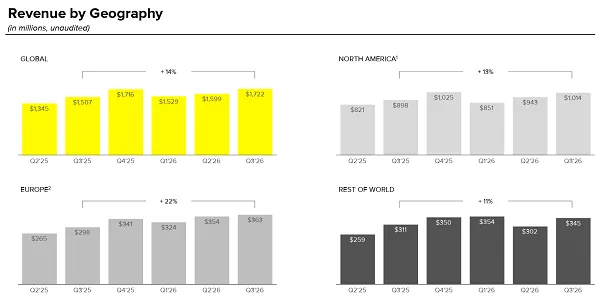
For the third quarter of 2026, Snap reported total revenue of $1.72 billion, representing a 14% increase compared to the same period in the previous year. This revenue acceleration was largely driven by improvements in advertising efficiency, enhanced creator partnerships, and a dramatic 84% surge in "Other Revenue," a category propelled by premium subscriptions such as Snapchat+, Lens+, and expanded Memories Storage.
Regionally, North America remained Snap’s primary financial engine, generating $1.01 billion in revenue—a 13% year-over-year increase—with average revenue per user (ARPU) climbing to $11.07, up from $10.26 in the preceding quarter. Europe also performed strongly, with revenues rising 22% to $363 million. Meanwhile, the Rest of World segment contributed $345 million, an 11% increase.

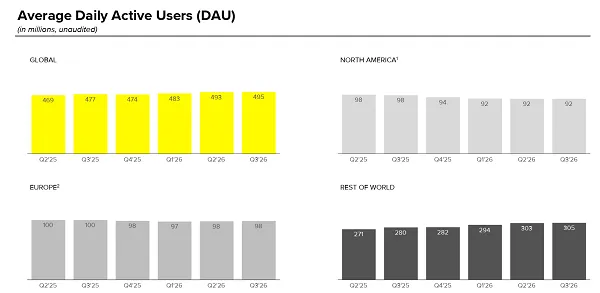
Despite these positive top-line figures, daily active user (DAU) metrics underscored a troubling plateau. Snapchat closed the quarter with 495 million daily active users, representing a meager increase of just 2 million users from the 493 million reported in the second quarter.
Chronology and Market Dynamics
The stagnation of Snapchat’s user base is not entirely new, but the Q3 2026 report highlighted a stark geographic polarization. While the platform has historically relied on steady user acquisition across all territories, the latest data revealed absolute zero net user growth in both North America and Europe. Consequently, 100% of Snapchat’s modest global user additions stemmed entirely from the Rest of World segment.
This geographic divergence creates a strategic vulnerability for Snap. Because the platform monetizes international audiences at a fraction of the rate of Western users—generating roughly $1.13 per user in the Rest of World compared to over $11 in North America—user growth is currently concentrated in regions yielding the lowest advertising returns.
Concurrently, the regulatory landscape has introduced immediate attrition risks. Following the implementation of Australia’s landmark legislation in December 2025 restricting social media access for children under the age of 16, Snap reported locking or disabling more than 415,000 user accounts in the country. Given that Snap previously claimed over 8 million Australian users in August 2023, these enforcement measures effectively stripped the platform of approximately 5% of its local user base in under a year. As similar legislative proposals regarding teen social media bans gain momentum across various global jurisdictions, analysts note that Snapchat’s core demographic—approximately 55% of U.S. teens aged 13 to 17 use the app, according to Pew Research data—remains vulnerable to regulatory shrinkage.
Engagement Metrics and Ecosystem Health
To counteract slowing user acquisition, Snap leadership emphasized internal ecosystem health and user engagement during the earnings release. In his prepared remarks, Snap CEO Evan Spiegel highlighted resilient communication and content consumption trends within the application.
Average daily messages sent on Snapchat increased by 8% year over year during the third quarter, while the volume of users participating in reciprocal two-way communication grew by 6%. Simultaneously, the platform’s short-form video discovery engine, Spotlight, experienced a 130% year-over-year increase in content creators posting videos, alongside a 40% rise in daily active viewers. These metrics indicate that while net user acquisition has slowed, existing users are spending deeper, more active periods interacting within the application’s core communication and entertainment loops.
Furthermore, Snap’s subscription ecosystem achieved a major milestone during the quarter, crossing the 30 million subscriber threshold collectively across Snapchat+, Lens+, and paid Memories Storage tiers. This diversified revenue stream has provided a crucial buffer against macroeconomic advertising fluctuations.
Official Responses and Strategic Initiatives
Snap executives used the Q3 2026 earnings call to outline how artificial intelligence and hardware diversification are shaping the company’s future roadmap.
CEO Evan Spiegel credited machine learning models and AI integration as fundamental operational catalysts that have significantly enhanced the efficacy of Snap’s ad targeting platforms and internal team workflows. By refining automated bidding and ad creation tools, Snap has managed to extract higher monetization value out of its existing user base despite flat user growth in saturated markets.
In addition to algorithmic enhancements, Snap has aggressively expanded its B2B advertising pitches and restructured creator compensation frameworks to attract professional digital marketers. Beyond software and advertising, the company’s long-term vision increasingly hinges on wearable computing.
In September 2026, Snap officially launched its next-generation Augmented Reality (AR) Specs. Priced at $2,200, the high-end hardware device became available for pre-order in the United States, France, and the United Kingdom. Designed to pioneer advanced digital connectivity through wearable visual overlays, the glasses represent Snap’s bid to establish a leadership position in spatial computing.
However, financial disclosures for Q3 indicate that the AR Specs have not yet registered as a material driver of corporate revenue. While Chief Financial Officer Doug Hott detailed the 84% expansion in "Other Revenue" driven by software subscriptions and cloud storage, neither Spiegel nor Hott provided specific pre-order volume figures or shipment timelines for the AR hardware during their prepared commentary. This omission suggests that commercial scaling for the device remains in its nascent stages.
Broader Impact and Industry Implications
The Q3 2026 financial report illustrates a pivotal transitional phase for Snap Inc. The company has successfully demonstrated an ability to increase profitability and advertising yield in mature markets even as organic user expansion grinds to a halt. By leaning into AI-driven ad platforms, subscription-based services, and high-engagement features like Spotlight and direct messaging, Snap has insulated its financial results against immediate stagnation.
Nevertheless, significant vulnerabilities remain. The concentration of user growth in low-ARPU international regions limits the top-line impact of these new registrations. More pressingly, the global proliferation of strict age-verification mandates and teen social media bans poses a systemic threat to platforms heavily reliant on younger demographics.
Looking forward, Snap’s valuation and long-term trajectory will likely depend on two major variables: the successful market penetration and eventual consumer adoption of its high-priced AR Specs, and the company’s agility in navigating an increasingly hostile international regulatory environment for minor accounts. For now, Snap remains a profitable enterprise successfully extracting greater value from an established user base, but its roadmap for the next decade will require navigating formidable structural challenges.