The Evolution of Local Artificial Intelligence A Comprehensive Guide to Deploying Small Language Models with Ollama

The landscape of artificial intelligence is currently undergoing a significant architectural shift, moving away from a total reliance on massive, centralized cloud-based APIs toward decentralized, local inference. This transition is driven by the emergence of Small Language Models (SLMs)—compact versions of their larger counterparts that are optimized to run on consumer-grade hardware. While the industry has long been dominated by "frontier" models like GPT-4 and Claude 3.5, which require thousands of interconnected GPUs, a new generation of efficient models such as Meta’s Llama 3.2 and Google’s Gemma 2 are proving that high-quality reasoning and natural language processing can occur entirely offline. Central to this movement is Ollama, an open-source tool that has simplified the complex process of local AI deployment into a streamlined workflow achievable in under 15 minutes.
The Shift Toward Local Inference
For much of the past two years, the barrier to entry for local AI was prohibitively high. Developers and enthusiasts were forced to navigate a labyrinth of CUDA driver installations, Python environment conflicts, and manual weight conversions. The technical debt associated with running a model locally often outweighed the benefits for the average user. However, the release of optimized model weights and the development of the GGUF file format—which allows for efficient CPU and GPU inference—laid the groundwork for a more accessible ecosystem.
Ollama emerged as a solution to this fragmentation. By packaging model architectures, weights, and configurations into a unified "Modelfile" system, it functions similarly to Docker but is purpose-built for large language models. It operates as a background service that manages hardware acceleration natively, whether utilizing Apple’s Metal API, NVIDIA’s CUDA, or AMD’s ROCm. This abstraction layer allows users to interact with sophisticated AI through a simple command-line interface, effectively democratizing access to private, secure, and cost-effective intelligence.
Technical Chronology of the Local AI Movement
The journey toward localized AI can be categorized into four distinct phases. The first phase, the "Frontier Era," saw the rise of massive models accessible only via API. The second phase, the "Llama Breakthrough," occurred in early 2023 when Meta released the weights of its Llama model to the research community, sparking a wave of innovation in open-source AI. The third phase focused on "Optimization," where techniques like quantization became mainstream, allowing models to be compressed without significant loss in intelligence. We are currently in the fourth phase: "The Era of the SLM," where models are specifically trained to be small and efficient from the outset, rather than being mere "shrunk-down" versions of larger models.
This chronology is essential to understanding why a model like Llama 3.2 3B is significant. It represents a pinnacle of efficiency, providing reasoning capabilities that rival models twice its size from just a year ago. By reducing the parameter count while maintaining high data quality during training, researchers have created models that can fit into the VRAM (Video Random Access Memory) of a standard laptop.
Implementation Guide: The Unified Setup Path
Deploying a local model via Ollama follows a standardized "happy path" across macOS, Windows, and Linux. The process is designed to be frictionless, moving from installation to active chat in a matter of minutes.
Step 1: Installation and Environment Configuration
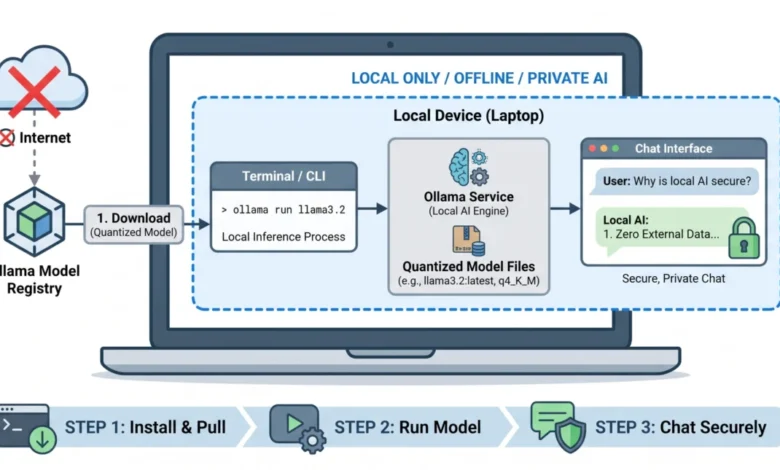
The first step involves acquiring the Ollama binary. On macOS and Windows, this is a standard installer that sets up the background daemon. On Linux, a single-line curl command typically handles the installation. Once installed, the Ollama service remains idle in the system tray, listening for instructions on port 11434. This architecture allows the model to remain resident in memory for fast responses while allowing other applications to communicate with it via a local API.
Step 2: Model Acquisition and Quantization
Once the environment is active, the user pulls a model from the Ollama library. For most users, the Llama 3.2 3B model is the recommended starting point. Running the command ollama run llama3.2 triggers a multi-stage process. Ollama first checks for the model locally; if not found, it begins downloading the manifest and the various layers of the model.
A critical component of this step is quantization. A standard 3-billion parameter model at 16-bit precision would require approximately 6 GB of VRAM. However, Ollama defaults to 4-bit quantization (specifically the q4_K_M method). This process compresses the weights into 4-bit integers, reducing the footprint to roughly 2.0 GB. This compression is what enables a standard broadband user to download a fully functional AI in under three minutes and run it on hardware with limited resources.
Step 3: Interactive Inference
The final step is the initialization of the chat session. When the download reaches 100%, the terminal transforms into an interactive prompt. At this stage, the model is fully loaded into the system’s RAM or GPU VRAM. The inference is entirely local; no data packets containing user prompts are sent to external servers. This provides a "Zero External Data Transmission" environment, which is a primary requirement for many enterprise and privacy-conscious users.
Supporting Data: Hardware Requirements and Performance Metrics
To ensure a successful deployment, users must understand the relationship between model size and hardware capacity. The following data outlines the typical requirements for various model tiers:
| Model Tier | Parameter Count | Minimum RAM/VRAM | Ideal Hardware |
|---|---|---|---|
| SmolLM2 | 1.7 Billion | 2 GB | Budget Laptops / Mobile |
| Llama 3.2 | 3 Billion | 4 GB | Standard Ultrabooks |
| Mistral / Gemma 2 | 7-9 Billion | 8-12 GB | Gaming Laptops / MacBook Air (M2/M3) |
| Llama 3.1 | 70 Billion | 40 GB+ | Professional Workstations (A6000 / Multi-GPU) |
Performance is measured in tokens per second (t/s). For a comfortable reading experience, a model should produce at least 10–15 t/s. Llama 3.2 3B typically achieves 40–60 t/s on Apple Silicon (M-series) or modern NVIDIA RTX cards, making the interaction feel instantaneous.
Troubleshooting and System Optimization
Despite the streamlined nature of Ollama, hardware variations can lead to performance bottlenecks. The most common issue is "VRAM Spillover," which occurs when a model is too large for the dedicated graphics card memory. In such cases, Ollama falls back to the system CPU and RAM. While functional, this results in a dramatic slowdown, often dropping from 50 t/s to 2–3 t/s.
Another common hurdle involves GPU driver compatibility. On Windows and Linux, Ollama relies on the latest CUDA or ROCm drivers to interface with the hardware. If these drivers are outdated, the system may fail to recognize the GPU, defaulting to the CPU. Users are advised to verify their driver versions if they experience high CPU usage during chat sessions. Lastly, port conflicts on 11434 can prevent the application from starting; this is usually resolved by ensuring only one instance of the Ollama daemon is active.
Industry Implications and Expert Analysis
The rise of local AI through tools like Ollama has profound implications for data sovereignty and the economics of software development. Industry analysts suggest that by 2026, a significant portion of routine AI tasks—such as text summarization, code completion, and basic drafting—will shift from the cloud to the "edge."
Privacy and Security: Local models eliminate the risk of "prompt leakage," where sensitive corporate or personal data is used to train future versions of a commercial model. For legal and medical professionals, this is not merely a preference but a compliance necessity.
Economic Efficiency: For developers, the "cost per token" of a local model is effectively zero after the initial hardware investment. This allows for the creation of "agentic" workflows—where an AI performs hundreds of iterative tasks—without the fear of a massive API bill at the end of the month.
Innovation at the Edge: As hardware manufacturers like Intel, AMD, and Apple integrate dedicated Neural Processing Units (NPUs) into their chips, the performance of local models will continue to climb. We are entering an era where "intelligence" is a local utility, much like electricity or file storage, rather than a metered service provided by a handful of tech giants.
Conclusion and Future Outlook
Setting up a local language model is no longer a weekend-long engineering project; it is a fifteen-minute task that grants a user total control over their digital assistant. By leveraging Ollama and the current generation of SLMs, individuals and organizations can reclaim their data privacy while exploring the frontiers of artificial intelligence. As the library of available models grows to include specialized versions for coding, mathematics, and creative writing, the ability to swap between these "local brains" will become a fundamental skill for the modern knowledge worker. The foundation laid by this setup is the first step toward a more resilient, private, and accessible AI future.