The rise of culinary-themed sports jargon and the evolution of digital NFL fan discourse

The return of college football and the National Football League (NFL) has signaled more than just a transition into autumn; it has marked a notable shift in the vernacular of digital sports culture. Social media platforms, particularly X (formerly Twitter), have recently seen an explosion in food-centric terminology used to critique professional quarterback performance. Most notably, the term "meatball sub" has emerged as the latest iteration of sports "slander," serving as a derogatory descriptor for an interception or a particularly poor decision by a quarterback. This phenomenon, which conflates fast-food menu items with athletic failure, represents a broader trend in how fans express frustration through hyper-specific, absurd metaphors.
The Etymological Roots of the Meatball
To understand the current obsession with sandwich-themed insults, one must look at the historical usage of the term "meatball" in professional sports. For decades, the term has been a fixture of baseball lexicon. In the context of Major League Baseball, a "meatball" is a pitch thrown directly over the heart of the plate—a delivery that is easy for a batter to hit. The implication is that the pitcher has served up an easy opportunity, essentially "putting the ball on a platter."
As the popularity of NFL analytical discourse migrated from traditional media to community-driven social platforms, the terminology began to evolve. Because the football itself is an oblong, distinct shape compared to a baseball, the moniker "meatball" required an adjustment to fit the new medium. By attaching "sub" to the term, social media users created a hybrid descriptor that effectively mocks the quarterback’s delivery. The implication is that the quarterback has "served" the opposing team an interception as easily as a deli worker might assemble a sandwich.
Chronology of the Trend
While the trend reached a fever pitch during the opening week of the 2024 NFL season, its origins can be traced back to the 2023 season. Social media activity indicates that the fusion of food and football errors gained traction in late 2023. One of the earliest documented instances of this specific brand of humor involved New Orleans Saints quarterback Derek Carr. In November 2023, a post circulated on social media criticizing a high-profile interception by describing it as a "fully loaded shrimp po’boy."
The nuance of the joke was multi-layered: it utilized a food item deeply associated with the city of New Orleans to emphasize the severity of the turnover. This established a precedent where the specificity of the food item added to the humor of the critique. The more obscure or incongruous the sandwich, the more the post resonated with the algorithm-driven audience.
The Case of Drake Maye and the Jersey Mike’s Connection
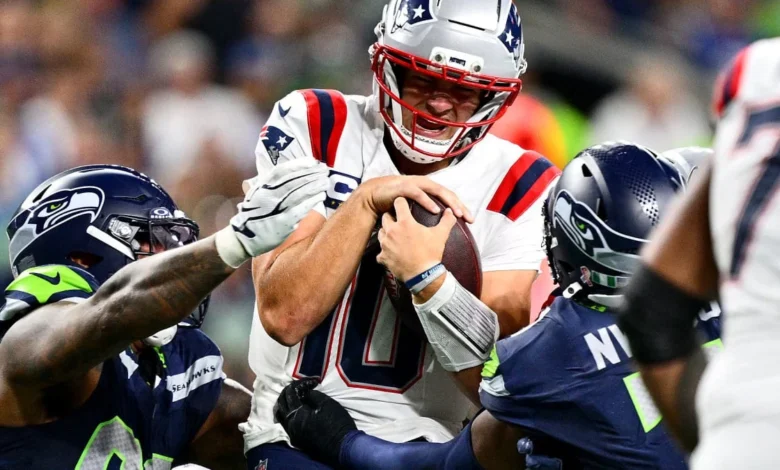
The trend hit its zenith during the first week of the 2024 NFL season, largely centered around New England Patriots quarterback Drake Maye. The circumstances surrounding Maye provided a unique "perfect storm" for social media engagement. Maye had already been a subject of intense scrutiny following an offseason characterized by high expectations and a controversial MVP voting placement during his second year in the league.
The narrative gained momentum due to Maye’s real-world professional associations. In recent years, the quarterback has partnered with local franchises of the sub-sandwich chain Jersey Mike’s for charitable endeavors in the Boston area. When Maye delivered a lackluster performance against the Seattle Seahawks—highlighted by three critical interceptions—the internet’s reaction was instantaneous. Users flooded the timeline with variations of sandwich-related puns, directly linking his real-world corporate partnerships to his on-field struggles. Phrases such as "ordering a club" or "serving a meatball sub" became the primary method of criticizing his performance, creating a viral loop that tied the athlete’s off-field identity to his on-field errors.
Contextualizing Sports Slander
The "sandwich" phenomenon is part of a larger, ongoing evolution in sports discourse. Over the past decade, fans have moved away from traditional critiques of mechanics or strategy in favor of high-engagement, performative "slander." This shift is largely driven by the competitive nature of social media platforms, where the most creative, bizarre, or aggressive content is rewarded with visibility.
Historically, this behavior mirrored trends in the National Basketball Association (NBA). The "get ready to learn Chinese" meme, which emerged to mock players perceived to be on the verge of being cut from their NBA rosters, set the standard for this type of discourse. The joke implies that a player’s performance is so substandard that their only remaining career path is to play for a team in the Chinese Basketball Association.
In the NFL, the stakes are different because there is no direct equivalent to the "lesser league" trope. As a result, fans have pivoted to "fast food" imagery. The underlying message remains consistent: the player has performed so poorly that they are effectively signaling their own departure from the league.
Fact-Based Implications and Analysis
From an analytical standpoint, the prevalence of these memes serves as a barometer for player popularity and expectation. When a quarterback is the subject of such specific internet mockery, it is almost always a result of a discrepancy between the expectations placed upon them and their actual output.
The data suggests that these trends have a finite lifespan. As of the second week of the 2024 season, there were already indicators of "meme fatigue" among social media users. While the "sandwich" terminology provided a novel way to process frustration during Week 1, the repetition of the joke has led to diminishing returns in engagement.
However, the impact of these trends on sports media cannot be ignored. Sports journalists and traditional broadcasters are increasingly forced to acknowledge these digital narratives, as they represent the dominant sentiment of the modern fan base. While the players themselves rarely address such memes publicly, the pressure created by viral social media cycles contributes to the overall narrative environment surrounding professional athletes.
Broader Cultural Impact
The move toward food-based lexicon in sports is symptomatic of the "gamification" of fan interaction. By turning a critical interception into a culinary metaphor, fans detach from the frustration of a loss and convert it into a piece of digital content. This creates a protective layer of irony that allows fans to vent without engaging in the more toxic, personal attacks that often plague social media platforms.
Furthermore, this trend highlights the influence of brand integration in sports. Drake Maye’s association with a sandwich chain provided the perfect "hook" for the internet’s collective imagination. It suggests that in the modern era, an athlete’s off-field sponsorships and public image are inextricably linked to how their professional performance is viewed and critiqued.
As the 2024 NFL season continues, it is likely that the "sandwich" trend will fade, only to be replaced by a new, equally absurd framework for discussing athletic failure. For now, the "meatball sub" serves as a case study in how quickly digital communities can coalesce around a shared, ironic language, proving that in the age of viral social media, even the most mundane turnover can become a defining cultural moment. Whether these memes will be remembered in the "generational" highlight reels at the end of the season remains to be seen, but they have undeniably defined the opening chapter of this year’s professional football campaign.