The Southern American Sumi-e Exploring the Intricate Ink Artistry and Creative Evolution of Will Thompson

Will Thompson, a Georgia-based traditional ink artist known to the digital art community as @The300ChickenNuggets, has garnered significant attention for his pioneering aesthetic, which he describes as "Southern American Sumi-e." This stylistic fusion represents a departure from traditional Western illustration, blending the ancient philosophies of East Asian ink wash painting with the moody, detail-oriented sensibilities of contemporary science fiction and the natural world. Utilizing a precise combination of sumi and Diamine inks on Bristol vellum, Thompson’s work is defined by its meticulous line work, fine brush strokes, and an atmospheric darkness that manages to be both expansive and claustrophobic.
The emergence of Thompson’s work comes at a time when the art world is increasingly bifurcated between the rapid proliferation of generative artificial intelligence and a renewed, grassroots appreciation for high-effort traditional media. Thompson’s journey from a student of law to a practitioner of fine ink art serves as a testament to the enduring power of manual craft. His technique—a slow, meditative process of growing a piece through minute ticks and lines—reflects a disciplined approach that he balances with what he characterizes as "ADHD-fueled creativity." This duality is central to his "Self-Creating Prophecy" philosophy, wherein the artwork evolves spontaneously from a core of intense, structured detail.
The Genesis of a Stylistic Fusion: From Courtrooms to Canvas
The trajectory of Will Thompson’s career provides essential context for the precision found in his illustrations. Hailing from the state of Georgia, Thompson’s early academic life was dedicated to the study of law. The legal profession, known for its requirement of extreme attention to detail, rigorous structure, and the navigation of complex systems, likely provided a subconscious foundation for the "minute ticks" that define his current artistic output. However, Thompson found that his true vocation lay outside the courtroom, leading him to pivot toward a full-time pursuit of traditional ink drawing.
The term "Southern American Sumi-e" is more than a clever moniker; it is a technical description of his cross-cultural methodology. Sumi-e, or Suibokuga, is a traditional Japanese ink wash painting style that dates back centuries, focusing on the beauty of the brushstroke and the "spirit" of the subject rather than mere literal representation. By adopting the tools of this tradition—specifically sumi ink—and applying them to subjects rooted in Western science fiction and the landscapes of the American South, Thompson creates a visual dialogue between the old world and the new.
His choice of Bristol vellum as a primary substrate is equally deliberate. Bristol board, particularly the vellum finish, offers a slightly textured surface that provides "tooth" for the ink. This allows for the high-contrast shadows and the "dark and encapsulating" depth that have become Thompson’s signature. Unlike smooth surfaces where ink may sit on top and pool, the vellum absorbs the Diamine and sumi inks in a way that permits the layering of "spontaneous" strokes over a highly structured base.
Technical Analysis of Materials and Methodology
To understand the impact of Thompson’s work, one must analyze the chemical and physical properties of his chosen media. Sumi ink is traditionally made from vegetable soot and glue. It is known for its permanent, deep black hue and its ability to be diluted into a vast range of grays. Thompson pairs this with Diamine ink, a brand of fountain pen ink manufactured in Liverpool since 1864. Diamine inks are celebrated for their flow properties and the unique "sheen" or "shading" they exhibit on specific papers.
The integration of these two types of ink allows Thompson to achieve a tonal range that is difficult to replicate with standard technical pens. The sumi ink provides the structural darkness—the "violent voids" and "consumed shadows"—while the Diamine ink allows for subtle color shifts, such as the teals and purples seen in his cosmic pieces.
Thompson describes his creative process as a "Self-Creating Prophecy." In a journalistic sense, this can be interpreted as a feedback loop between the artist and the medium. By starting with minute, repetitive marks, the artist allows the piece to dictate its own eventual form. This approach is particularly relevant in the context of ADHD-fueled creativity, where the hyper-focus required for repetitive detail serves as a grounding mechanism for the more spontaneous, imaginative leaps required to build fantastical worlds.
A Portfolio of Defiance and Wonder: Four Key Works
Thompson recently presented four definitive examples of his work, each illustrating a different facet of his "Southern American Sumi-e" style. These pieces serve as a microcosm of his broader themes: isolation, the inevitability of nature, and the defiance of the individual against overwhelming forces.
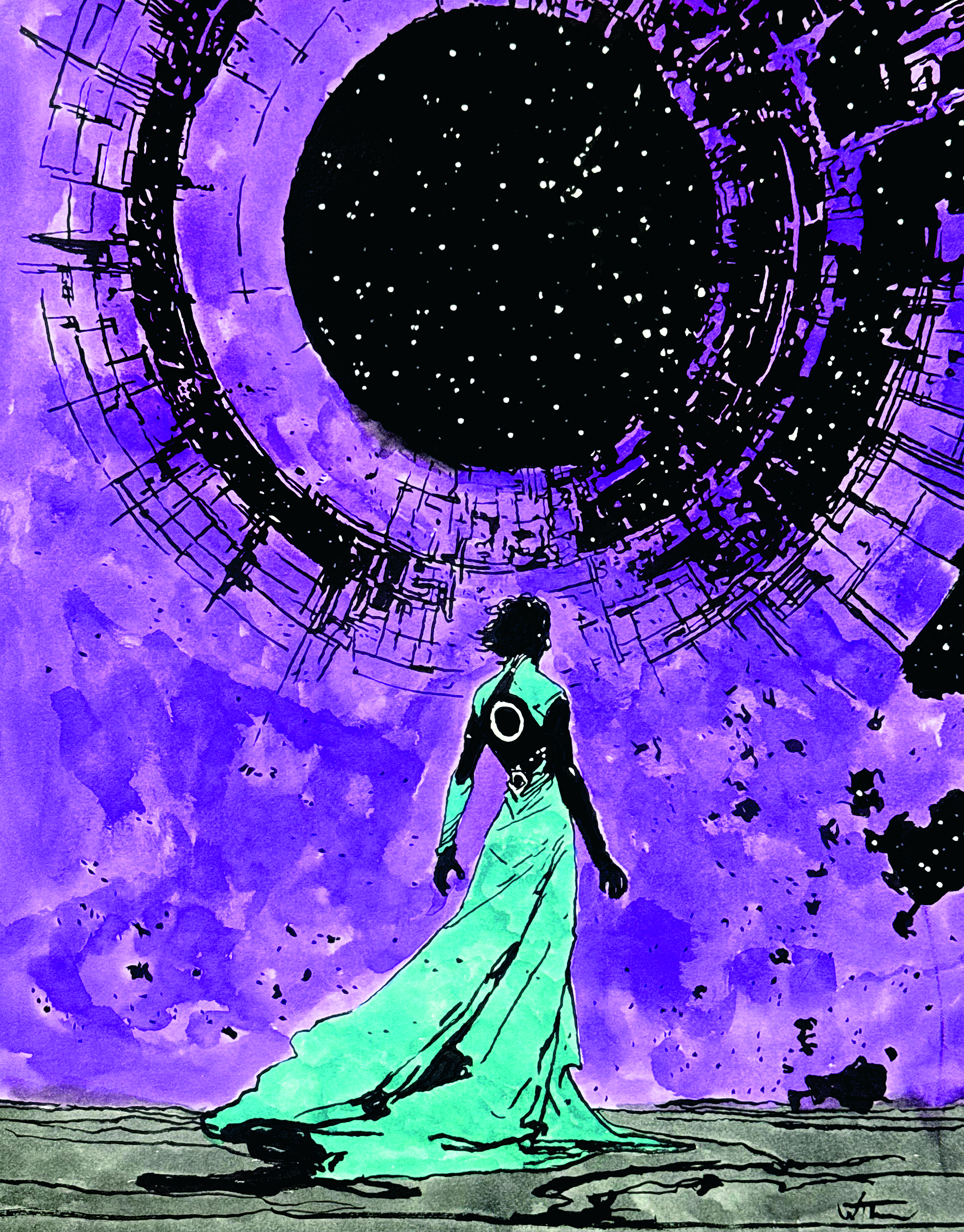
Space-time Mage
In this piece, Thompson explores the intersection of the mystical and the cosmic. A solitary figure, cloaked in teal, stands against a "violent purple void." The Mage is depicted not as a master of the universe, but as a witness to it—consumed by the scale of what lies beyond. The detail in the cloak’s folds and the ethereal texture of the surrounding space demonstrate Thompson’s ability to use fine brush strokes to create a sense of infinite distance.
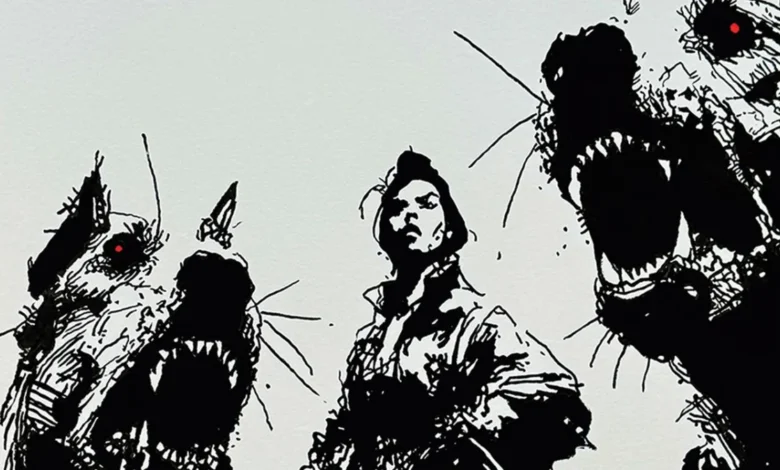
Prey
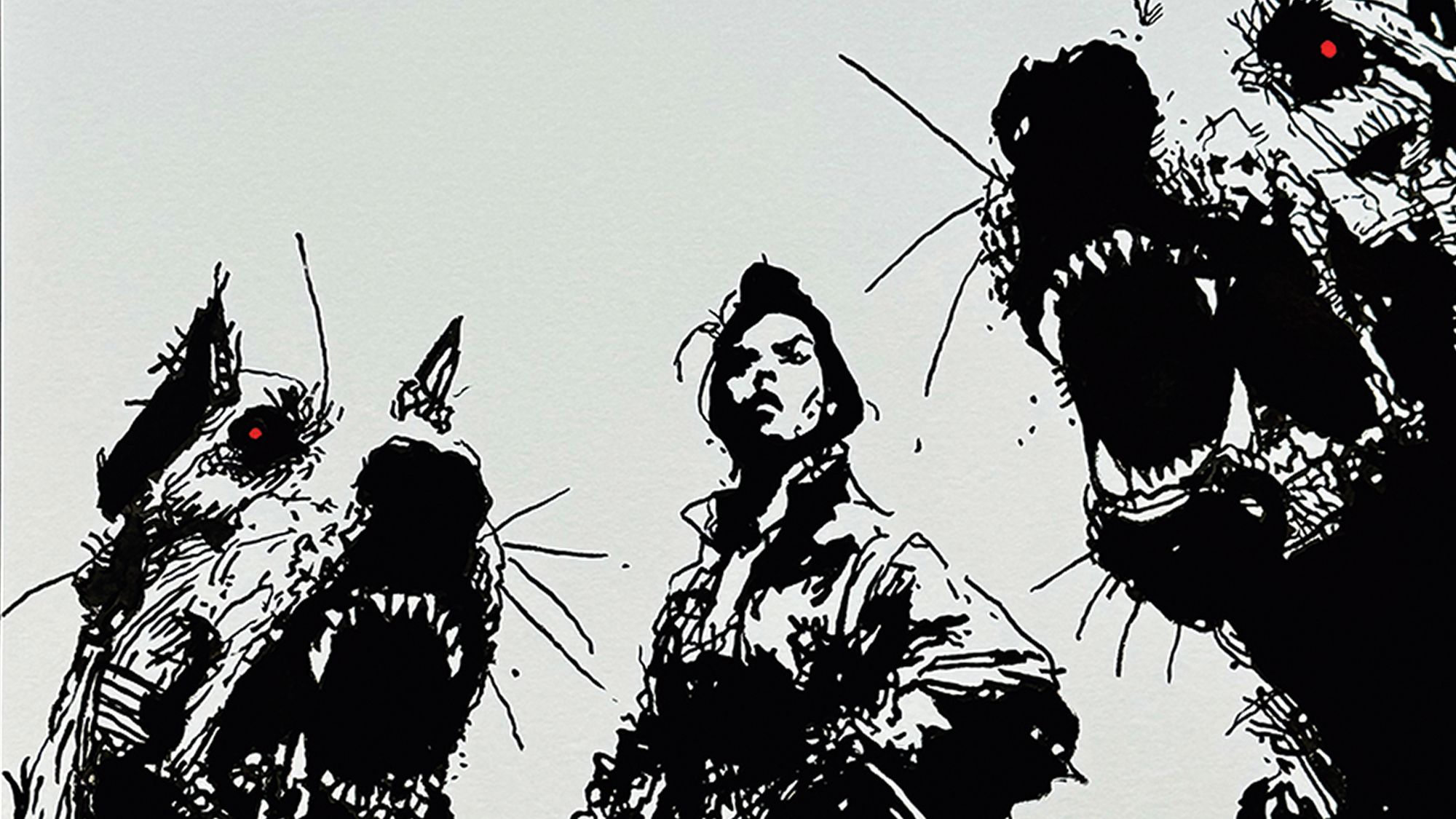
"Prey" shifts the focus to the natural (and supernatural) world. The central figure is a female hunter or deity who "doesn’t chase; she arrives." Accompanied by two red-eyed beasts, she represents a chilling inevitability. Here, Thompson’s use of contrast is at its peak; the burning red of the eyes provides a sharp, unsettling focal point against the intricate, dark line work of the figures. This piece highlights the "whimsical yet meticulously crafted" nature of his portfolio.
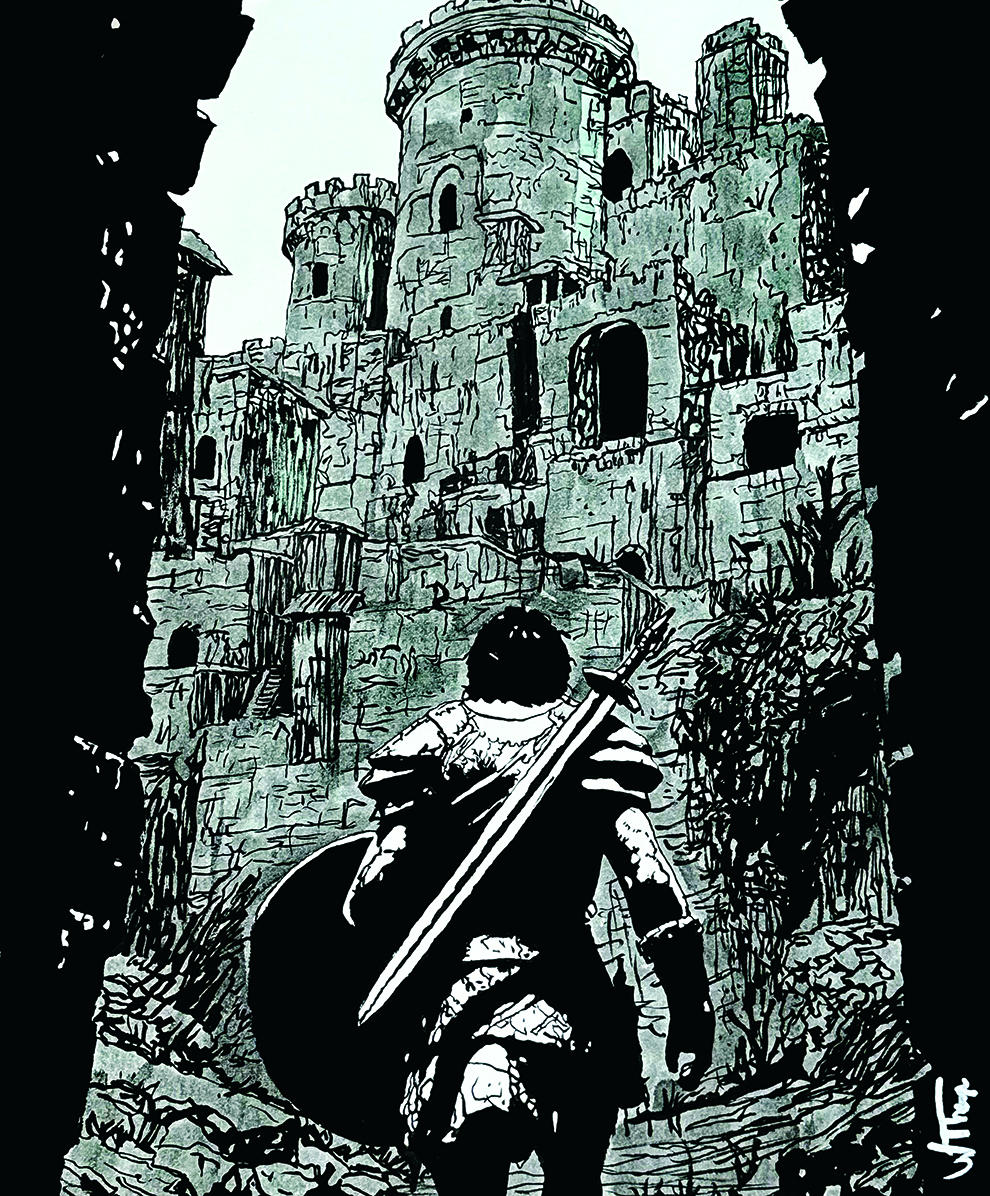
Darkest Dungeon
Reflecting themes found in dark fantasy and ruin-exploration narratives, "Darkest Dungeon" depicts a lone warrior confronting a massive, crumbling fortress. Every stone is rendered with individual attention, emphasizing the weight of history and the "act of defiance" inherent in moving forward. The piece is a masterclass in architectural ink work, using shadow to convey both the physical scale of the structure and the psychological burden of the protagonist.
Malfeasance
The fourth piece, "Malfeasance," introduces a more aggressive, kinetic energy. The character is described as having "no mercy, no pause, no hesitation." The visual representation—horns forward, eyes burning—suggests a force of absolute destruction. The linework here is sharper and more jagged, reflecting the "eruption" of the character’s presence. It demonstrates the versatility of Thompson’s "minute ticks," showing they can convey explosive movement just as effectively as they do still, cosmic silence.
Industry Context and the Resurgence of Traditional Ink
The reception of Thompson’s work within the professional art community has been notably positive. Originally featured in ImagineFX, a leading publication for digital and traditional artists, Thompson’s style has been highlighted as an example of how traditional media can remain competitive in a digital-first market.

Industry analysts suggest that the "tactile authenticity" of artists like Thompson provides a necessary counterweight to the "perfection" of digital rendering. There is a growing market for art that shows the "hand of the creator"—the slight irregularities and the sheer labor involved in "slowly growing" a piece from thousands of individual ink marks. Furthermore, Thompson’s openness about his ADHD and how it informs his creative process has resonated with a broader audience, contributing to a more nuanced understanding of neurodiversity in the arts.
From a commercial perspective, the "Southern American Sumi-e" style occupies a unique bridge between fine art and commercial illustration. While his themes are firmly rooted in the genres of sci-fi and fantasy—markets typically dominated by digital painting—his execution is that of a traditionalist. This makes his work highly sought after for high-end print editions, gallery showcases, and specialized publications that prioritize the "inky," physical quality of the work.
Broader Implications for Contemporary Art
The evolution of Will Thompson from a law student to a master of ink art reflects a broader cultural trend: the pursuit of "slow" craft in an "instant" world. The meticulous nature of his work requires a time investment that is fundamentally at odds with the fast-paced consumption of modern social media, yet it is precisely this investment that makes the work stand out on platforms like Instagram and Twitter (X).
His work also challenges the geographical boundaries of art styles. By taking the "Sumi-e" label and prefixing it with "Southern American," Thompson asserts that traditional techniques are not static artifacts of a single culture, but living tools that can be adapted to reflect the soul and the landscape of the artist’s own environment. The "darkness" in his work may be influenced by the "Southern Gothic" tradition—a literary and artistic genre characterized by a sense of decay, hidden secrets, and the sublime power of the natural world.
As Thompson continues to develop his "Self-Creating Prophecy," the art world will likely see an expansion of this style into larger-scale works and perhaps more complex narrative projects. For now, his four presented works stand as a definitive statement of intent: a reminder that with enough "minute ticks," an artist can build an entire universe from a single bottle of ink.
For those looking to follow in Thompson’s footsteps, the artist’s success underscores the importance of mastering one’s tools. The specific interaction between sumi ink and Bristol vellum is a technical hurdle that, once cleared, allows for a level of detail that defines an artist’s career. As traditional art continues to find its footing in the 21st century, the work of Will Thompson serves as both a blueprint and an inspiration for the next generation of ink-driven creators.