The rapid evolution of Large Language Model (LLM) applications has shifted the industry focus from simple text generation to the deployment of autonomous "agentic" systems. These agents, capable of executing multi-step tasks and maintaining prolonged interactions, have forced engineers to confront a fundamental architectural decision: the management of state. As enterprises move AI agents from experimental sandboxes to production-grade environments, the choice between stateless and stateful design has become a primary determinant of system scalability, cost efficiency, and user experience.
The Core Architectural Dilemma
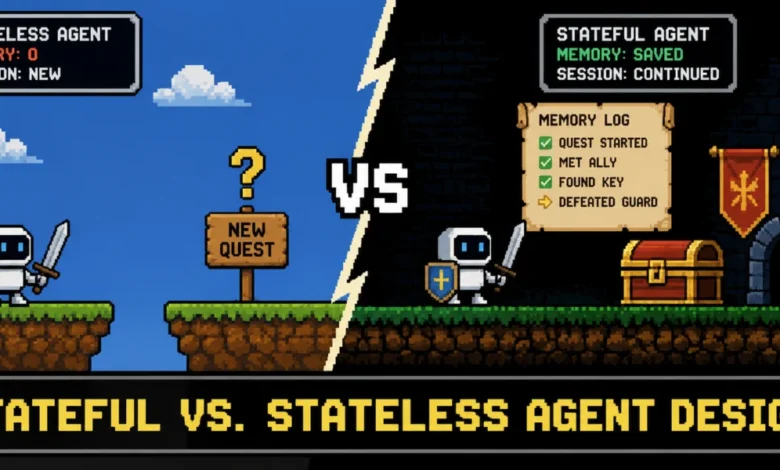
In the context of AI agents, "state" refers to the collective memory of an interaction, including conversation history, context retrieved from external databases, and the intermediate results of tool executions. A stateless agent treats every incoming request as a vacuum-sealed event, possessing no inherent memory of what occurred seconds prior. Conversely, a stateful agent maintains a persistent record of the interaction, allowing for continuity across multiple turns.
The decision of where this memory resides—whether it is passed back and forth by the client or stored on a centralized server—dictates the entire infrastructure roadmap. This choice impacts everything from load balancer configurations to database selection and token management strategies.
Stateless Agents: The Paradigm of Horizontal Scalability
Stateless agents operate on a "fire and forget" principle. When a user sends a prompt, the agent processes the input, generates a response, and immediately clears its local environment. For the agent to understand a multi-turn conversation, the client application (the frontend) must provide the entire historical context with every new request.
Technical Workflow and Implementation
In a stateless implementation using modern APIs, such as the Groq Llama 3.1 8B Instant model, the agent functions as a pure transformation engine. The frontend serves as the "brain" of the operation, appending previous user messages and assistant replies to a growing list of messages.
For instance, using the Llama 3.1 8B model—noted for its efficiency on Groq’s 2026 free tier, which supports up to 14,400 requests per day—a stateless agent relies on the messages array in the API call to provide context. If the client fails to include the history, the agent suffers from immediate amnesia, unable to recall even basic information like the user’s name or the previous topic of discussion.
The Economics of Statelessness
The primary advantage of this model is architectural simplicity. Because no user data is stored on the agent’s server, incoming traffic can be distributed across an infinite number of identical instances. This makes stateless agents ideal for serverless deployments and highly elastic cloud environments.
However, this simplicity comes with a "token tax." As a conversation progresses, the payload sent to the LLM grows exponentially. Since LLM providers charge based on the total number of tokens processed (both input and output), a stateless agent becomes progressively more expensive and slower as the context window fills. This "snowball effect" eventually hits a ceiling where the cost per interaction outweighs the utility of the agent.
Stateful Agents: Persistence and Complex Workflows
Stateful agents shift the burden of memory from the client to the server-side infrastructure. In this model, the client only needs to send the newest prompt along with a unique Session ID. The agent then retrieves the relevant history from a persistent database—such as SQLite for small-scale testing or Redis and PostgreSQL for production—before performing inference.
The Database Layer
A stateful implementation requires a dedicated storage layer. When a request arrives, the agent queries the database using the Session ID, reconstructs the conversation history, processes the new prompt, and then writes the updated history back to the database. This creates a seamless experience for the user, as the agent appears to "remember" them without the client app needing to manage massive JSON payloads.
This design is essential for asynchronous workflows. In scenarios where an agent must pause to wait for a human approval or a long-running external API call, a stateful architecture ensures that the agent can resume exactly where it left off, even if hours or days have passed.
Challenges of Distributed State
While stateful agents offer a superior user experience, they introduce significant complexity to the deployment pipeline. In a horizontally scaled environment, a load balancer might send Turn 1 of a conversation to Server A and Turn 2 to Server B. If the state is stored locally on Server A, Server B will have no record of the previous interaction, leading to "localized amnesia."
To mitigate this, engineers must implement centralized memory caching. Using a high-performance, in-memory data store like Redis allows all agent instances to access a shared state. This ensures consistency but adds a new point of failure and increased latency due to the extra network hops between the agent and the memory store.
Chronology of Agent State Management
The industry’s approach to state has evolved alongside the capabilities of the models themselves:
- 2022 – The Era of Prompting: Early LLM applications were almost exclusively stateless. Users interacted with models via web interfaces that managed the history, but the underlying APIs remained transactionally isolated.
- Early 2023 – The Rise of Orchestration: Tools like LangChain and LlamaIndex introduced "Memory" modules. These initially focused on client-side state management but quickly evolved to support database integrations.
- Late 2023 – Long-Term Context Windows: As context windows expanded to 128k tokens and beyond, the cost of stateless "context stuffing" became a major concern, driving the need for smarter state management and Retrieval-Augmented Generation (RAG).
- 2024 and Beyond – Agentic Workflows: The shift toward agents that use tools and plan multi-step strategies has made stateful design the default for enterprise applications, requiring robust "agent memory" architectures.
Supporting Data: Token Usage and Performance Benchmarks
Data from production deployments reveals the stark contrast in resource utilization between the two designs. In a typical 10-turn conversation using a model like Llama 3.1:
- Stateless Token Consumption: By the 10th turn, the input payload may be 10 to 15 times larger than the first turn. If each turn averages 200 tokens, the 10th call requires processing 2,000 tokens of context just to generate a 50-token response.
- Stateful Efficiency: While the LLM still processes the full context (unless summarization techniques are used), the network bandwidth between the client and the server remains constant. The client only sends the ~200 new tokens, significantly reducing egress costs and improving mobile performance where bandwidth is limited.
- Latency Factors: Stateless agents often face higher "Time to First Token" (TTFT) as the prompt size grows, as the model must pre-fill the KV (Key-Value) cache for the entire history. Stateful systems can utilize KV-caching more effectively on the provider side if the session is pinned to specific hardware, though this is a developing area of LLM infrastructure.
Industry Implications and Expert Analysis
The choice between stateful and stateless design is not merely a technical preference but a strategic business decision.
Privacy and Security:
Stateful agents introduce significant data privacy considerations. Storing conversation history on the server means the provider is now a custodian of potentially sensitive user data, necessitating strict compliance with GDPR, HIPAA, or SOC2 regulations. Stateless agents, by shifting data storage to the client, can sometimes simplify the compliance burden for the service provider.
The "Memory Bottleneck":
Experts suggest that the future of agentic systems lies in a hybrid approach. "Short-term memory" (the current conversation) may be handled through stateful database lookups, while "long-term memory" (historical user preferences) is managed via vector databases and RAG.
Deployment Strategy Recommendations:
For developers building at scale, the following heuristics are emerging:
- Use Stateless for high-volume, low-complexity tasks like sentiment analysis, translation, or single-turn customer support queries where the cost of database management outweighs the token savings.
- Use Stateful for complex personal assistants, coding agents, and multi-step business process automation where context continuity is non-negotiable and the workflow is likely to be interrupted.
Final Outlook
As we move deeper into the era of agentic AI, the "brain" of the agent is increasingly becoming inseparable from its "memory." While stateless designs offer a path of least resistance for initial deployment, the demand for sophisticated, human-like interaction is driving the industry toward a stateful future. The winners in the AI space will be those who can balance the extreme scalability of stateless architectures with the rich, context-aware capabilities of stateful systems, likely through the use of high-performance distributed caching and intelligent context pruning.