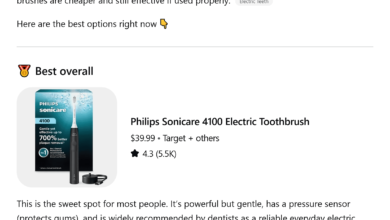
The rapid shift in how users interact with the internet has fundamentally altered the digital marketing landscape. As generative AI models like ChatGPT, Gemini, and Perplexity become the primary interface for information retrieval, businesses are pivoting from traditional Search Engine Optimization (SEO) to Answer Engine Optimization (AEO). While the objective remains the same—capturing user attention—the financial commitment required to dominate AI-generated search results varies dramatically, ranging from a modest $30 monthly subscription for self-service monitoring tools to over $15,000 per month for comprehensive, full-service agency management.
The surge in interest surrounding AEO is a direct response to the decline of the "ten blue links" model of search. Data from 2025 indicates that while AI-driven referral traffic is still in its relative infancy—accounting for less than 2% of total referral traffic—the growth rate of this channel has tripled in a single year. As search behaviors shift toward conversational queries, organizations are grappling with how to allocate budgets to a field where the rules of engagement are still being written.
The Financial Landscape of AEO
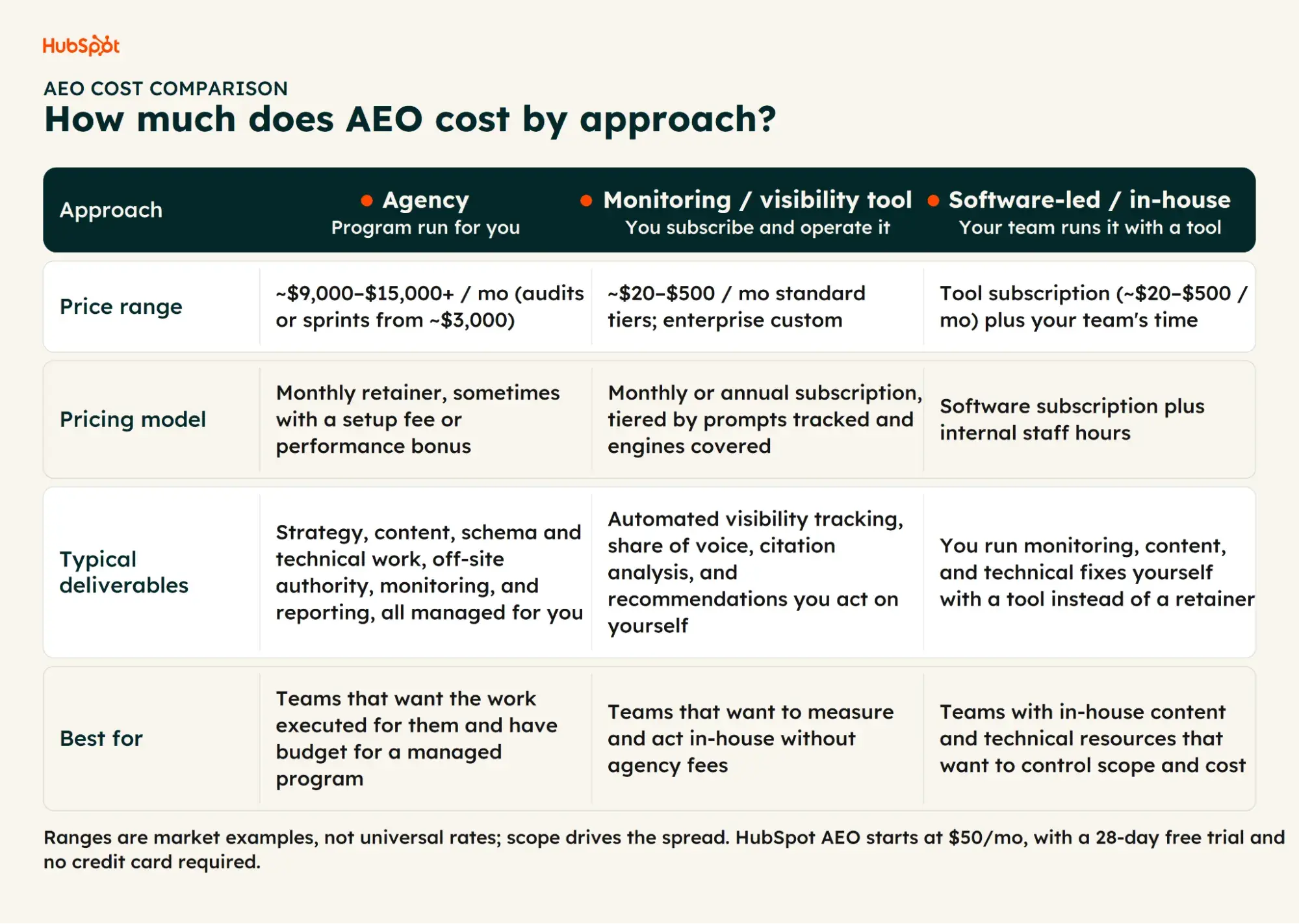
Understanding the cost structure of AEO requires segmenting the market into three distinct tiers: the self-service monitoring model, the software-led internal execution model, and the outsourced agency model. Each tier offers a different level of labor, strategic insight, and technical depth.
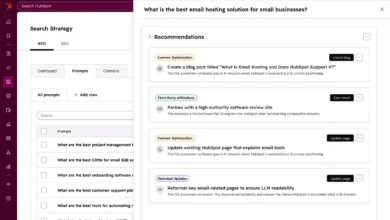
At the base level, organizations can utilize specialized monitoring tools to track brand visibility, share of voice, and citation frequency across various AI platforms. These tools typically range from $29 to $489 per month. For example, HubSpot’s AEO offering is positioned at $50 per month, providing a baseline for brands to track their presence across major engines. These platforms are designed for teams that possess internal technical and content resources but lack the specific data required to measure performance within large language models (LLMs).

The mid-tier approach involves software-led initiatives where a team uses the data provided by monitoring tools to drive internal content and technical changes. In this scenario, the cost is the sum of the software subscription plus the allocated hours of the internal marketing staff. This is often the preferred route for established companies with existing content teams who wish to maintain tight control over their messaging and search strategy.
At the upper echelon, full-service agency programs offer an end-to-end solution. These retainers, which can start around $9,000 and climb to $15,000 or more, include everything from high-level AEO strategy and technical schema implementation to content production and off-site authority building. Agencies in this space, such as RevenueZen, offer "total market" packages that remove the burden of execution from the client entirely.
A Chronology of the AEO Shift
The evolution of AEO is inextricably linked to the rapid advancement of AI search capabilities. Throughout 2024, the industry saw the first wave of "AI search experiments," where early adopters began testing the impact of structured data on how models summarized information. By early 2025, search giants and AI startups formalized the integration of real-time web browsing into their chat interfaces, effectively turning every query into a potential citation opportunity.
By the summer of 2025, the market saw the emergence of dedicated AEO tooling, moving the practice from a speculative art to a measurable science. This period marked a critical inflection point where "monitoring" became the standard unit of measurement. As of early 2026, the focus has shifted toward attribution—connecting the presence of a brand in an AI-generated answer to actual business outcomes like lead generation or direct sales.
Supporting Data and Market Analysis
The wide variance in AEO pricing is not necessarily indicative of predatory practices, but rather a reflection of the scope of work. A critical analysis of the current market suggests that five primary factors drive the pricing of these services:

- Content Volume: The number of topics, articles, and product pages that require optimization for AI-readability.
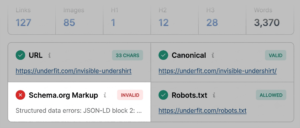
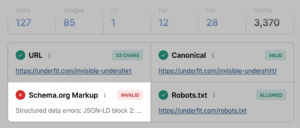
- Technical Complexity: The need for advanced schema markup, entity recognition, and structured data architecture to ensure AI models interpret brand information accurately.
- Off-site Authority: The degree to which an agency must engage in digital PR and link-building to bolster the brand’s credibility in the eyes of LLMs.
- Monitoring Depth: The number of prompts, keywords, and specific AI engines (e.g., Perplexity vs. Gemini) being tracked.
- Reporting and Strategy: The frequency of data analysis and the subsequent adjustment of the marketing roadmap.
Industry experts note that a significant portion of the cost in high-tier agency programs is dedicated to "knowledge graph" optimization. Unlike traditional SEO, where the goal is to rank a link, AEO success depends on providing a factual, concise, and authoritative answer that an AI model can confidently pull into a response. This requires a level of precision in content architecture that exceeds standard blogging practices.
The Intersection of SEO and AEO
One of the most persistent questions for marketing executives is whether AEO should cannibalize existing SEO budgets. The consensus among search professionals is that the two are symbiotic, not mutually exclusive. SEO provides the domain authority and page-level ranking that search engines use as a source of truth for their AI models. Consequently, cutting SEO investment to fund AEO often leads to a degradation of the very foundation that allows an AI to "cite" a brand.
A failure to understand this relationship often leads to common "red flags" in the industry. For instance, if an agency promises "guaranteed AI rankings" without a clear strategy for technical schema or content structure, or if they equate traditional keyword-stuffing with AEO, it is likely a sign of an underdeveloped service offering. A legitimate AEO engagement should focus on the "entity"—the brand or product—and how it is represented within the broader digital knowledge graph.
Establishing an AEO Pilot Program
For organizations looking to enter the AEO space without committing to a long-term, high-cost retainer, a 60-to-90-day pilot program is recommended. This period is sufficient to establish a baseline and observe the impact of minor optimizations.
The pilot should prioritize three distinct pillars:
- Benchmarking: Utilizing tools to establish a baseline for how frequently the brand is cited in response to industry-relevant queries.
- Low-Hanging Fruit: Addressing obvious gaps in technical schema or outdated content that is currently being "misread" by AI models.
- Monitoring Trends: Using the 60-to-90-day window to track not just individual rankings, but the direction of the brand’s visibility trend.
During this pilot, the use of free or low-cost trials is a prudent financial strategy. For instance, leveraging a 28-day trial of a tool like HubSpot AEO allows teams to track up to 25 prompts across major engines without an upfront capital expenditure. This provides the empirical data necessary to secure a larger budget for a full-scale program.
Broader Implications and Future Outlook
As we move deeper into 2026, the cost of AEO is expected to normalize. As more tools reach the market and the methodologies for optimizing for AI become standardized, the "premium" associated with early-stage consulting will likely diminish. However, the labor-intensive nature of content and entity optimization suggests that the high-end tier for managed services will remain a fixture for large enterprises.
The implications for the industry are profound. Businesses that fail to adapt their content strategy for AI consumption risk becoming "invisible" in the new search paradigm. As AI models become more adept at synthesizing information, the brands that win will be those that provide the most accurate, structured, and authoritative data.
Ultimately, the decision to invest in AEO should be driven by the degree to which a brand’s target audience relies on AI search. For B2B firms or highly technical industries where query-based information retrieval is common, the return on investment for a robust AEO program is likely to be substantial. For others, a lean, monitoring-led approach may be sufficient to maintain a presence while the market matures. Regardless of the chosen path, the transition from being "searchable" to being "answerable" is no longer an optional evolution; it is a necessity for the modern digital enterprise.