Popular Markdown Writing App Ulysses Receives Major Update with Siri AI Integration and Customization Features Alongside macOS 27 and iOS 27


Ulysses, the premier plain-text writing and productivity application long favored by authors, journalists, and content creators, has announced a major software update timed alongside the official release of macOS 27 Golden Gate and iOS 27. The comprehensive update brings deep Apple ecosystem integration, headlined by native Siri AI support, alongside a redesigned interface, fully customizable toolbars, new project templates, and expanded organizational capabilities designed to streamline modern digital workflows.
Main Facts and Core Features of the Update
The latest version of Ulysses introduces several key enhancements tailored to leverage the architectural and functional capabilities of Apple’s newest operating systems. Among the most notable additions is the integration of Siri AI. Except for users within the European Union—where regulatory frameworks regarding artificial intelligence deployment differ—users can now invoke Siri AI directly within the application to assist with a variety of writing tasks.

This functionality includes onscreen awareness, allowing the assistant to comprehend context across open sheets and reference materials. A dedicated macOS toolbar button instantly summons the new Siri AI interface, empowering writers to draft new prose, rewrite existing paragraphs, execute comprehensive proofreading, and interact with text via natural language prompts.
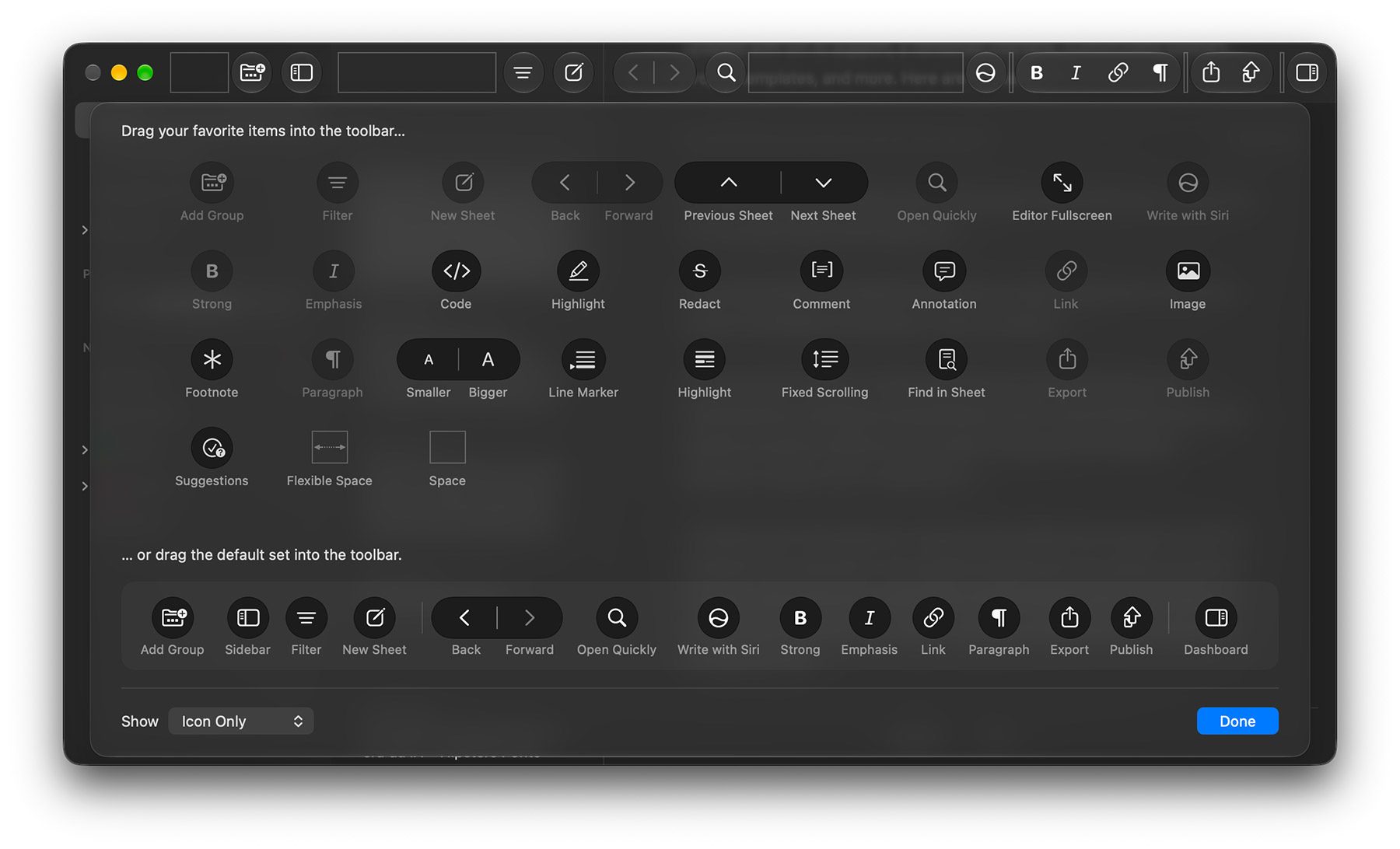
Beyond artificial intelligence integration, the update focuses heavily on user interface customization. For the first time, Ulysses allows users to completely personalize their toolbars. Writers can arrange navigation buttons, structural blocks, whitespace management tools, and contextual suggestions to fit their personal preferences and daily writing habits.
Organizational features have also been refined. The application now incorporates a modern set of group icons featuring requested pictograms, enhancing visual categorization in the sidebar. Additionally, accessibility improvements have been implemented, specifically targeting filter conditions and group icon editing to ensure a smoother experience for users relying on assistive technologies.
Finally, the introduction of project templates addresses a longstanding request from power users. When initializing a new writing project within Ulysses, users can now select from a variety of pre-configured templates that populate the project with placeholder groups and empty sheets, significantly reducing setup time for structured long-form writing endeavors.
Background Context and Evolution of Ulysses
To understand the significance of this update, one must examine the trajectory of Ulysses within the productivity software market. First introduced over a decade ago, Ulysses carved out a distinct niche by offering a distraction-free writing environment built around a robust Markdown parser. While text editors have proliferated across macOS, iPadOS, and iOS, Ulysses maintained a loyal subscriber base by balancing minimalist design with powerful hierarchical document management.
Over the past ten years, the application has systematically adapted to major shifts in Apple’s software ecosystem. From the transition to Apple Silicon processors to the adoption of modern iPad multitasking features and iCloud synchronization architectures, the development team has consistently aligned software updates with the release cadence of major macOS and iOS iterations. The synchronization of this latest update with macOS 27 and iOS 27 underscores the developers’ commitment to maintaining day-one compatibility with Apple’s platform advancements.

Chronology of the Release Cycle
The rollout of the new Ulysses update follows a well-established software release timeline customary for major productivity applications within the Apple ecosystem:
- Early September 2026: Apple issues the Golden Gate build of macOS 27 and finalizes the release candidate builds for iOS 27, signaling to third-party developers that platform APIs are finalized.
- Mid-September 2026: The Ulysses development team finalizes testing for their operating system update, ensuring seamless integration with new system frameworks, including Apple’s updated intelligence and interface guidelines.
- Release Day: Ulysses officially pushes the update live to the Mac App Store and App Store, concurrent with the broader public availability of macOS 27 and iOS 27. Simultaneously, availability is confirmed across alternative software distribution platforms such as Setapp.
Technical Implications and Ecosystem Analysis
The integration of Siri AI into a specialized, text-centric application like Ulysses reflects a broader industry trend: the normalization of embedded artificial intelligence within professional software. Rather than forcing users to context-switch between dedicated AI chatbots and their primary workspace, tools are increasingly bringing intelligence directly to the point of creation.
By incorporating onscreen awareness and specialized writing actions, Ulysses positions Siri AI not as a novelty, but as a functional co-pilot for drafting, editing, and structural revision. However, the exclusion of EU users highlights the ongoing compliance challenges software developers face regarding regional AI regulations, demonstrating how international legal landscapes directly impact feature parity in global software rollouts.

Furthermore, the introduction of customizable toolbars and project templates signals a maturation in how developers approach user personalization. While minimalism remains a core tenet of the Ulysses brand, the application recognizes that different writing workflows—ranging from academic research to rapid-fire journalism—demand flexible workspace configurations. Allowing users to tailor their interface without cluttering the core writing canvas preserves the distraction-free ethos that has defined the app for over a decade.
Broader Market Impact and Availability
Ulysses continues to operate on a subscription model, with availability spanning the native Apple App Stores for Mac, iPad, and iPhone, as well as inclusion in the Setapp subscription service. As users upgrade their hardware and software to macOS 27 and iOS 27, the availability of a fully optimized writing suite serves as a vital component of the broader platform transition.
The update demonstrates that established productivity tools must continually evolve—incorporating artificial intelligence, advanced customization, and ecosystem-specific features—to retain user loyalty in an increasingly competitive market. For the millions of writers who rely on Markdown-based workflows, the latest iteration of Ulysses bridges the gap between traditional minimalist text editing and the demands of modern, AI-assisted content creation.
Related posts: