
A federal judge has issued a significant ruling in the realm of First Amendment jurisprudence, granting a preliminary injunction that prevents Immigration and Customs Enforcement (ICE) from pursuing legal action against a private citizen for sending a highly critical, emotionally charged email to a federal official. The decision by U.S. District Judge Rudolph Contreras underscores the high threshold required for government entities to classify political speech as a "true threat" of violence, reaffirming that the expression of moral outrage toward government conduct remains protected under the U.S. Constitution.
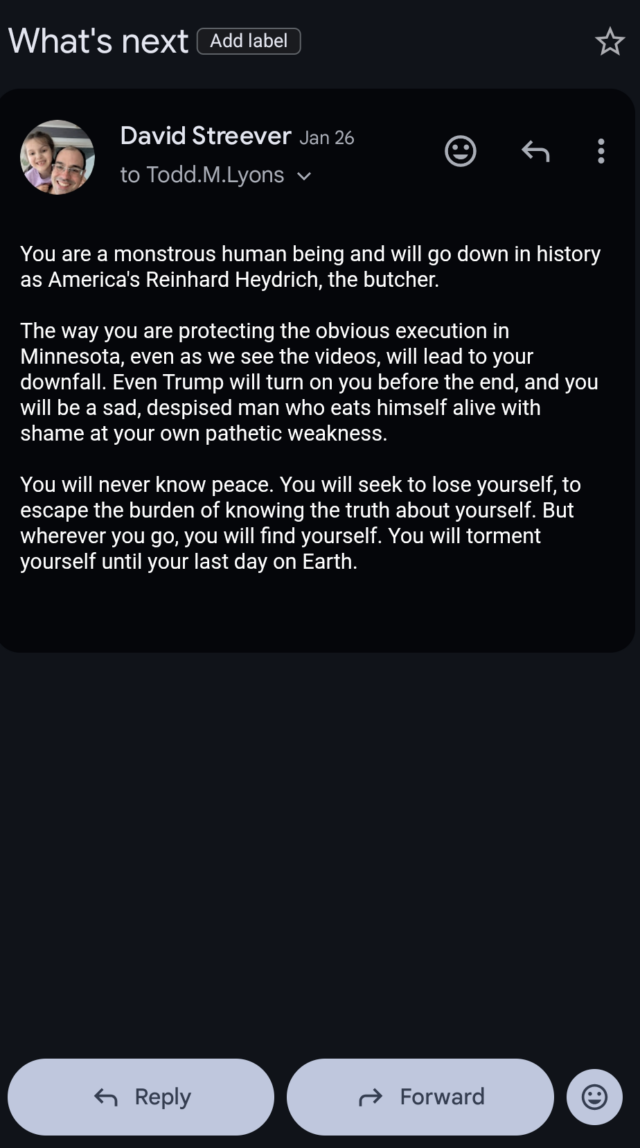
The legal battle stems from an incident in January involving David Streever, who sent a three-paragraph message to Todd Lyons, then the acting director of ICE. The email was prompted by the deaths of two Minnesota protesters, Renee Good and Alex Pretti, who were killed during demonstrations against the agency. Streever’s correspondence was scathing, characterizing Lyons as a "monstrous human being" and drawing historical comparisons to Reinhard Heydrich, a high-ranking Nazi official often associated with the Holocaust. Streever’s message suggested that Lyons would eventually be forced to reckon with the moral weight of his actions, predicting that the official would "eat himself alive with shame."
A Chronology of the Conflict
The timeline of the case reveals a concerning disconnect between the receipt of the email and the government’s subsequent reaction. For five months following the delivery of the message in January, ICE took no discernible action. However, the situation escalated dramatically later in the year when federal agents appeared at Streever’s residence to serve a formal warning notice. This document claimed that the email constituted a potential criminal threat of violence, a designation typically reserved for communications involving credible plans to kidnap, assault, or murder public officials.
When agents failed to find Streever at home, they escalated their search, eventually locating him at a hotel. This encounter, described by legal counsel from the Foundation for Individual Rights and Expression (FIRE) as "deeply alarming," left Streever in a state of self-censorship, as he feared further government retaliation. It was not until the subsequent legal challenge that the internal mechanics of the investigation were scrutinized by the federal court.

Judge Contreras’s opinion revealed that while ICE internally claimed to have closed the investigation within a month of receiving the email, they failed to communicate this closure to Streever. Instead, a series of contradictory statements—including a post on the platform X from an official Department of Homeland Security (DHS) account—led Streever to reasonably believe that he remained the target of a federal probe.
The Threshold of Protected Speech
The core of the legal dispute centered on whether Streever’s language crossed the line from protected political hyperbole into the realm of "true threats." Under Supreme Court precedent, true threats are not protected by the First Amendment; however, the government bears a heavy burden in proving that a statement constitutes a serious expression of an intent to commit an act of unlawful violence.
Judge Contreras found that the government’s reliance on the email as a justification for a criminal warning was insufficient. In his ruling, the judge noted that Streever’s email, while undoubtedly unkind and aggressive in tone, was fundamentally a piece of political speech. He wrote: "Streever’s email addressed salient political decisions to a government official, an arena where the First Amendment’s speech protections reach their zenith." The judge further clarified that the content of the email—predicting the official’s future moral crisis and comparing his conduct to historical figures—did not contain a specific or imminent threat of physical harm.
Supporting Data and Institutional Context
The government’s defense during the litigation highlighted a broader climate of tension surrounding immigration enforcement. ICE officials pointed to a reported 946 percent increase in threats directed toward agency personnel between 2024 and 2025. This statistic was offered as evidence that the agency was operating under heightened security protocols, necessitating a more proactive stance against any communications that could be construed as menacing.
However, the court remained skeptical of this justification as a blanket rationale for chilling political discourse. While acknowledging the agency’s responsibility to protect its staff, Judge Contreras argued that the necessity of protecting law enforcement does not grant the government a license to infringe upon the constitutional rights of critics. The ruling serves as a check on the agency’s tendency to equate moral condemnation with physical danger, reminding federal entities that the government must maintain a clear distinction between the two.
Official Responses and the Stance of the Parties
Throughout the legal proceedings, ICE maintained that its actions were intended to protect the integrity of its operations and the safety of its staff. The agency argued that the email possessed "threatening undertones" that necessitated a formal response. However, when pressed by the court, ICE’s legal representatives conceded that they did not challenge the assertion that the email was protected expression. This concession was a pivotal moment in the case, effectively undermining the agency’s justification for the warning notice.
The Foundation for Individual Rights and Expression (FIRE), which represented Streever, has hailed the ruling as a victory for the First Amendment. Adam Steinbaugh, a senior attorney at FIRE, emphasized that the use of "ominous letters" to threaten citizens with prison time for expressing dissent is an impermissible tool of government coercion. The organization has maintained that the court’s decision provides a robust shield for individuals who engage in sharp, even offensive, criticism of government officials.
Broader Implications for Political Discourse
The case of David Streever carries significant implications for the future of political dissent in the United States. As the nation remains polarized over immigration policy, the role of government agencies in monitoring, cataloging, and responding to public feedback has come under increased scrutiny. This ruling establishes a vital precedent: the government cannot use the machinery of the criminal justice system to silence those who express profound moral opposition to agency policies.
Furthermore, the injunction issued by Judge Contreras provides immediate relief to Streever, prohibiting ICE from enforcing the warning notice or taking further action based on the initial complaint. While the injunction does not insulate Streever from all future investigations, it forces the government to operate within the strict confines of constitutional law when evaluating public criticism.
The case also highlights the chilling effect that government surveillance and intimidation can have on the democratic process. When a citizen is forced to explain to their family that they might be detained for an email, the resulting psychological and social cost is immense. Streever’s public comments following the ruling reflected this sentiment: "I cherish our right to speak openly about issues of public concern. I hope others will not be discouraged from peacefully expressing their views, even when those views are critical of the government."

Looking Ahead
As the litigation proceeds toward a final resolution, the focus will likely shift to whether the government’s actions constituted illegal retaliation. The court has already indicated that Streever is likely to succeed in proving that the agency’s conduct was an attempt to coerce him into abandoning his First Amendment rights.
The lack of an immediate appeal from the government suggests that the agency may be reassessing its strategy regarding the management of public criticism. If the injunction holds—and legal experts suggest the court’s analysis is soundly rooted in established constitutional law—it will serve as a permanent reminder that the First Amendment protects the right to speak one’s conscience, particularly when that conscience is directed at those in power.
For now, the ruling stands as a testament to the resilience of the U.S. judicial system in the face of executive overreach. By prioritizing the protection of free speech over the agency’s desire to sanitize its inbox of critical feedback, Judge Contreras has reaffirmed that in a democracy, the government must be able to withstand the heat of public discourse, no matter how uncomfortable that discourse may be. The case serves as a critical touchstone for future litigation involving the boundaries of the First Amendment in an increasingly digitized and high-stakes political environment.