The Light Is Red Owen: How a Tragic E-Bike Accident Sparked a Dark Viral Meme Trend and Online Backlash

The rapid evolution of internet culture has frequently blurred the line between tragedy and dark humor, presenting profound challenges regarding empathy, digital ethics, and community standards on social media. A stark example of this phenomenon emerged in mid-September 2026, when the tragic death of 14-year-old Utah resident Owen Harris became the subject of a widespread, controversial meme trend across platforms such as TikTok, Instagram Reels, and X (formerly Twitter). Colloquially known as "The Light Is Red Owen," the trend centers on dark comedic interpretations of the fatal traffic collision that claimed the young teenager’s life. While the viral content quickly amassed millions of views through chaotic visual formats reminiscent of distracted driving tropes, it simultaneously triggered a massive wave of online condemnation, reigniting urgent discussions concerning the psychological impacts of viral insensitivity, the anonymity of digital spaces, and the ethical boundaries of modern internet humor.
Main Facts of the Incident
The underlying event that catalyzed this digital phenomenon occurred on Saturday, September 12, 2026, in the state of Utah. Owen Harris, a 14-year-old local resident, was operating an electric bicycle (e-bike) within a residential or commercial municipality. According to initial preliminary reports released by local law enforcement and regional news outlets, Harris entered an active intersection while operating the e-bike and allegedly ran a red traffic signal.
Simultaneously, a motor vehicle traveling through the intersection struck the young cyclist. Due to the high impact of the collision and the vulnerability of operating an e-bike without vehicular structural protection, Harris sustained critical injuries. Emergency responders arrived promptly at the scene, administering life-saving measures before transporting him to a medical facility. Despite the efforts of emergency medical personnel, Harris succumbed to his injuries.
News of the fatal accident circulated through local news channels within days, drawing standard expressions of community grief. However, the tragedy took an unanticipated and disturbing turn when algorithmic content creation ecosystems on short-form video platforms intercepted the details of the crash. Within 72 hours of the accident being publicly reported, the specific circumstance of running a red light was abstracted, weaponized, and reframed into an internet meme format.
Chronology of the Viral Trend
The digital trajectory of "The Light Is Red Owen" offers a sobering look at how quickly localized tragedies can transform into global internet phenomena.
The timeline began on September 12, 2026, with the fatal collision itself. For the subsequent 48 hours, news of the accident remained contained within traditional regional reporting channels and local community groups. However, on September 15, national aggregators and wider social media circles began picking up the story, highlighting the involvement of an e-bike and the specific detail regarding the traffic signal violation.
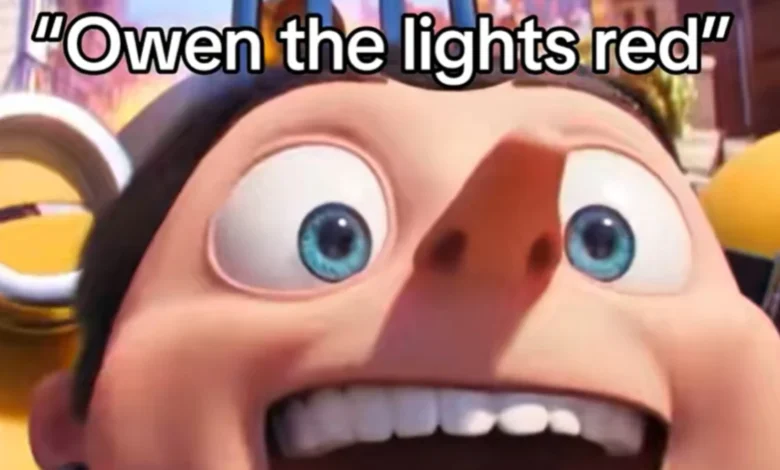
The inflection point occurred on September 16, 2026. A TikTok creator operating under the handle @zephra.posts published a short-form video utilizing a chaotic visual sequence from the animated film Despicable Me, featuring characters Gru and the Minions rocketing away in a high-speed vehicle. The video was explicitly captioned with the phrase "Owen the light’s red," drawing a direct, mocking parallel to the final moments of Harris’s life. The algorithm immediately favored the engagement-baiting nature of the post. Within 48 hours of publication, the video surpassed 3.3 million views, normalizing the premise and pushing the phrase into trending recommendations.
As the week progressed, the trend metastasized. On September 17, 2026, another TikTok user, @skrozn, uploaded a derivative meme incorporating high-speed, fiery footage from the Ghost Rider film franchise, accumulating over 149,000 views within a single day. Simultaneously, the trend expanded across platforms; Instagram user xkenshutsu published a parallel meme leveraging a classic, widely recognized clip of SpongeBob SquarePants driving erratically and ignoring roadway hazards.
By September 17, dozens of independent accounts were utilizing variations of phrases such as "Yo Owen the light is red" overlaid onto frantic driving media, drawing comparisons to older internet formats like the "SpongeBob Driving Crazy" and "Beast Boy driving crazy" tropes.
Backlash and Counter-Narratives
Almost concurrently with the rapid ascent of the meme trend, a significant and vocal counter-movement materialized across the same digital ecosystems. Users disturbed by the casual cruelty of the trend began publishing critical commentary, demanding that platforms moderate and remove the exploitative content.
On September 17, 2026, TikToker @hoopervalley8 posted a video directly addressing the virality of the incident. The creator condemned the participants in the trend, emphasizing the harsh reality that a minor had lost his life and noting the compounding cruelty of mocking an individual who was not a public figure and had no way to consent to or defend against the digital mockery. This critical video resonated deeply, securing over 1.2 million views in 24 hours and sparking comment sections filled with expressions of disgust toward the meme creators.
Additional creators, such as @justvibin_4life, published dedicated commentary highlighting the vulnerability of children and teenagers navigating modern transportation infrastructure, particularly the burgeoning prevalence of e-bikes in suburban and urban environments. These commentators argued that turning a young person’s fatal miscalculation into a recurring punchline represented a profound moral failure within youth-dominated internet culture.
Contextualizing the Rise of E-Bike Infrastructure and Safety
Beyond the socio-cultural implications of the meme, the tragic accident that inspired "The Light Is Red Owen" highlights a broader, urgent municipal and public safety concern: the exponential rise of electric bicycles among teenagers and the accompanying infrastructure challenges.
In recent years, e-bikes have transformed youth mobility across the United States, offering an affordable, accessible, and fast mode of independent transportation for adolescents who have not yet reached driving age. However, this shift has outpaced traditional safety education and municipal traffic enforcement. E-bikes are capable of achieving speeds significantly higher than traditional bicycles, often blending the vulnerabilities of a pedestrian with the kinetic energy and velocity of a motorized vehicle.
Traffic safety experts note that intersections present the highest point of risk for micromobility users. Adolescents, whose neurological development regarding risk assessment and impulse control is still maturing, frequently struggle with calculating the stopping distances, speeds, and traffic signals required to safely navigate complex intersections alongside heavy motor vehicles. While the internet focused its collective attention on the dark comedy of the red-light violation, safety advocates emphasized that the underlying incident speaks to a critical need for enhanced infrastructure—such as protected bike lanes and clearer signal timing—as well as mandatory safety education for young riders utilizing high-powered electric transport.
Socio-Psychological Analysis of Dark Internet Humor
The emergence of "The Light Is Red Owen" falls into a long, troubling lineage of modern dark humor characterized by the immediate trivialization of real-world tragedies. Media studies scholars and digital sociologists point to several mechanisms that explain why users participate in such trends.
First, the psychological phenomenon of emotional detachment in digital spaces allows young content creators to view real-world events through a purely hyper-mediated lens. To many terminally online users, global platforms function as a continuous stream of fiction, where real people cease to be human beings with grieving families and instead become abstract characters in an ongoing, surreal digital narrative.
Second, the algorithmic reward system of platforms like TikTok and Instagram Reels incentivizes shock value and rapid engagement. Because the algorithm rewards watch-time, shares, and comment-section debates—even arguments fueled by outrage—creators are financially and socially incentivized to push ethical boundaries further with each iteration of a trend. The speed at which a localized tragedy can be stripped of its humanity and repurposed for comedic value underscores the systemic flaws inherent in attention-economy business models.
Broader Implications for Digital Ethics and Platform Governance
The trajectory of the Owen Harris meme trend serves as a profound stress test for contemporary content moderation and digital ethics. As short-form video platforms continue to dominate the information landscape, the capacity for decentralized mobs of users to coordinate, amplify, and monetize insensitivity toward private citizens remains largely unchecked by automated moderation filters.
Traditional media policies generally protect public figures from harassment, but private citizens—particularly minors who become involuntary subjects of viral spectacles—frequently fall into regulatory gray areas. When tragedies involving children are converted into gamified punchlines, it forces a critical evaluation of platform responsibility. Critics argue that tech companies must implement more agile, human-in-the-loop moderation strategies capable of identifying and suppressing exploitative content before it achieves irreversible viral velocity.
Furthermore, the incident leaves a lasting emotional footprint on the victim’s family and local community, who are forced to navigate the agonizing reality of private grief being publicly trivialized on a global scale. While the initial wave of viral memes eventually subsides as algorithmic attention shifts to the next digital novelty, the legacy of "The Light Is Red Owen" remains a stark reminder of the dark underbelly of internet culture—a space where the line between tragedy and entertainment is continually eroded in the relentless pursuit of online visibility.