The Lifecycle of LLM Data Degradation
In the standard development lifecycle of a large language model, developers begin by curating a high-quality dataset, converting text into numerical vector embeddings, and storing these in specialized vector databases. This baseline serves as the "source of truth." However, production environments are rarely static. User behavior, emerging industry terminology, and shifts in global sentiment can cause the incoming data distribution to evolve.
Historically, machine learning engineers relied on monitoring metrics such as Population Stability Index (PSI) or Kolmogorov-Smirnov (K-S) tests for tabular data. These statistical methods, however, are ill-equipped to handle the high-dimensional, dense vector spaces typical of modern LLMs, where embeddings may span 384, 768, or even 1,536 dimensions. As these dimensions increase, the "curse of dimensionality" renders traditional univariate drift detection ineffective, often masking significant shifts in the underlying semantic meaning of the data.
Chronology of Detection Methodology
The industry has moved through several phases of drift detection, starting from simple manual audits to the current state of automated, model-based monitoring. In the early stages of the generative AI boom, teams primarily relied on human-in-the-loop evaluation, which proved unscalable. By 2024, the focus shifted toward "domain classification," a method where a secondary, lightweight machine learning model is trained to distinguish between baseline data and live production traffic.
The logic is straightforward: if a classifier can easily differentiate between historical data and new production data, the production data has drifted significantly. If the classifier struggles to tell them apart, the distribution remains stable. This binary classification approach, typically utilizing Random Forest or Gradient Boosting architectures, provides a robust metric for drift—the Area Under the Receiver Operating Characteristic Curve (ROC-AUC). An ROC-AUC score of 0.5 suggests the models are indistinguishable (no drift), while a score approaching 1.0 indicates that the production data has shifted into a distinct, potentially problematic, new distribution.
Technical Implementation: A Dual-Approach Framework
To implement effective monitoring, developers often integrate tools like Scikit-LLM, which acts as a bridge between high-level LLM providers and the scikit-learn ecosystem. The core requirement for any drift detection pipeline is the generation of consistent embeddings.
The Domain Classifier Method
The model-based approach requires maintaining a reference set of embeddings. When a new batch of production data arrives, the system constructs a labeled dataset: assigning a "0" to baseline embeddings and a "1" to production embeddings. A lightweight classifier, such as a Random Forest, is then trained on this mixed set.
from sklearn.ensemble import RandomForestClassifier
from sklearn.model_selection import train_test_split
from sklearn.metrics import roc_auc_score
import numpy as np

# Establishing the baseline and production vectors
n_samples = 500
n_features = 384
X_reference = np.random.normal(loc=0.0, scale=1.0, size=(n_samples, n_features))
X_production = np.random.normal(loc=0.3, scale=1.0, size=(n_samples, n_features))

# Preparing for classification
y_reference = np.zeros(n_samples)
y_production = np.ones(n_samples)
X_combined = np.vstack((X_reference, X_production))
y_combined = np.hstack((y_reference, y_production))

# Splitting and training the detector
X_train, X_test, y_train, y_test = train_test_split(X_combined, y_combined, test_size=0.3)
drift_classifier = RandomForestClassifier(n_estimators=50, max_depth=5).fit(X_train, y_train)

# Evaluation
y_pred_proba = drift_classifier.predict_proba(X_test)[:, 1]
roc_auc = roc_auc_score(y_test, y_pred_proba)
If the ROC-AUC exceeds a predetermined threshold—commonly set at 0.65—the system triggers an automated alert, signaling that the data has drifted sufficiently to warrant a review of the model’s context or a potential update to the vector database.
The Centroid (Center of Mass) Method
For resource-constrained environments, the centroid method offers a lower-latency alternative. By calculating the mean vector of the reference data and the mean vector of the production data, one can measure the "distance" between the two points. Using cosine distance—the standard metric for comparing vectors—the system determines if the "center of mass" of the incoming data has migrated. While this approach is computationally efficient, it is less sensitive to structural changes within the data distribution, such as multi-modal shifts, where the mean remains the same despite a change in the variance or shape of the data.
Implications and Industry Best Practices
The implications of failing to monitor embedding drift are severe. In a Retrieval-Augmented Generation (RAG) pipeline, for instance, embedding drift leads to poor document retrieval. If the user’s queries shift from technical support to new product features not covered in the original index, the LLM will hallucinate or provide irrelevant answers, directly impacting customer satisfaction and operational efficiency.
Industry experts suggest a "layered" monitoring approach. Organizations should not rely solely on one metric. Instead, they should combine:
- Statistical Drift Detection: Monitoring input distribution shifts.
- Performance Monitoring: Tracking the actual accuracy of LLM outputs.
- Feedback Loops: Utilizing human or model-based feedback (e.g., thumbs up/down) to validate if the drift is actually causing user-perceived performance drops.
Addressing the "Drift" Reality with Scikit-LLM
Recent integrations, such as using Groq’s high-speed inference endpoints via Scikit-LLM, have made it possible to perform these checks in near real-time. By utilizing lightweight local embedding models like all-MiniLM-L6-v2 in conjunction with Scikit-LLM, developers can perform drift detection on live traffic without incurring prohibitive latency.
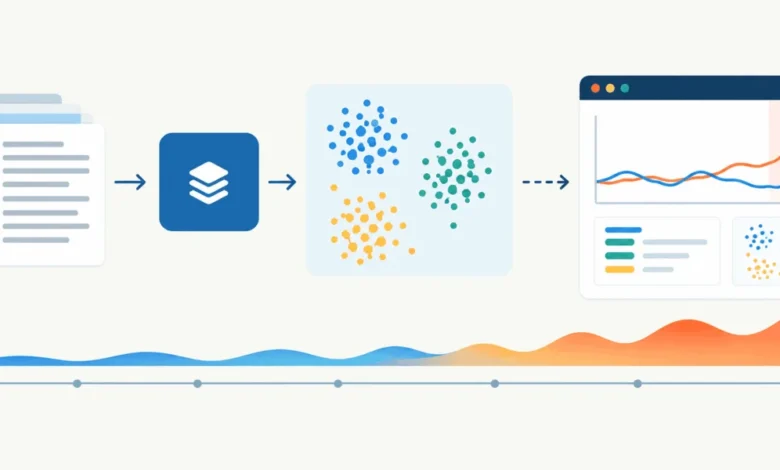
When applied to real-world scenarios—such as a shift from routine billing inquiries to complex, high-velocity cryptocurrency market queries—the difference in embedding space becomes clear. Even when using optimized models, the cosine distance between these two distinct semantic clusters is substantial enough to trigger alerts. This provides a clear, actionable signal: when the language of the user base changes, the supporting AI infrastructure must adapt.
Future Directions for Autonomous Monitoring
The current state of drift detection is largely reactive, triggering alerts that require human intervention. However, the trajectory of the field suggests a move toward "self-healing" pipelines. Future systems will likely not only detect drift but automatically trigger a re-embedding of relevant documents, fine-tune the model on the new data, or adjust the retrieval logic to accommodate the shift.
For the present, however, the establishment of a robust monitoring framework remains the most critical step for companies moving LLMs from the laboratory to the enterprise. By implementing domain classifiers and centroid monitoring, organizations can gain visibility into the silent, shifting tides of their production data, ensuring that their models remain as relevant and accurate on day 1,000 as they were on day one. Through the integration of standardized libraries like Scikit-LLM and rigorous statistical oversight, the unpredictability of user behavior can be transformed from a risk into a manageable, measurable variable in the AI production lifecycle.