Bridging the Accessibility Gap: How AudioEye Combines AI and Human Expertise to Transform the Digital Landscape

In the modern digital economy, the internet serves as the primary gateway to commerce, healthcare, education, and social interaction. Yet, for an estimated 1.3 billion people globally living with disabilities, the web remains fraught with invisible barriers. As legal requirements tighten worldwide and businesses increasingly recognize the commercial cost of exclusion, digital accessibility has evolved from a peripheral compliance checkbox into a critical pillar of corporate strategy. At the forefront of this transformation is AudioEye, a digital accessibility platform that leverages a hybrid model of artificial intelligence and human expertise to help organizations ensure their digital properties are usable for everyone.
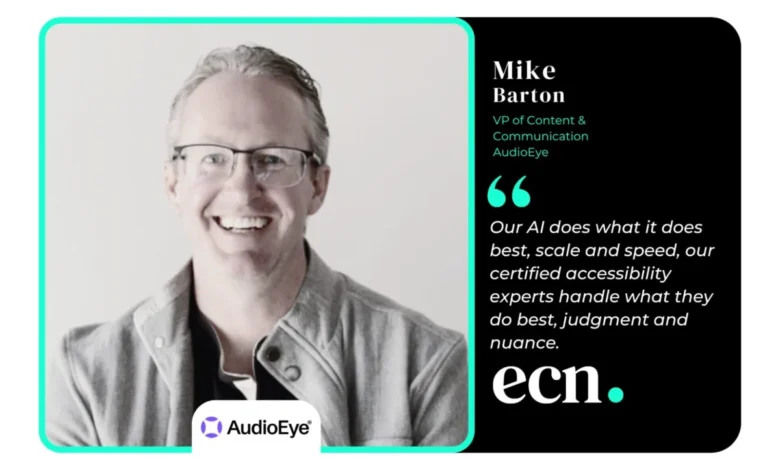
To understand the current state of digital accessibility and the technology driving its evolution, Mike Barton, Vice President of Content Marketing and Communications at AudioEye, outlines the company’s mission, the broader regulatory shifts transforming the market, and the intersection of artificial intelligence and web usability.
The Mission and Vision for an Open Web
Founded over a decade ago, AudioEye was built on a foundational premise: every individual should have equal access to the web. Today, the platform is trusted by more than 127,000 organizations, ranging from small local enterprises to massive multinational corporations, to maintain inclusive digital experiences.
According to Barton, AudioEye’s corporate mission focuses on delivering the strongest and most cost-effective accessibility protection in the industry. However, the company’s long-term vision looks past mere compliance.
"Our vision is bigger: a digital world where accessibility isn’t an afterthought or a legal scramble, but the default," Barton explains. "That’s the bar we hold ourselves to, and it’s why we keep investing in better detection, faster fixes, and stronger legal protection for our customers."
The Evolution of Digital Accessibility: From Niche Concern to Mainstream Imperative
When AudioEye first entered the market nearly two decades ago, digital accessibility was largely viewed as a niche concern. The vast majority of companies either treated it as an optional task or ignored it entirely, operating under the assumption that standard web design inherently served all users.
Over the past ten years, however, the landscape has fundamentally shifted. The convergence of rising legal actions, sweeping international regulations, and rapid technological advancements has elevated accessibility to a high-stakes corporate priority. Data indicates that accessibility-related lawsuits have doubled over the past five years, creating substantial financial and reputational risks for non-compliant organizations. Simultaneously, regulatory frameworks have expanded across borders. The implementation of the European Accessibility Act (EAA), for instance, has extended stringent accessibility mandates to any business serving European Union customers, regardless of where the company is physically headquartered.
Concurrently, artificial intelligence is reshaping how websites are constructed and discovered, creating both new challenges and new solutions for web developers. This dynamic environment has forced businesses to abandon passive approaches to web inclusion in favor of active, ongoing remediation strategies.
Defining Digital Accessibility and Its Business Implications
Digital accessibility refers to the intentional design and engineering of websites, mobile applications, and digital content so that individuals with disabilities can navigate and interact with them seamlessly. This includes individuals with visual, auditory, physical, and cognitive impairments who frequently rely on assistive technologies, such as screen readers, voice recognition software, and keyboard-only navigation.
Beyond the ethical imperative of digital inclusion, ignoring accessibility carries profound economic consequences. Globally, people with disabilities represent an estimated $18 trillion in purchasing power. Research shows that approximately 70% of consumers with disabilities will immediately abandon a website if they encounter barriers, frequently taking their business to competitors whose platforms are fully accessible.
Furthermore, the legal landscape has grown increasingly hostile toward non-compliant entities. In the United States, ADA-related digital lawsuits have surged significantly since 2020. Companies that treat accessibility merely as a static compliance checkbox are increasingly finding themselves vulnerable to demand letters, settlements, and costly litigation. Conversely, forward-thinking organizations that treat accessibility as a baseline business standard—or even a growth engine—are capturing underserved market segments and fortifying their brand reputations.
The Hybrid Approach: Scaling Automation with Human Judgment
As the volume of digital content continues to multiply, relying exclusively on manual audits or fully automated software has proven insufficient. AudioEye addresses this challenge through a hybrid model that pairs artificial intelligence with certified human expertise.
In practice, the AudioEye platform integrates via a single line of JavaScript embedded within a website’s code, operating similarly to a consent banner or live chat widget. Once active, proprietary AI scans the rendered pages against the Web Content Accessibility Guidelines (WCAG), which serve as the international benchmark for digital accessibility. Independent studies indicate that advanced AI scanning tools can detect up to 2.5 times more technical issues than traditional automated testing software. Approximately half of these identified barriers are resolved automatically and in real time.
However, technology alone cannot resolve every accessibility hurdle. Nuanced barriers—such as the contextual intent of a button, the reading order of a complex data table, or the user experience of navigating a multimedia carousel—frequently require human intuition and lived experience. To bridge this gap, AudioEye employs certified accessibility specialists, including individuals with disabilities, to conduct rigorous manual audits. These experts uncover issues invisible to algorithms, writing and deploying custom code fixes directly through the platform.
"Software finds the patterns. Experts find what hides between them. Together, they make accessibility actually work," Barton notes. This dual-layered strategy results in approximately 97 percent of accessibility issues being resolved before an organization’s internal development team needs to intervene.
Industry-Specific Vulnerabilities and Regulatory Compliance
While digital accessibility is a universal obligation for any organization with an online presence, certain sectors face heightened regulatory scrutiny and legal exposure.
E-commerce remains the primary target for digital accessibility litigation, accounting for approximately 78 percent of all web-related lawsuits. Online retailers face immediate financial losses when customers cannot complete transactions due to broken form fields, missing alternative text on product images, or unlabelled checkout buttons. Beyond retail, highly regulated industries such as healthcare, financial services, and government agencies carry substantial legal and regulatory exposure due to their public-service mandates.
To help businesses navigate these complex compliance frameworks, AudioEye focuses on making adherence a natural byproduct of thorough remediation rather than the temporary goal of a one-time audit. By combining automated detection with expert-led code deployment, the platform ensures continuous coverage across WCAG Success Criteria.
When organizations face legal challenges, AudioEye provides forensic validation, expert reports, and direct collaboration with legal counsel. The company differentiates itself in the market by offering robust legal protection structures designed to mitigate the financial risks associated with demand letters and compliance claims.
The Emerging Intersection of Accessibility and AI Discovery
Looking toward the future, the digital accessibility landscape is poised for further disruption driven by global regulatory expansion and the rapid advancement of artificial intelligence.
The implementation of the European Accessibility Act has fundamentally altered compliance maps for multinational corporations, making cross-border accessibility a permanent fixture of international trade. At the same time, AI is transforming the web from both directions. While AI-powered automation enhances the speed and scale at which accessibility platforms can detect and remediate errors, general-purpose AI coding tools are simultaneously generating millions of inaccessible web pages at unprecedented rates, trained on a legacy internet that was never built inclusively.
Moreover, the rise of AI-driven search agents and autonomous web navigators is creating a new paradigm for digital discovery. These automated agents rely heavily on a website’s accessibility tree—the structured underlying data that describes page elements—to interpret content, answer user queries, and complete online transactions on behalf of consumers.
"Accessibility and AI discovery are going to be the same conversation in a few years," Barton predicts. As autonomous agents become the primary front door for internet navigation, non-accessible websites risk becoming entirely invisible to next-generation search technologies.
Ultimately, the future of the internet hinges on universal usability. As AudioEye and similar industry stakeholders continue to refine the tools bridging automation and human empathy, the objective remains clear: building a digital ecosystem that functions effortlessly for every user, regardless of ability.
Related posts: