The Evolution of the Inference Bottleneck
The demand for LLM inference has surged by over 400% annually, according to recent industry analytics. This growth is driven by the integration of generative AI into high-traffic customer support portals, real-time coding assistants, and complex RAG (Retrieval-Augmented Generation) pipelines. Historically, developers focused on training efficiency, but as of 2024, the industry consensus has shifted toward inference optimization.
Inference is fundamentally different from traditional software execution. It is characterized by high memory bandwidth requirements and an "autoregressive" nature—each generated token depends on the preceding ones. This creates a computational bottleneck where the hardware often spends more time waiting for memory to move data than performing mathematical operations.
Diagnosing the Workload: A Six-Step Diagnostic Framework
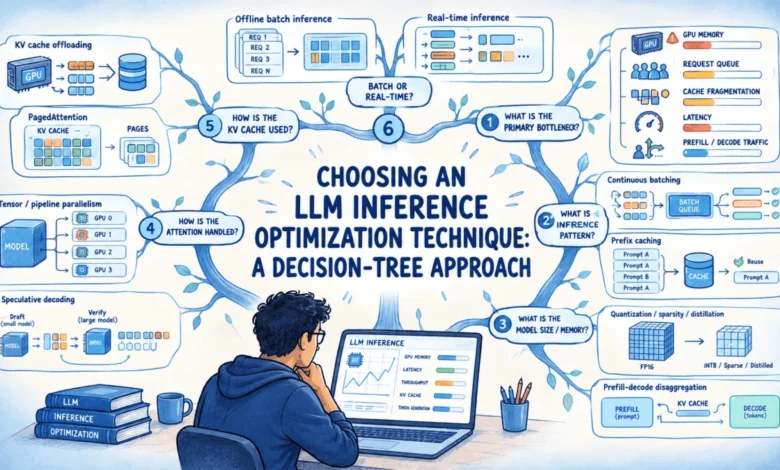
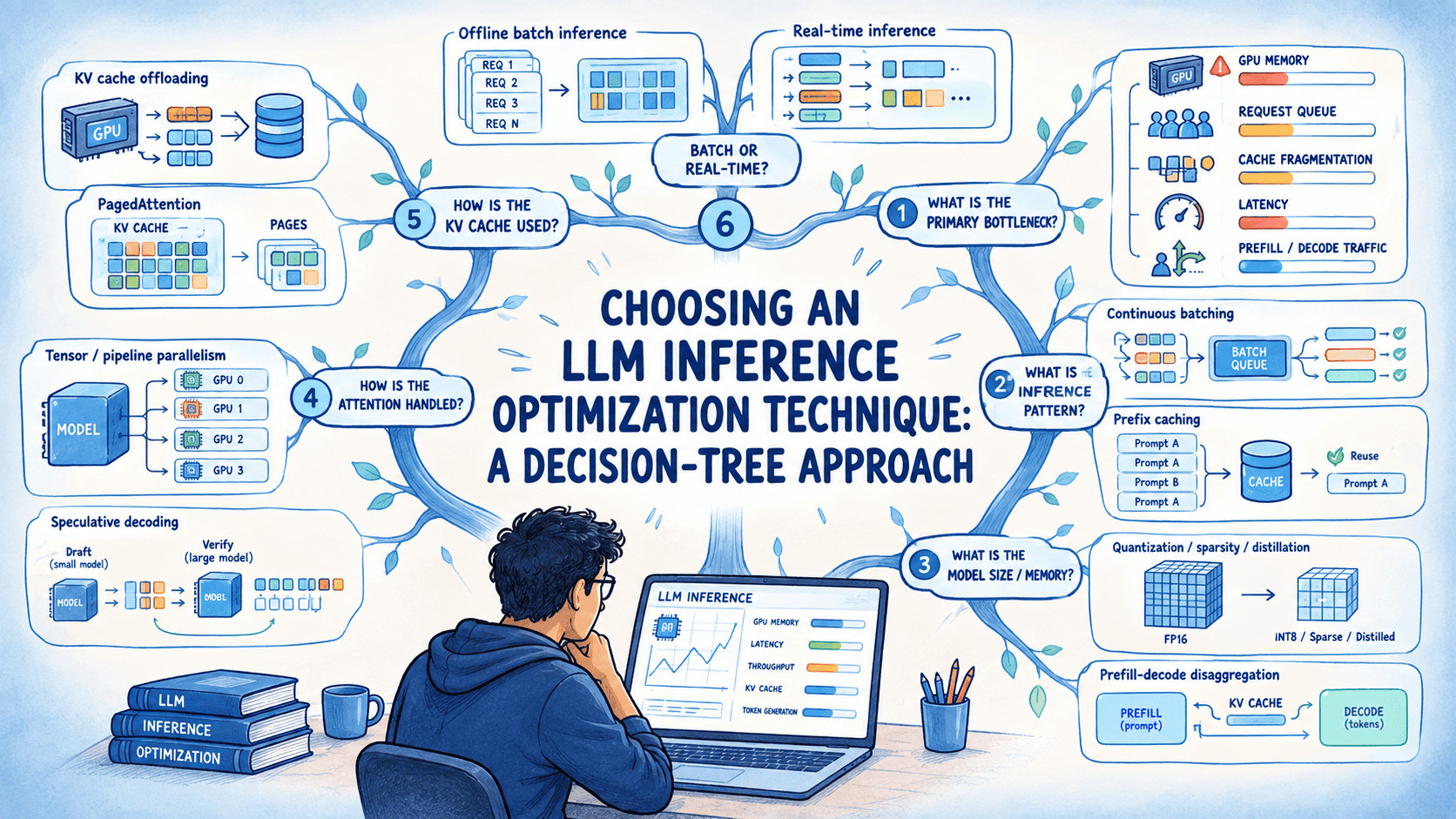
To avoid the common pitfall of "over-engineering"—where complex optimizations are applied to a workload that does not require them—engineers should follow a structured decision tree. This approach systematically isolates the bottleneck.
1. Assessing Memory Capacity and Model Footprint
The initial step is to determine if the model fits comfortably within the GPU’s VRAM. If the model occupies more than 80% of available memory, there is insufficient headroom for the KV (Key-Value) cache, which is essential for storing context during generation. When memory is constrained, performance degrades linearly. In these instances, techniques like quantization (reducing precision from FP16 to INT8 or FP4), sparsity, or distillation are necessary. By reducing the bit-depth of weights, engineers can often double the batch size, significantly improving throughput.
2. Evaluating Prompt Structure and Prefix Caching
For applications like RAG or multi-turn chat, the prompt often contains massive amounts of static data—such as long system instructions or extensive conversation history. Recomputing these tokens for every request is a significant waste of cycles. Prefix caching allows the system to store the KV cache of these repeated sequences. Data suggests that in enterprise RAG applications, prefix caching can reduce Time-To-First-Token (TTFT) by up to 60%, as the GPU only needs to process the new, variable portion of the user query.
3. Analyzing Concurrency and Batching Strategies
"Naive" batching, where a system waits for all requests in a batch to complete before moving to the next, is a major source of GPU underutilization. If a user asks a short question and another asks for a long document summary, the shorter task sits idle. Continuous batching, a technique pioneered by modern serving engines, allows for the injection of new requests as soon as an individual slot in the batch becomes available. This maximizes hardware occupancy, which is critical for scaling to thousands of concurrent users.
4. Mitigating KV Cache Fragmentation via PagedAttention
Traditional memory allocation for KV caches often reserves contiguous blocks of memory based on the theoretical maximum sequence length. Because most requests are significantly shorter than this maximum, memory is wasted, leading to fragmentation. PagedAttention—inspired by virtual memory management in operating systems—partitions the KV cache into small, non-contiguous "pages." This allows the serving engine to allocate memory dynamically, effectively increasing the maximum concurrent batch size without requiring additional hardware.
5. Optimizing for Latency with Speculative Decoding
When the primary concern is the speed at which tokens appear on the screen (inter-token latency), speculative decoding is the industry standard. This technique utilizes a small, "draft" model to predict the next few tokens, which the primary "target" model then verifies in a single parallel pass. If the draft model is accurate, the system can output multiple tokens in the time it would normally take to generate one. Industry benchmarks indicate that this can provide a 2x to 3x increase in effective decoding speed for high-performance applications.
6. Scaling Architectures through Prefill-Decode Disaggregation
At the highest levels of scale, the "prefill" phase (processing the prompt) and the "decode" phase (generating tokens) compete for the same GPU resources. Prefill is compute-heavy, while decode is memory-bandwidth-heavy. Disaggregation splits these workloads onto specialized nodes. Prefill nodes handle the initial prompt processing, while dedicated decode nodes focus on token generation. While this introduces network overhead and complexity, it is the only viable path for massive-scale platforms serving millions of tokens per second.
Implications of Optimization Choices
The selection of an optimization strategy carries downstream implications for both accuracy and operational cost. Quantization, for instance, introduces a non-zero risk of model degradation; empirical tests have shown that dropping below 4-bit precision can significantly alter the model’s reasoning capabilities. Similarly, while speculative decoding improves latency, the requirement to run two models simultaneously consumes more VRAM, potentially limiting the maximum throughput.
Engineering teams must balance these trade-offs against their specific Service Level Agreements (SLAs). For real-time chat, latency is the primary KPI; for offline data processing, throughput and cost-per-token take precedence.
The Role of Modern Serving Engines
The current ecosystem—dominated by frameworks such as vLLM, TGI (Text Generation Inference), and TensorRT-LLM—has abstracted much of this complexity. Many of these engines now include auto-tuning features that implement PagedAttention and continuous batching by default. However, relying on defaults can lead to "configuration drift," where an engine is optimized for a general use case but fails to perform under the specific distribution of a proprietary workload.
Future Outlook and Conclusion
As we look toward 2026 and beyond, the trend in LLM inference is moving toward "hardware-aware" optimization. This involves co-designing the model architecture with the inference engine to ensure that tensor operations align perfectly with the GPU’s physical memory hierarchy.
The decision tree approach provides a roadmap for this complexity. By identifying whether a bottleneck is memory-bound (requiring quantization or PagedAttention), compute-bound (requiring speculative decoding or parallelism), or logic-bound (requiring prefix caching or disaggregation), engineers can transition from reactive troubleshooting to proactive architectural design.
As LLMs become increasingly integrated into core business processes, the ability to select the correct optimization strategy will define the difference between a high-performing, cost-efficient AI deployment and a stalled, expensive infrastructure project. The key to success lies in consistent monitoring, empirical testing, and a deep understanding of the hardware-software interface.
Related posts: