The Rise of "Your First Time In a Fancy Cafe" AI-Generated Video Trend on TikTok and Instagram

The digital landscape of late 2026 has witnessed yet another rapid paradigm shift in internet culture, driven by the increasing accessibility and hyper-realism of artificial intelligence video generation. A new satirical meme format titled "Your First Time In a Fancy Cafe" has dominated social media feeds across TikTok, Instagram Reels, and other short-form video platforms. The trend, which originated at the beginning of November 2026, revolves around an AI-generated comedy sketch depicting the baffling and overly avant-garde design choices of contemporary upscale hospitality establishments. By exaggerating the minimalist and often impractical furniture found in modern minimalist cafes, creators have tapped into a widespread cultural fatigue regarding pretentious aesthetic trends in urban consumer spaces.
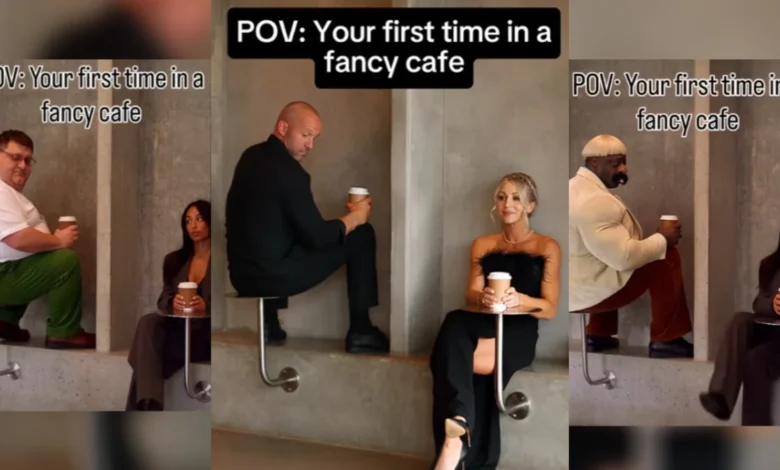
At its core, the viral phenomenon uses algorithmic generation to present a deeply relatable yet surreal comedic premise: a customer enters a sleek, minimalist establishment, mistakes a metal table for a chair, and sits down before a subsequent patron enters to inadvertently expose the awkward architectural confusion. Set to Steve Lacy’s recognizable track "Oh Yeah?", the original sketch struck a nerve with millions of internet users, transforming from a viral novelty into a versatile, user-generated template that satirizes modern design culture, public figures, and internet lore.
Main Facts of the Viral Phenomenon
The trajectory of the "Your First Time In a Fancy Cafe" trend offers a textbook case study in how modern AI video tools are reshaping digital content creation. The foundational video of the trend was uploaded to TikTok by user @leehoustonx on November 1st, 2026. Within a span of just 48 hours, the initial post accumulated over 9.2 million views, driven by the algorithm-friendly pacing, crisp visual fidelity characteristic of advanced text-to-video models, and deadpan comedic timing.
The narrative structure of the original video is deceptively simple. A man enters what appears to be a hyper-modern, concrete-and-metal cafe. Confident in his bearings, he lowers himself onto what his spatial reasoning identifies as a comfortable chair. He sits comfortably for a brief moment until a woman walks into the frame, completely upending his understanding of the room. It becomes glaringly obvious that he is not sitting on a chair at all, but rather perching awkwardly on a narrow, cold metal table meant for food preparation or display, mistaking the brutalist layout for traditional seating. Upon realizing his humiliating mistake, he immediately adjusts his posture, attempting to maintain his dignity.
This surreal yet painfully plausible scenario resonated instantly because it mirrors real-world criticisms of modern interior design. In recent years, urban cafes and minimalist restaurants have faced online mockery for prioritizing stark, industrial aesthetics over basic ergonomic comfort—features like concrete benches, steel ledges, and absence of back support. The AI video successfully weaponized this cultural grievance, turning architectural pretension into a universally understood punchline.
Chronology and Timeline of the Spread
The propagation of the "Your First Time In a Fancy Cafe" meme followed a classic hyper-acceleration curve typical of late-2020s viral phenomena.
On November 1st, 2026, TikTok user @leehoustonx launched the trend with the original upload. The video’s immediate traction caught the attention of algorithmic content curators across multiple platforms, setting the stage for cross-pollination between TikTok and Instagram Reels.
By November 2nd, 2026, the trend had transcended its original creator, morphing into a standardized meme template. Rather than generating entirely new scenarios, digital creators began substituting the characters in the video with recognizable pop culture figures, historical personas, and infamous internet memes. This remix culture allowed the core visual joke to be recycled into dozens of distinct variations within a 24-hour window.
Prominent instances during this peak spread phase included a post by Instagram user kevinwinnik on November 2nd, which captured massive engagement by securing over 14.5 million likes within a single day. Concurrently, TikTok creator @boby.biggsjohnson published a parallel iteration that pulled in over 4.2 million views in its first 24 hours online.
As the trend matured over the course of November 2nd and 3rd, creators began introducing satirical and absurdist casting choices. Notably, Instagram user skyneet_ published a version that replaced the cafe patrons with figures heavily tied to contemporary internet discourse, including Jeffrey Epstein and Charlie Kirk. This specific iteration demonstrated how rapidly meme templates are co-opted to reflect broader political and cultural satire, garnering over 62,900 likes within its first day of publication.
Supporting Data and Engagement Metrics
The quantitative metrics associated with the "Your First Time In a Fancy Cafe" trend highlight the staggering distribution capabilities of modern algorithmic feeds. Unlike text-based memes of the early internet or early-generation image macros, AI-generated video formats require significantly higher computational overhead to produce, yet they achieve velocity comparable to or exceeding traditional user-generated content.
Within the first 48 hours of its debut, the cumulative view count across the top five iterations of the meme surpassed 30 million views. Instagram Reels proved to be a particularly fertile ground for high-engagement loops, with accounts like kevinwinnik demonstrating conversion rates where millions of users interacted with the content within hours of deployment. Search interest metrics, though largely concentrated on social discovery platforms rather than traditional search engines, reflected a sharp upward spike in queries related to AI video generation tools and the specific audio tracks utilized in the skits.
The low barrier to entry for modern video generation software—combined with advanced face-swap and character-replacement algorithms—has enabled creators to scale these trends rapidly. What previously would have required a physical production crew, professional actors, and post-production editing suites can now be conceptualized, rendered, and published within minutes using consumer-grade AI platforms.
Broader Impact and Industry Implications
Beyond serving as a fleeting source of digital entertainment, the "Your First Time In a Fancy Cafe" trend underscores several significant shifts in media consumption, software capabilities, and cultural commentary.
First, the meme illustrates the normalization of generative AI in mainstream comedy. While early iterations of AI video were frequently criticized for their uncanny valley aesthetic, morphing limbs, and logical inconsistencies, recent advancements have allowed creators to use these quirks purposefully for comedic effect. The slight surrealism inherent in text-to-video outputs actually enhances the absurdist nature of jokes about hyper-modern interior design.
Second, the trend highlights the evolution of participatory internet culture. Users are no longer content merely consuming viral videos; the template invites endless permutations, allowing subcultures to inject their own inside jokes, political satire, and niche references into a globally recognized framework. This decentralized remixing process ensures that a single piece of AI-generated content can spawn thousands of derivative works, keeping the meme relevant far longer than traditional viral clips.
Finally, the phenomenon serves as a cultural mirror reflecting society’s growing weariness with aesthetic over-optimization. As urban centers become increasingly saturated with minimalist, brutalist, and austere commercial spaces, consumers are finding collective catharsis in mocking the absurdity of modern design trends. Whether through a real-world chuckle or a viral AI-generated sketch on Instagram Reels, the message remains clear: form must occasionally yield to function.