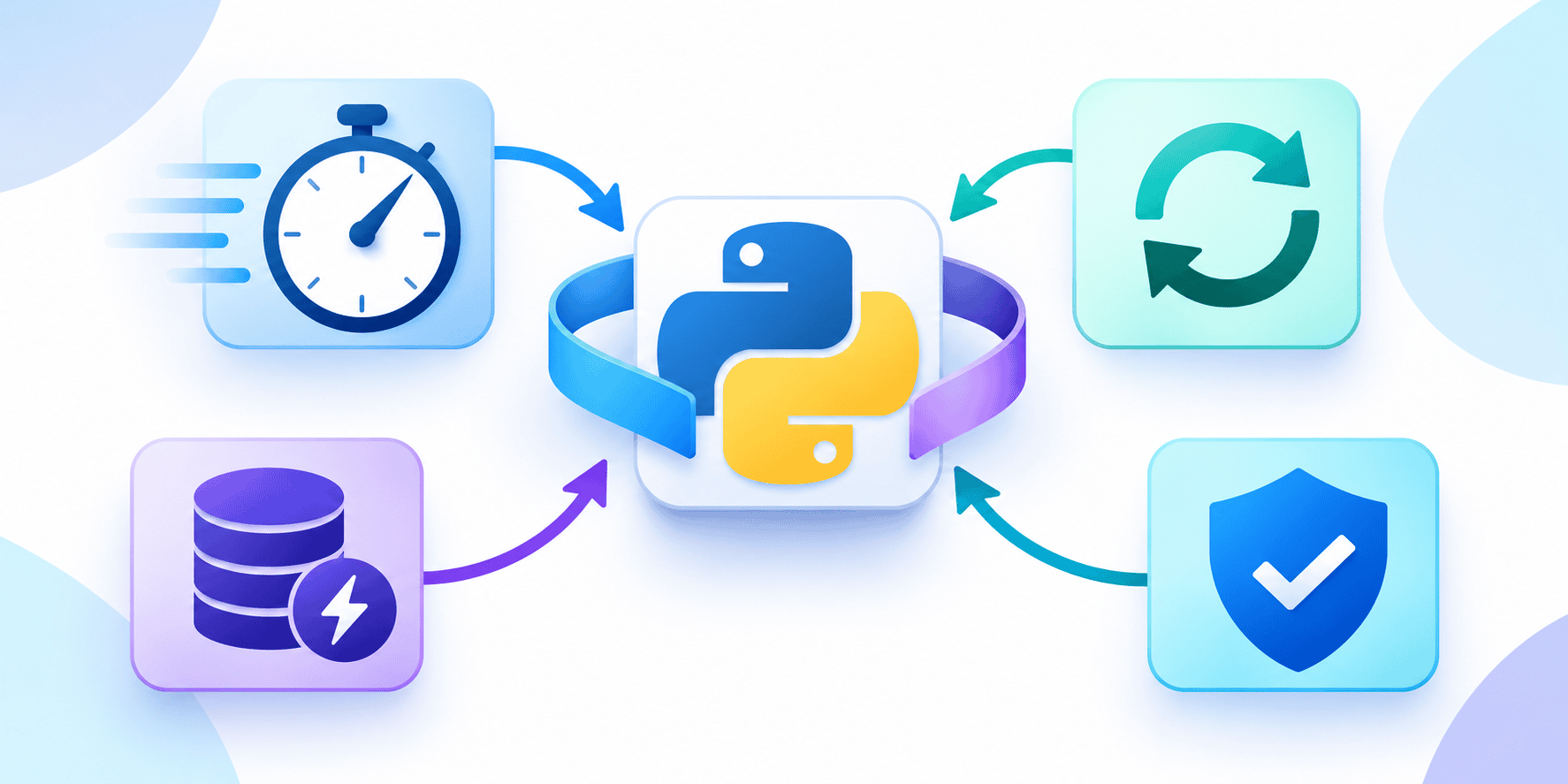
The evolution of modern software architecture often begins with simplicity, but as projects scale, the accumulation of "boundary code"—the logic responsible for logging, error handling, and performance monitoring—can quickly obscure the core business logic of an application. In the Python ecosystem, decorators serve as a critical tool for decoupling this auxiliary infrastructure from the primary functional code. By abstracting cross-cutting concerns, developers can maintain cleaner, more maintainable codebases. This article examines the mechanics of Python decorators, providing a comprehensive guide to building robust utilities for timing execution, implementing resilient retry strategies, optimizing performance through caching, and enforcing rigorous input validation.
The Mechanics of Function Decorators
At their core, decorators are a form of syntactic sugar that allows programmers to modify the behavior of a function or class without altering its underlying structure. Technically, a decorator is a callable that takes a function as an input and returns a new function (or "wrapper") that executes additional logic before or after the original function.
The Python language defines the @ symbol as the standard syntax for this operation. When a decorator is applied to a function definition, the interpreter executes the decorator expression at the moment of definition. This means that decorators are processed during the import or initial load phase of the application. The result of this process is that the function name is rebound to the wrapper object returned by the decorator. Understanding this lifecycle is vital; because decorators execute once at load time, any setup logic—such as registering a function in a service map—occurs before the application begins processing requests.
Preserving Metadata with functools.wraps
One of the most frequent errors in custom decorator design is the inadvertent destruction of function metadata. When a decorator replaces a function with a wrapper, the original function’s name, docstrings, and signature are effectively hidden. This results in significant debugging challenges, particularly when using automated documentation tools or profilers that rely on function metadata to report performance metrics.
The standard library’s functools.wraps is the industry-standard solution for this issue. By applying @functools.wraps(func) to the inner wrapper, developers ensure that the metadata of the original function is copied to the wrapper. Furthermore, this practice preserves the __wrapped__ attribute, which provides a direct link back to the original, undecorated function. This is essential for unit testing, as it allows developers to isolate and test the core logic without being hindered by the timing or retry behaviors added by the decorator.
Implementing Precision Timing
Performance observability is a cornerstone of production engineering. When monitoring machine learning pipelines or data processing tasks, developers often need to track execution time. While a simple time.time() call might suffice for high-level logging, the time.perf_counter() function is the superior choice for measuring precise intervals. It provides the highest available resolution for short-duration measurements, making it ideal for benchmarking specific code blocks.
A robust timing decorator should utilize a try...finally block. This ensures that the time taken for a function execution is recorded even if the function encounters an exception and fails. By wrapping the logic in this structure, developers can capture performance telemetry for both successful and failed operations, providing a more granular view of system bottlenecks.
Resilient Architectures: The Retry Pattern
In distributed systems, transient failures—such as network timeouts or temporary service unavailability—are inevitable. A retry decorator provides a mechanism for automatic recovery. However, building a "retry" utility requires careful attention to the "decorator factory" pattern. Because retry logic requires parameters (such as the number of attempts, delay intervals, and specific exception types to catch), the decorator must be structured in three layers: the outer function for configuration, the decorator function to receive the target, and the wrapper to handle the execution.
A critical rule in retry implementation is the selective handling of exceptions. A general-purpose retry decorator that catches all exceptions can mask fundamental bugs, such as KeyError or ValueError, which should trigger an immediate system halt rather than a retry. Furthermore, developers must be wary of side-effect-heavy operations. Retrying a function that performs a database write could result in duplicate entries if the initial call succeeded but the acknowledgement failed. Idempotency remains a prerequisite for safe retry strategies.
Optimization via Memoization
Performance can often be improved through memoization, the process of storing the results of expensive function calls to avoid redundant computation. Python’s functools.lru_cache provides a thread-safe, high-performance implementation of this concept. By storing the results of function calls keyed by their arguments, lru_cache significantly reduces overhead in repetitive computational tasks.
However, caching is not a universal solution. It should be restricted to "pure" functions—those that always produce the same output for the same input and do not have side effects. Caching functions that rely on mutable global states or time-based data can lead to subtle, difficult-to-reproduce bugs. Additionally, developers must be mindful of memory consumption. An unbounded cache in a long-running process can lead to memory leaks. Configuring an appropriate maxsize is essential to balance performance gains with system resource constraints.
Enforcing Invariants with Input Validation
Input validation is the final boundary layer. Rather than manually checking parameters at the start of every function, a decorator can centralize validation logic. By utilizing the inspect.signature module, a decorator can introspect the arguments passed to a function at runtime.
This approach allows for the creation of reusable validation rules—such as ensuring a batch size is positive or that a probability threshold remains within the unit interval. Using inspect.signature.bind() and apply_defaults(), a decorator can verify parameters before they reach the function body. This ensures that the business logic remains focused on computation rather than defensive programming. While this method is excellent for simple constraints, complex validation involving multi-field dependencies is better served by dedicated data validation libraries like Pydantic or structured dataclasses.
Strategic Considerations for Production Engineering
As applications grow, the temptation to "decorate everything" can lead to overly complex codebases. Decorators should be reserved for logic that is truly cross-cutting—logic that applies to multiple, disparate functions. If a piece of logic is specific to one function, it belongs inside that function.
When stacking multiple decorators, the order of application is critical. Decorators are applied from bottom to top, meaning the top decorator acts as the outermost wrapper. For example, placing a validation decorator above a cache decorator ensures that invalid calls are rejected before they ever hit the cache. Conversely, placing a timing decorator at the very top ensures that the total time recorded includes the overhead of all other decorators.
In conclusion, decorators are a powerful, yet nuanced, feature of the Python language. When implemented with careful attention to metadata preservation, proper error handling, and logical ordering, they provide a clean, elegant mechanism for building resilient and performant systems. By mastering these patterns, software engineers can ensure that their code remains modular, readable, and robust in the face of increasing complexity.