Navigating the Complex Landscape of E-Commerce Returns Across Europe: Challenges, Costs, and Strategic Solutions

The contemporary digital marketplace has fundamentally shifted consumer expectations, transforming the final click of a checkout page from a transaction’s conclusion into merely a milestone within a broader consumer journey. Within the dynamic European e-commerce ecosystem, product returns have evolved from an occasional logistical inconvenience into a central pillar of retail operations. Far from being a marginal concern, the management of reverse logistics now dictates the thin margin between sustained profitability and severe financial strain for merchants operating across the continent.
As digital retail continues its exponential expansion, the sheer volume of returned merchandise demands a sophisticated, multifaceted response. Retailers can no longer afford to treat returns as an afterthought; instead, they must integrate reverse logistics seamlessly into their overarching business models. This comprehensive examination explores the current statistical reality of returns in Europe, the profound logistical and environmental hurdles they present, and the innovative strategies forward-thinking enterprises are deploying to turn potential losses into competitive advantages.
The European E-Commerce Returns Landscape: Statistical Overview
Recent empirical data underscores the sheer magnitude of the returns phenomenon within European markets. Industry-wide averages indicate that between 30% and 40% of all online purchases ultimately find their way back to merchants. However, this metric masks significant regional disparities shaped by consumer culture, local consumer protection legislation, and the dominant product categories within specific national markets.
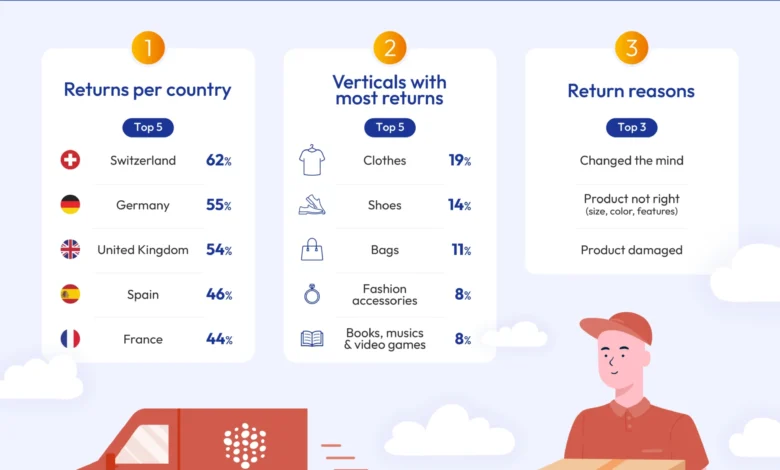
According to comprehensive market analyses conducted by Statista, Switzerland recorded the highest return rate per online buyer in Europe, soaring at an extraordinary 62%. Germany closely mirrors this high-engagement return culture with a 55% return rate, while the United Kingdom establishes a formidable third position at 54%. These figures reflect deeply ingrained consumer expectations regarding purchasing flexibility. In markets like Germany and the UK, free and frictionless returns have long been utilized by major online platforms as a primary tool to drive conversion rates, inadvertently fostering a culture where buying multiple sizes or variations of a single item with the explicit intent to return the majority has become standard practice.
This consumer behavior—increasingly recognized by industry analysts as "bracketing"—places an immense strain on corporate supply chains. Consumers frequently order three sizes of a garment or multiple colors of a household item to inspect them in a domestic setting before deciding on a single keeper. While this minimizes buyer’s remorse and encourages initial sales volume, the downstream operational consequences are severe.
Sector-Specific Vulnerabilities and Consumer Motivation
The propensity for returns varies dramatically across different retail sectors. Unsurprisingly, the fashion and apparel sector shoulders the highest burden of returned goods. Due to the deeply subjective nature of personal style, inconsistent sizing standards across international brands, and the inability to physically try on garments prior to purchase, apparel return rates frequently exceed 50% in standard online retail environments.
Conversely, consumer electronics and household goods experience more moderate return rates, hovering around 6% respectively. However, returns in these sectors carry distinct complications. Electronics returns are frequently driven by technical compatibility issues, complex user interfaces, perceived manufacturing defects, or buyer confusion regarding specifications. Unlike apparel—which can often be swiftly inspected, folded, and returned to active inventory—returned electronics require rigorous diagnostic testing, data wiping, and specialized repackaging before they can be deemed suitable for resale, often resulting in heavy discounting as "open-box" or refurbished merchandise.
Understanding the psychological and practical drivers behind these returns is essential for merchants seeking mitigation. Consumer surveys consistently highlight several primary catalysts for initiating a return:
- Sizing and fit discrepancies (particularly in footwear and apparel)
- Products failing to match online descriptions or photographic representations
- Delayed delivery timelines resulting in items arriving after a specific event or need
- Impulse purchasing driven by promotional discounts followed by post-purchase rationalization
- The aforementioned bracketing phenomenon
The Multi-Dimensional Challenges of Reverse Logistics
Addressing the complexities of reverse logistics requires merchants to navigate a labyrinth of operational, regulatory, financial, and environmental obstacles. Unlike outbound logistics—which are typically optimized for mass distribution from centralized warehouses to individual consumers—inbound reverse logistics involve collecting disparate parcels from thousands of individual locations and funneling them back through a consolidated processing network.
Logistical and Cross-Border Complexities
The logistical infrastructure required to execute efficient returns is exceptionally demanding. For merchants operating cross-border within the European Union, these challenges are magnified exponentially. Variations in national legislation, divergent consumer rights directives, and localized business practices complicate everything from refund timelines to exchange protocols.
Furthermore, the post-Brexit regulatory landscape has introduced significant friction for merchants trading between the UK and the EU. Customs declarations, import duties, and value-added tax (VAT) reclaim procedures on returned goods demand meticulous administrative oversight. Companies that fail to navigate this intricate cross-border regulatory framework risk severe financial penalties, prolonged customs delays, and irreversible damage to their brand reputation through delayed customer refunds.
Financial Pressures and Profitability
From a strict financial perspective, returns erode profit margins at multiple junctures. The direct costs associated with reverse shipping, manual inspection, grading, cleaning, restocking, and repackaging often outweigh the original profit margin of the item. Furthermore, returned merchandise frequently cannot be reintroduced into the primary inventory as "new." Consequently, retailers are forced to liquidate these items through secondary channels, sell them at steep discounts on dedicated outlet platforms, or, in worst-case scenarios, write them off entirely.
Industry experts note that businesses attempting to absorb the full cost of free returns without adequate forecasting face severe liquidity pressures. This economic reality has prompted a growing number of major retailers—who previously championed unconditional free returns—to reevaluate their policies and introduce nominal return fees to deter frivolous purchasing behavior.
Environmental Imperatives and Sustainability
In parallel with financial and logistical hurdles, the ecological footprint of e-commerce returns has emerged as a critical corporate governance issue. The modern consumer increasingly demands sustainable business practices, yet the mechanics of returns are inherently carbon-intensive.
Transporting returned goods back through distribution networks generates substantial greenhouse gas emissions. Additionally, the packaging lifecycle is heavily impacted; returned items frequently require supplementary bubble wrap, tape, and secondary boxes to ensure safe transit, generating mountains of single-use plastic and paper waste. Beyond transportation and packaging, the environmental cost extends to product disposal. Historically, a fraction of returned inventory that could not be economically reintegrated into supply chains was incinerated or sent to landfills. Regulatory bodies across Europe are increasingly clamping down on such practices, forcing corporations to adopt circular economy principles.
Managing Consumer Expectations
Balancing corporate profitability with customer satisfaction represents a delicate tightrope walk. Modern consumers demand a return experience that is instantaneous, transparent, and entirely cost-free. Research indicates that the clarity and leniency of a merchant’s return policy serve as a decisive factor at the initial moment of purchase. If a consumer perceives the return process as overly complicated or financially punitive, they are likely to abandon their shopping cart entirely.
Conversely, poorly executed returns management—such as sluggish refund processing or limited physical drop-off locations—leads directly to consumer alienation. When a customer must wait weeks for a refund or travel excessive distances to locate a designated drop-off point, brand loyalty evaporates. Consequently, enterprises must invest heavily in localized return infrastructures, such as dense drop-off networks or strategic regional return hubs, to minimize friction and sustain consumer trust.
Strategic Solutions for Optimizing E-Commerce Returns
To survive and thrive amid these systemic challenges, e-commerce merchants are deploying advanced technological, operational, and strategic interventions designed to minimize return volumes while streamlining the processing of unavoidable returns.
Implementing User-Friendly, Transparent Policies
The foundation of an effective returns strategy rests upon clear communication. Merchants are increasingly adopting transparent, easy-to-navigate return portals that guide the consumer effortlessly through the process. Providing pre-printed return labels within the original packaging, extending return windows during peak seasonal periods, and automating instant refund notifications upon carrier scan significantly enhance the customer experience while reducing customer service overhead.
Leveraging Advanced Technological Solutions
Technology plays an indispensable role in modern reverse logistics management. Enterprises are deploying sophisticated return management software (RMS) platforms integrated directly with warehouse management systems (WMS). These platforms automate the tracking of returned parcels from the moment a consumer initiates a return online, enabling predictive inventory forecasting and accelerating the re-entry of salable stock into active distribution channels.
Furthermore, retailers are harnessing the power of artificial intelligence and data analytics to preemptively address the root causes of returns. By aggregating and analyzing granular return data, merchandising teams can identify systemic product issues—such as a specific clothing line running two sizes too small or an electronic gadget suffering from a recurring software glitch. Armed with these insights, brands can update online sizing calculators, incorporate high-definition video product demonstrations, and refine detailed product descriptions to manage consumer expectations accurately prior to purchase.
Embracing Circular and Ecological Strategies
In response to mounting environmental pressures, sustainable reverse logistics have become a key differentiator for forward-looking brands. Companies are increasingly adopting eco-friendly packaging solutions, such as biodegradable mailers and reusable shipping boxes equipped with dual adhesive strips designed specifically for return journeys.
Moreover, optimized batch shipping and localized consolidation centers reduce the number of individual vehicle journeys required to transport returned goods, directly lowering carbon emissions. Forward-thinking brands are also establishing robust secondary markets, utilizing recommerce platforms to refurbish, clean, and resell returned merchandise, thereby closing the loop and eliminating waste.
Conclusion
The proliferation of e-commerce returns across Europe is an inescapable reality of the digital retail economy. Rather than viewing reverse logistics as an intractable operational burden, successful merchants are recognizing it as a critical touchpoint for customer retention and brand differentiation.
By marrying user-friendly return policies with cutting-edge technological infrastructure, rigorous data analytics, and sustainable ecological practices, European e-commerce enterprises can successfully navigate the complexities of reverse logistics. Striking this delicate equilibrium between operational profitability, environmental stewardship, and uncompromising customer satisfaction will ultimately define the market leaders of the next decade.
Related posts: