The Evolution of Content Moderation: Balancing AI Scalability and Human Judgment in the Digital Age

Content moderation has evolved far beyond the early days of internet forums where community managers manually reviewed text queues to delete obvious spam. Today, as billions of users generate petabytes of data across global social networks, content moderation has transformed into a sophisticated, high-stakes discipline. Organizations ranging from small businesses to multinational enterprises face the continuous challenge of filtering user-generated content, protecting brand equity, and maintaining regulatory compliance. Modern content moderation requires a calculated hybrid approach: leveraging artificial intelligence for rapid, large-scale triage while deploying human judgment to navigate complex linguistic nuance, cultural context, and sensitive consumer interactions.

The practice encompasses reviewing, filtering, and responding to public comments, direct messages, brand mentions, and third-party reviews. The primary objective is to facilitate genuine engagement while intercepting fraudulent bots, malicious trolls, and reputational hazards. As digital platforms continue to expand, regulatory frameworks such as the European Union’s Digital Services Act (DSA) and the Artificial Intelligence Act have introduced rigorous legal expectations for transparency, risk assessment, and platform accountability, elevating content moderation from a routine administrative task to a core component of corporate governance.
The Strategic Importance of Brand Safety and Customer Engagement
Effective content moderation serves as a critical operational pillar across three core business functions: customer service, brand protection, and crisis management.

Social media has effectively supplanted traditional call centers as the primary consumer support channel. When customers encounter friction with a product or service, they frequently air their grievances publicly on social platforms. A structured moderation workflow ensures these incoming messages are triaged and addressed swiftly, minimizing customer churn and demonstrating corporate responsiveness. However, moderation is fundamentally distinct from censorship or the systematic erasure of negative feedback. Healthy brand communities rely on constructive criticism; moderating content is designed to eliminate malicious toxicity rather than silence valid consumer dissatisfaction.
From a brand protection standpoint, unchecked negativity can permanently degrade public perception. Audiences quickly associate neglected, chaotic comment sections with institutional failure or corporate apathy. This phenomenon is particularly damaging when brands collaborate with external creators or rely on user-generated content (UGC). If an influencer shares sponsored content and encounters an unmonitored wave of harassment in the comment section, the incentive to collaborate evaporates, crippling future marketing pipelines.
Furthermore, moderation teams frequently act as an early-warning radar system for potential public relations crises. A sudden, coordinated surge in negative sentiment, systemic complaints, or targeted disinformation can escalate rapidly. Identifying these indicators early allows enterprise risk management, legal, and public relations departments to intervene before minor grievances compound into widespread corporate crises.
Chronological Evolution and Methodologies of Content Moderation
The methodology of content moderation has matured through distinct phases over the past two decades. Early digital communication relied heavily on reactive and manual reviews. As platforms scaled exponentially, manual intervention proved insufficient, prompting the development of automated filtering and structured multi-tiered workflows.
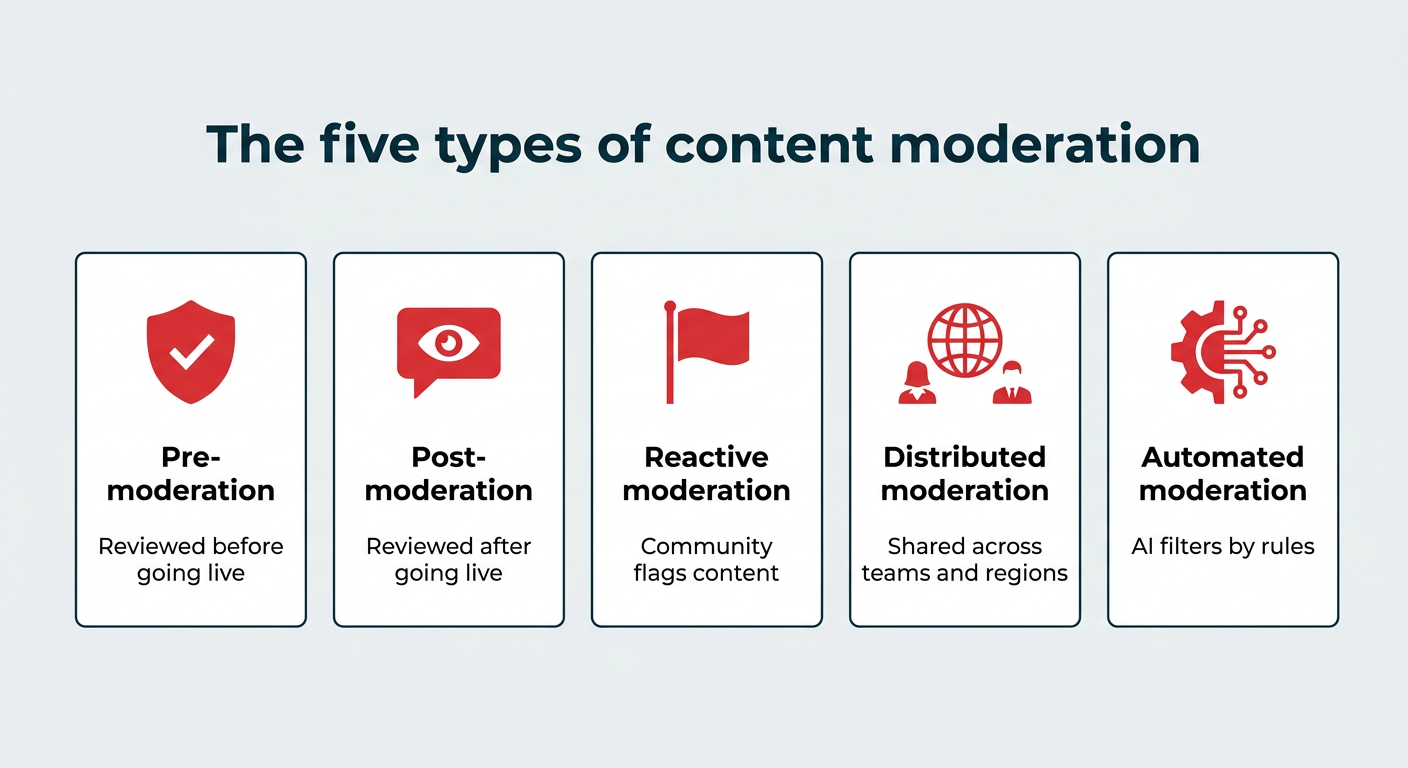
Contemporary organizations deploy five primary moderation frameworks, often combining them to balance speed, scale, and accuracy:
- Pre-moderation: Content is intercepted and reviewed by moderators prior to publication. While it offers the highest level of brand protection, it introduces significant latency, making it viable primarily for highly regulated industries such as healthcare and financial services where compliance failures carry severe legal penalties.
- Post-moderation: Content goes live immediately and is audited retroactively. This preserves real-time communication flow but inherently risks exposing audiences to objectionable material before human or automated review catches it.
- Reactive moderation: Organizations rely on community reporting mechanisms to flag violations. Once users report content, moderators evaluate it against established community guidelines. This model is essential for massive, decentralized communities where real-time oversight of every post is physically impossible.
- Distributed moderation: Responsibility is decentralized across specialized teams organized by geographical region, language proficiency, time zone, or platform specialization. This prevents employee burnout and maintains consistent enforcement across global markets.
- Automated moderation: Algorithms and machine learning models analyze, flag, or remove content based on predefined parameters. Recent transparency reports from major platforms, including TikTok’s regulatory filings under the EU Digital Services Act, indicate that automated systems routinely handle upwards of 90 percent of initial enforcement actions without human intervention.
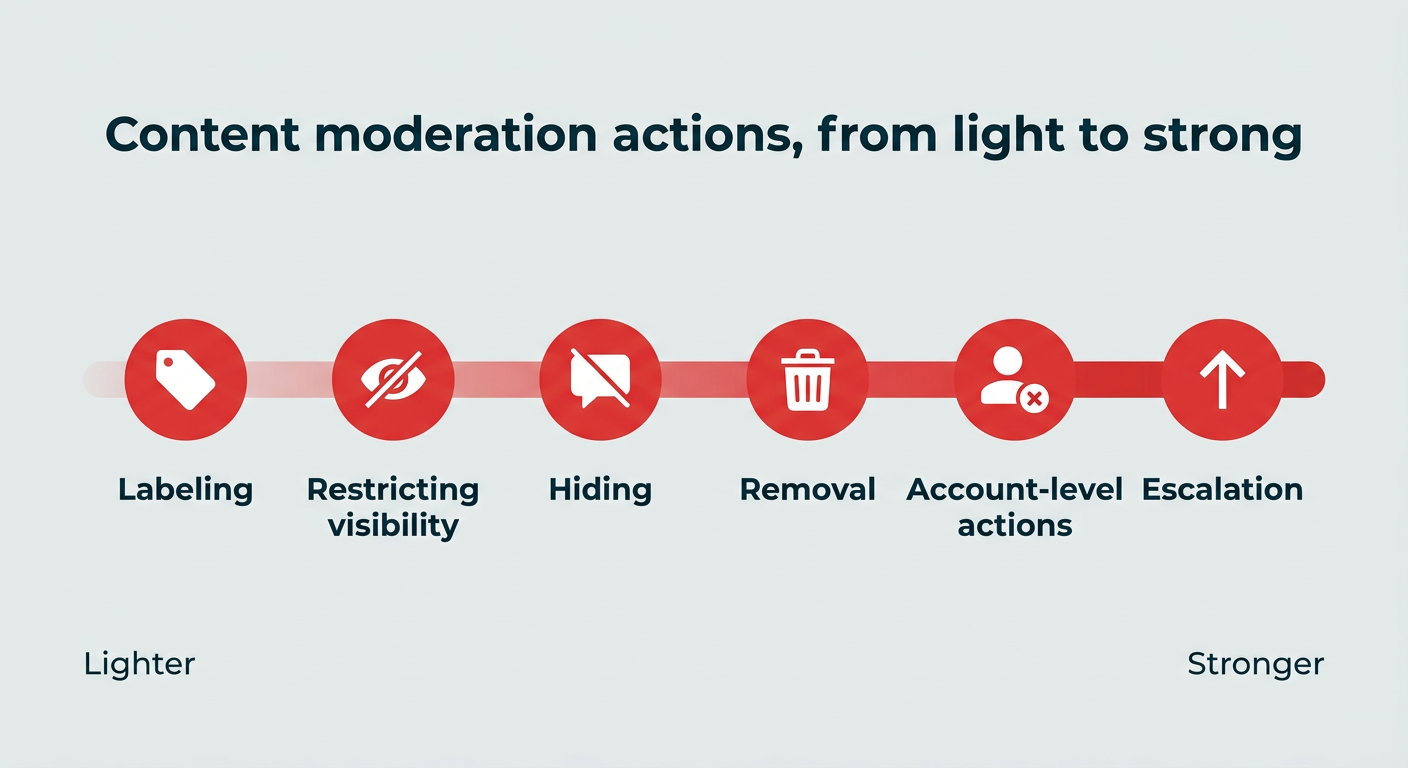
When content violates established guidelines, moderation teams apply a spectrum of operational actions ranging from light interventions—such as labeling or content warnings—to strong interventions, including temporary suspensions, permanent bans, and legal escalations.
The Intersection of Artificial Intelligence and Human Insight
The deployment of artificial intelligence in content moderation has transformed how organizations manage high volumes of data. Modern AI systems utilize natural language processing (NLP) to evaluate intent, sentiment, and semantic context rather than merely scanning rigid keyword blocklists. Simultaneously, advanced computer vision models screen images and video files for prohibited imagery, such as graphic violence, unauthorized brand counterfeits, or explicit material.
Despite these technological advancements, artificial intelligence exhibits pronounced limitations. Machine learning models frequently struggle with abstract human communication, including sarcasm, regional idioms, reclaimed slurs, and rapidly evolving internet slang. These limitations manifest as false positives—where harmless content is incorrectly removed—and false negatives, where genuine threats evade detection.

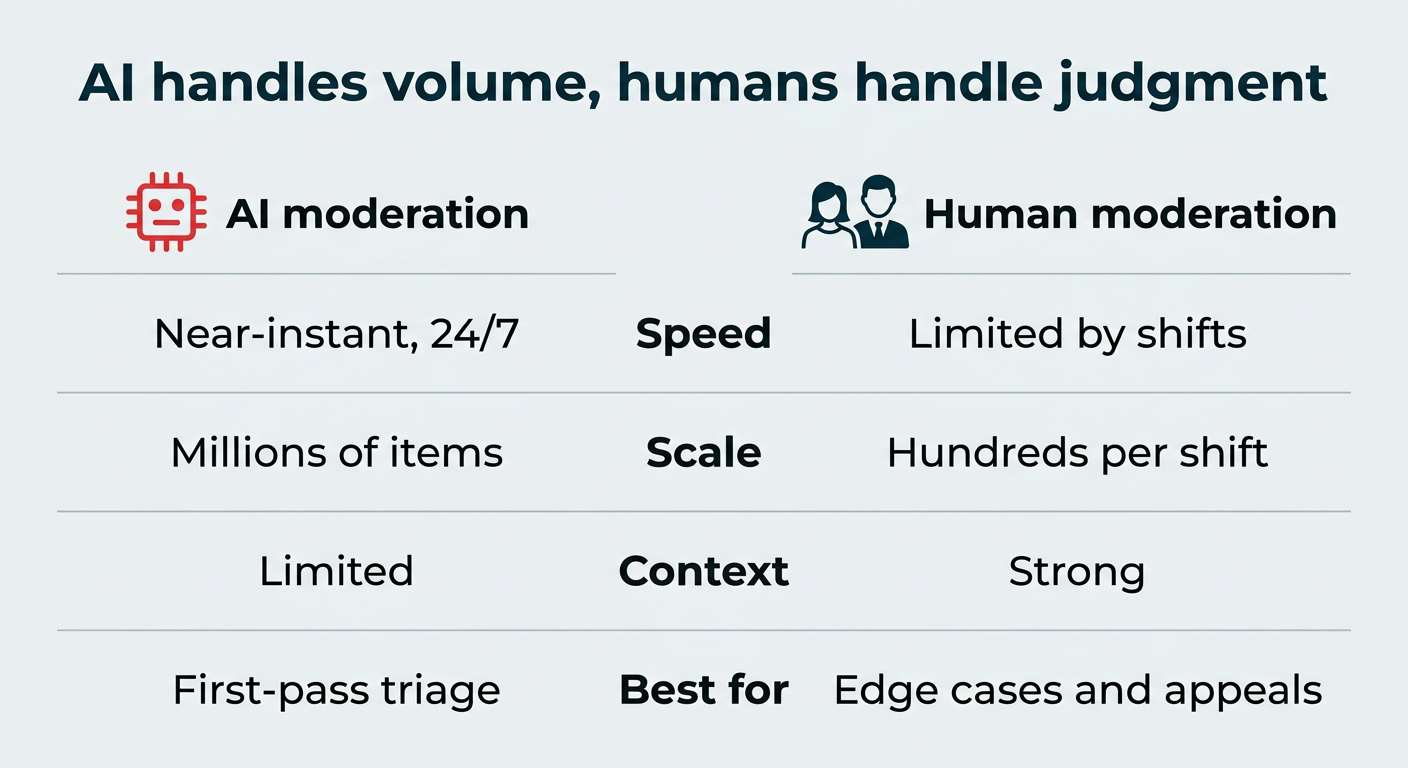
| Factor | AI Moderation | Human Moderation |
|---|---|---|
| Speed | Near-instantaneous, operational 24/7 | Constrained by human staffing limits and shifts |
| Scale | Processes millions of items simultaneously | Processes hundreds of items per shift |
| Accuracy on Obvious Violations | High for clear spam, profanity, and explicit media | High, but operationally slower |
| Contextual Understanding | Low; frequently misinterprets sarcasm and nuanced intent | High; robust comprehension of underlying meaning |
| Cultural and Linguistic Nuance | Uneven across regional dialects and secondary languages | Strong, particularly with localized human reviewers |
| Cost Efficiency | Low cost per unit reviewed | High operational expenditure per unit reviewed |
| Operational Consistency | Highly consistent execution, but prone to repeating systematic errors | Varies between individual reviewers |
| Optimal Application | First-pass filtering, triage, and high-volume data reduction | Complex edge cases, appeals, and sensitive communications |
The prevailing consensus across the digital media industry highlights a complementary division of labor: artificial intelligence manages volume, while human moderators exercise judgment. Automation clears predictable spam and protects personnel from viewing continuous streams of graphic material, routing ambiguous edge cases to trained professionals.
Regulatory Pressures and Compliance in 2026
The legal landscape governing online content has grown increasingly stringent. Regulatory bodies worldwide are holding platforms and corporate entities accountable for digital safety, transparency, and data governance.

In the European Union, the Digital Services Act (DSA) establishes comprehensive compliance obligations regarding illegal content, rapid notice-and-action mechanisms, and mandatory transparency reporting for online intermediaries. While these direct statutory burdens primarily target major hosting platforms, the resulting compliance frameworks heavily influence the operational tools, appeals processes, and data retention practices required of corporate brands operating digital channels.
Concurrently, the European Union’s Artificial Intelligence Act imposes risk-management classifications on algorithmic systems. This directly impacts how commercial content moderation software is engineered, audited, and deployed. In heavily regulated sectors such as pharmaceuticals, finance, and healthcare, the stakes are exceptionally high. Sharing unverified product claims or failing to retain auditable records of moderation decisions can trigger severe regulatory sanctions. Consequently, enterprise workflows increasingly incorporate dedicated governance layers to maintain complete traceability of every moderation action executed across global accounts.
Best Practices and Technological Solutions for Modern Enterprises
To navigate the complexities of digital communication safely, organizations must implement structured operational frameworks supported by enterprise-grade software solutions. Industry experts recommend six foundational best practices:
- Establish unambiguous moderation guidelines: Organizations must draft detailed policies that define acceptable speech, outline specific violation thresholds, and align closely with existing corporate style guides and crisis management plans.
- Maintain comprehensive responsiveness: Automated filters should remove spam and malicious interference, ensuring that legitimate customer support inquiries receive timely, professional attention.
- Utilize advanced filters and alerts: Establishing customized blocklists and automated keyword alerts prevents harmful material from surfacing publicly.
- Automate routine interactions: Leveraging conversational AI and saved replies for repetitive customer service inquiries optimizes resource allocation.
- Prioritize moderator well-being: Sustained exposure to toxic digital environments carries documented mental health consequences. Organizations must provide psychological support, regular debriefing sessions, and workload management strategies.
- Implement robust governance frameworks: Establishing verifiable audit trails ensures that moderation decisions remain compliant with platform terms of service and regional regulatory mandates.
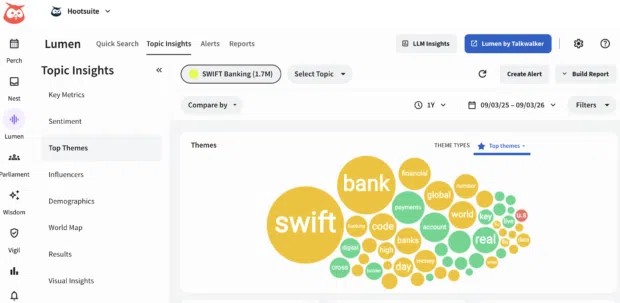
To execute these strategies efficiently, brands deploy integrated software ecosystems. Platforms such as Hootsuite Social OS centralize brand monitoring, customer care, and workflow governance through specialized applications like Lumen for listening and insights, Nest for unified inbox management, Wisdom for AI-assisted response generation, and Vigil for enterprise-grade compliance. Independent solutions such as Respondology, BrandFort, and Smart Moderation further provide automated, AI-driven comment protection tailored for major social networks including Meta platforms, YouTube, and TikTok.

Ultimately, effective content moderation is an ongoing operational commitment rather than a static administrative fix. By pairing the computational scale of artificial intelligence with the empathy and contextual intelligence of human moderators, organizations can successfully protect their brand reputation, foster thriving digital communities, and maintain unwavering trust with their audiences in an increasingly complex digital ecosystem.