TikTok Unveils Comprehensive Q5 Marketing Playbooks to Help Gaming and Mobile App Brands Capitalize on the Post-Holiday Consumer Surge

The digital advertising landscape undergoes a significant shift once the mainstream holiday shopping frenzy concludes on December 25. While many traditional marketers scale back their budgets and wind down their campaigns for the remainder of the calendar year, a unique window of opportunity opens up. Known across the marketing industry as "Q5"—the nebulous yet highly lucrative stretch of time running from December 26 through January 31—this period is characterized by unique consumer behaviors, increased digital consumption, and distinct purchasing motivations. In response to this recurring seasonal phenomenon, short-form video behemoth TikTok has published two new strategic marketing guides specifically tailored for gaming and mobile application developers. These newly released playbooks aim to equip brands with the technical know-how, data-driven insights, and campaign structures necessary to capture the attention of a highly engaged audience during the final days of the year and the dawn of the next.
The release of these comprehensive guides underscores TikTok’s ongoing evolution as a critical performance-marketing engine rather than merely a platform for brand awareness. As developers vie for user acquisition and retention in an increasingly competitive digital economy, understanding the nuances of Q5 behavior has transitioned from a supplementary strategy to an essential component of annual marketing planning.
Main Facts of the Q5 Initiative
TikTok’s newly issued resources comprise two distinct, highly focused documents: a four-page strategic overview tailored for gaming companies and an equally detailed guide dedicated to mobile app promotions. Both documents emphasize that consumer intent does not dissipate after the wrapping paper is cleared away; rather, it shifts.
According to platform data cited within the playbooks, a massive 70% of consumers actively plan to shop during the week immediately following December 25. This post-Christmas shopping surge is primarily driven by individuals looking to take advantage of end-of-year clearance sales, utilize newly acquired gift cards, and spend monetary gifts received during the holidays. Furthermore, TikTok’s internal metrics reveal that 75% of platform users maintain or even increase the amount of time they spend shopping during Q5 compared to the peak pre-holiday weeks. Perhaps most importantly for individual-focused app verticals, 63% of these active shoppers are purchasing items specifically for themselves—a psychological shift from the gift-giving obligations of November and early December.
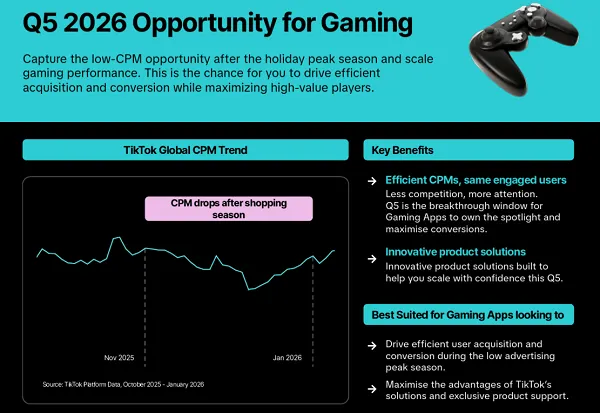
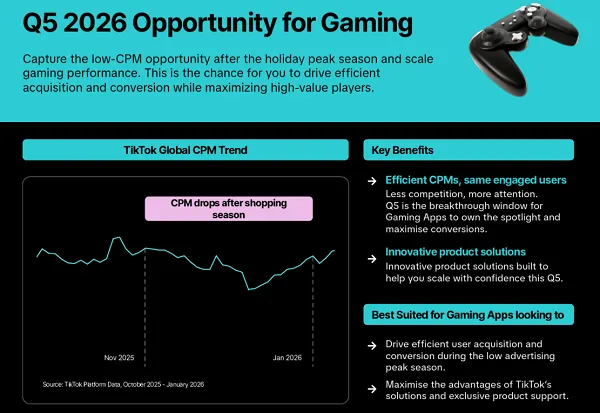
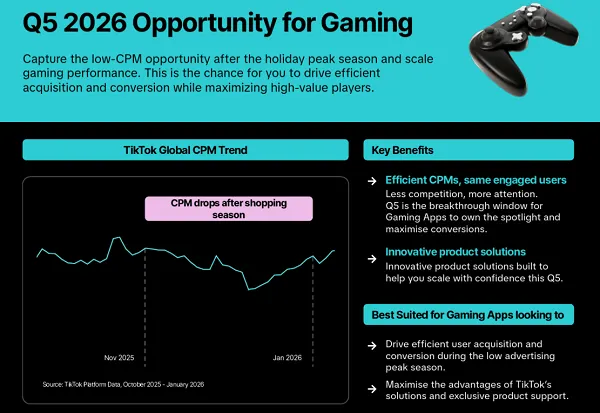
For the gaming sector, the guides highlight a critical economic advantage: a notable decrease in the cost per ad (CPA) during the Q5 window. Because many mainstream retail, travel, and luxury brands significantly reduce their advertising spend between Christmas and New Year, the auction landscape becomes less crowded. This reduction in advertiser competition allows gaming and app developers to secure ad placements at a significantly lower cost, maximizing their return on ad spend (ROAS) precisely when consumers have the leisure time to download, explore, and immerse themselves in new digital experiences.
The Background Context of Q5 Marketing
To fully understand the significance of TikTok’s latest publications, one must examine the historical evolution of the retail and digital marketing calendar. Traditionally, the fourth quarter (Q4) of the fiscal year—encompassing October, November, and December—has been treated by brands as the definitive holy grail of sales periods. Fueled by high-profile shopping holidays such as Black Friday, Cyber Monday, and the weeks leading up to Christmas, marketing budgets reach their zenith during this timeframe.
However, as e-commerce matured throughout the 2010s and early 2020s, digital analysts and media buyers began noticing an anomaly in consumer behavior. Far from dropping off a cliff on December 26, digital engagement, mobile app downloads, and online retail transactions remained surprisingly robust. Consumers found themselves at home with newly purchased smartphones, tablets, and gaming consoles, armed with gift cards, holiday cash, and—crucially—free time resulting from holiday vacations and school breaks.
This realization led to the coining of the term "Q5." Initially viewed as an informal industry inside joke or an afterthought for clearance campaigns, Q5 has steadily transformed into a recognized, strategic marketing period. Companies specializing in digital goods, subscription services, mobile gaming, and productivity apps realized that consumers were uniquely receptive to onboarding new experiences during this transitional phase. TikTok’s decision to formalize this concept through dedicated playbooks marks a maturation of Q5 from a guerrilla marketing tactic into an institutionalized pillar of modern digital media planning.
A Chronological Timeline of Q5 Development
The recognition and formalization of the Q5 period have accelerated rapidly over the past several years, shifting from sporadic observation to data-backed strategy.
Early Evolution (Mid-2010s): Digital marketers and programmatic advertising agencies first observe unexpected spikes in mobile app installations and in-game purchases during the final week of December. Early adopters begin quietly shifting small portions of their Q4 budgets into the post-Christmas void to capitalize on cheaper ad inventory.
Mainstream Adoption (Late 2010s to 2020): As mobile gaming explodes in popularity and subscription-based app models become the industry standard, data analysts begin publishing independent reports highlighting Q5 as a high-conversion, low-competition anomaly. Major platforms begin observing structural changes in user screen time between Christmas and New Year.
Platform Formalization (2021–2023): Recognizing the commercial potential, major social media networks begin compiling seasonal insights for enterprise clients. Data science teams track user behavior meticulously, proving that post-holiday engagement is not a fluke, but a predictable, recurring consumer trend driven by gift card redemptions and device activations.
The Current Landscape (2024–Present): Platforms like TikTok move beyond basic seasonal advice by issuing highly granular, technical playbooks. The release of dedicated guides for gaming and mobile apps signifies a shift toward prescriptive, actionable guidance that includes tracking setups, campaign structures, and budget optimization tailored specifically for the post-holiday window.
Detailed Breakdown of TikTok’s Gaming Guide
The four-page guide specifically designed for gaming brands tackles the unique challenges and opportunities facing game developers and publishers at the close of the year. Gaming is an inherently immersive medium, making user acquisition highly dependent on free time—a commodity that is abundant for millions of consumers during the final week of December and the first week of January.
The guide points out that while user acquisition costs (UA costs) often soar to prohibitive heights during the hyper-competitive weeks of Black Friday and early December, the Q5 period offers a welcome reprieve. Because broad-market retail advertisers pull back their campaigns, the digital advertising auction opens up, driving down the cost per ad. For mobile and console gaming companies operating on tight performance-marketing margins, this cost-efficiency is invaluable.
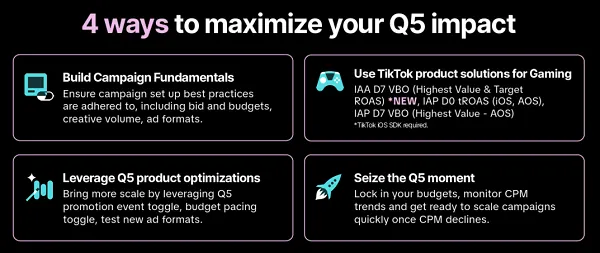
Beyond bidding strategy, the gaming playbook provides technical recommendations on campaign setup. It details how developers can leverage TikTok’s automated campaign tools and targeting capabilities to reach users who have just unwrapped new mobile devices, tablets, or gaming rigs. By aligning creative assets with the psychological mindset of a gamer starting a fresh title during holiday downtime, advertisers can significantly improve their conversion rates. The guide emphasizes the importance of showcasing gameplay footage immediately within the first three seconds of a video ad, acknowledging the fast-paced nature of the TikTok user experience.
Insights from the Mobile App Marketing Playbook
Parallel to the gaming resource, TikTok’s Q5 app marketing guide addresses the broader ecosystem of non-gaming applications—including e-commerce apps, fintech platforms, subscription streaming services, and health and fitness tools designed to capture the inevitable surge in New Year’s resolution traffic.
While the fundamental consumer dynamics mirror those of the gaming sector—high engagement, abundant free time, and increased willingness to spend gift card balances—the mobile app guide places a heavier emphasis on tracking setup and measurement best practices. In the wake of modern privacy changes and shifting attribution landscapes, accurately tracking campaign performance during high-velocity seasonal windows has become a complex endeavor for app developers.
TikTok’s playbook offers step-by-step notes on how to configure attribution partners, implement the TikTok Pixel and Events API effectively, and structure ad sets to measure down-funnel conversions rather than superficial vanity metrics like clicks and views. By ensuring that tracking infrastructure is robustly established prior to December 26, app marketers can dynamically adjust their bidding strategies in real-time as performance data flows in throughout the Q5 window.
Furthermore, the guide categorizes best practices by promotion type, recognizing that an app promoting a financial savings tool requires a vastly different creative approach than an app offering on-demand fitness coaching or streaming entertainment. Tailoring the creative message to match the specific intent of the user—whether that intent is financial organization heading into the new year or physical self-improvement—is highlighted as a primary driver of campaign success.
Official Responses and Industry Perspectives
While TikTok has not published direct quotes from external brand executives within these specific documentation releases, reactions from digital marketing agencies, performance-marketing experts, and industry analysts have been overwhelmingly positive.
Media buyers and growth marketing directors who have long utilized Q5 strategies have praised platforms for formalizing what was previously treated as tribal knowledge within media buying circles. Industry analysts note that by providing structured technical guidance, TikTok is actively lowering the barrier to entry for smaller or mid-sized app developers who may have previously lacked the analytical bandwidth to run complex end-of-year campaigns.
"For years, performance marketers treated the post-Christmas week as a hidden gem, often keeping our strategies close to the chest to avoid driving up auction prices," noted a senior director of paid media at a prominent digital marketing agency. "When a major platform like TikTok legitimizes this window by releasing dedicated technical playbooks, it signals to CFOs and CMOs that Q5 is not an experimental afterthought. It transforms post-holiday advertising from a quiet budget spillover into a core pillar of annual customer acquisition forecasting."
Other industry observers have pointed out that the timing of these releases aligns with a broader macroeconomic shift toward efficiency and accountability in digital advertising. In an economic climate where every marketing dollar is subjected to intense scrutiny, brands cannot afford to go dark for weeks at a time simply because traditional retail calendars dictate a holiday pause. TikTok’s data-driven approach provides the empirical justification marketing teams need to keep their campaigns running smoothly through the end of the year.
Broader Economic Impact and Future Implications
The publication of these Q5 playbooks carries significant implications for the broader digital advertising and app economy. As consumer habits continue to evolve, the traditional boundaries of retail seasons are blurring. The modern consumer expects continuous engagement, seamless digital transactions, and immediate gratification, regardless of whether it is a designated shopping holiday or a quiet Tuesday between Christmas and New Year’s Eve.
For the mobile app and gaming sectors, mastering the Q5 period can mean the difference between a stagnant fourth quarter and a record-breaking close to the fiscal year. By capturing high-intent users when acquisition costs are favorable, developers can build a robust user base that they can then nurture, monetize, and retain well into the subsequent year.
Moreover, TikTok’s strategic focus on technical guidance—such as tracking setup, attribution, and automated campaign structures—reflects a larger industry trend toward data-driven precision. As privacy regulations tighten and ad-tech ecosystems grow more complex, platforms that provide actionable, transparent methodologies for measuring return on investment will inevitably capture a larger share of performance-marketing budgets.
Ultimately, the codification of Q5 marketing through comprehensive resources like TikTok’s new playbooks signals a permanent shift in how brands plan their annual media calendars. The weeks between Christmas and New Year are no longer viewed as a dormant wasteland of consumer inactivity, but rather as a prime, high-converting frontier of digital opportunity. As more brands adopt these strategies, the competitive landscape of Q5 will undoubtedly evolve, but the foundational principles highlighted by TikTok—leveraging lower ad costs, targeting high intent, and aligning creative assets with post-holiday consumer mindsets—will remain vital components of successful digital marketing for the foreseeable future.