A Chronology of the Crisis
The disruption began in the early morning hours of November 13, when the Federal Aviation Administration (FAA) reported widespread communications issues affecting air traffic control systems. By mid-morning, the agency issued a formal nationwide ground stop for all departing flights. The order, which remained in effect for several hours, prohibited aircraft from taking off, though flights already airborne were permitted to complete their journeys. International arrivals were subjected to case-by-case processing, creating a bottleneck that rippled across global flight paths.
The decision to ground the fleet, while necessary for safety, sent shockwaves through the travel industry. Major domestic hubs—from Hartsfield-Jackson Atlanta International to Los Angeles International—quickly filled with travelers, many of whom were left to navigate the uncertainty of delayed or canceled itineraries. By late Friday, the FAA announced that the communications issues had been stabilized and the ground stop was lifted, though the aftershocks of the delay—including mass crew scheduling conflicts and displaced aircraft—meant that the recovery process would extend well into the weekend.
Historical Context and Rarity
To understand the gravity of the November 13 event, one must look at the rarity of such an order. A nationwide ground stop is a measure of last resort, typically reserved for events of national significance or systemic failure. The most notable instance remains the immediate aftermath of the September 11, 2001, terrorist attacks, when the entire U.S. airspace was closed for the first time in history.

The second major incident occurred in January 2023, caused by a catastrophic failure of the Notice to Air Missions (NOTAM) system. That event, which left thousands of flights grounded, prompted intense congressional scrutiny regarding the FAA’s reliance on legacy software and outdated hardware. When the November 13, 2026, incident occurred, it immediately invited comparisons to the 2023 failure, fueling public concern that the technological foundation of American aviation remains susceptible to systemic vulnerability despite years of promised modernization.
The Digital Reaction: Panic and Humor
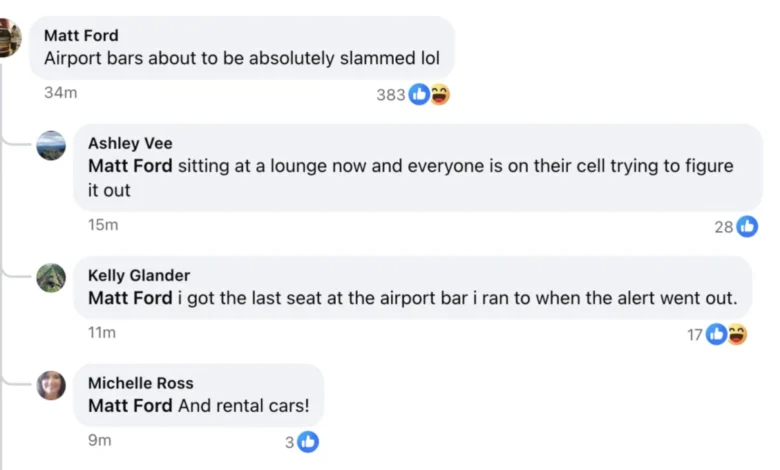
As official updates from the FAA remained sparse in the immediate aftermath, social media platforms became the primary source of information and venting for stranded passengers. On X (formerly Twitter) and Facebook, the discourse shifted rapidly from confusion to dark humor. The timing of the event—occurring on a Friday the 13th, closely following a separate, large-scale Microsoft outage—provided fertile ground for memes.
Users shared images of crowded airport concourses, long queues at security checkpoints, and the growing social scene at airport bars, which became the unofficial waiting rooms for thousands. While the internet’s capacity for levity provided a momentary distraction, the underlying tone of the discourse was one of exhaustion. For many travelers, this was not their first experience with the volatility of modern air travel, and the event solidified a growing public sentiment that the aviation system is currently operating at the edge of its capacity.
Infrastructure and Modernization Challenges
The November 13 failure has intensified the debate regarding the FAA’s $875 million investment in the new SMART (System Management and Airspace Resource Technology) system. The agency had recently announced the expansion of this AI-supported management tool to all 22 regional air traffic control centers. Designed to analyze weather patterns, traffic congestion, and staffing levels, SMART is intended to serve as a predictive engine for efficiency.

However, the occurrence of a nationwide ground stop so soon after the full rollout of this technology has prompted questions from industry analysts and policymakers. If the goal of the modernization effort is to increase safety and reliability, why did a communications disruption necessitate such a drastic, system-wide pause?
Furthermore, the agency’s ongoing efforts to phase out archaic technologies—including, notably, the continued use of legacy systems that still rely on floppy disk technology in some sectors—highlight the immense difficulty of updating a system that cannot afford a moment of downtime. The transition from legacy hardware to cloud-based, AI-integrated infrastructure is a complex operation, and Friday’s event served as a high-stakes stress test that revealed the limitations of this ongoing digital transformation.
Official Responses and Future Implications
Following the resolution of the ground stop, the FAA issued statements emphasizing that safety remained the primary driver behind the decision. Agency officials noted that the communications issue was identified and contained, preventing any potential for mid-air incidents. The White House and the Department of Transportation were briefed throughout the day, as the political pressure to provide answers mounted.
For the airline industry, the implications are significant. Beyond the immediate operational costs of fuel, crew repositioning, and passenger compensation, the event likely poses a challenge to public confidence. When a system as vital as the U.S. national airspace reaches a point of failure, it forces a conversation about the necessity of redundant systems. If one regional node or one software update can cascade into a nationwide shutdown, the current model of air traffic management may require a more robust, decentralized approach to risk mitigation.

The Human Toll: The Traveler’s Perspective
Beyond the technical data and the political maneuvering, the human cost was defined by the loss of time and the uncertainty of travel. In an era where air travel is increasingly commodified and automated, the feeling of being "at the mercy of the machine" is a shared experience. The passengers in Omaha, New York, and Denver who were stranded during the ground stop represent a microcosm of the modern economy: individuals trying to return home, reach business meetings, or connect with family, all reliant on a complex, invisible network that suddenly became painfully visible.
The fact that the disruption was resolved within a single business day will likely prevent long-term economic collapse, but the psychological impact on the traveling public is palpable. As the aviation industry looks toward 2027, the focus will undoubtedly remain on "resiliency." The question facing the FAA is no longer just about how to make flights faster or more efficient, but how to ensure that the system is durable enough to withstand the inevitable technical errors that accompany the integration of advanced AI into aging physical infrastructure.
Conclusion: A Wake-Up Call
The events of November 13, 2026, will be analyzed in technical reports and congressional hearings for months to come. While the memes and social media commentary provided a snapshot of the public’s frustration, the underlying issues are deeply technical and structural. The FAA is currently navigating the most significant technological transition in its history, attempting to modernize an aviation system built for the 20th century to meet the demands of the 21st.
As the agency continues its work to phase out obsolete hardware and refine its AI capabilities, the November 13 ground stop stands as a cautionary tale. It serves as a reminder that technological advancement, while necessary, carries the risk of unforeseen complexities. For now, the skies over the United States are open again, but the pressure on the FAA to demonstrate that it can manage these complex, interconnected systems without further incident has never been higher. The reliance on digital infrastructure is absolute, and in the world of aviation, the margin for error remains, as it always has been, razor-thin.