How the HubSpot Connector for Claude is Transforming Marketing Workflows and Data-Driven Decision Making

The integration of artificial intelligence into daily marketing operations has reached a saturation point, with 98% of marketing teams now utilizing AI in some capacity, according to the latest State of AI in Marketing report from HubSpot. While LLMs like Anthropic’s Claude have long been used for creative tasks—such as drafting social media posts, refining ad copy, and summarizing long-form content—a critical gap has remained: the disconnect between generative AI and live CRM data. The launch of the HubSpot connector for Claude addresses this fundamental friction by allowing the AI to interface directly with customer records, campaign performance metrics, and sales history.
This development marks a significant shift in how marketing departments handle data synthesis. Previously, marketers were forced to export spreadsheets, manually sanitize data, and prompt AI with isolated datasets, leading to fragmented insights. By providing Claude with read access to HubSpot’s Smart CRM, organizations can now execute workflows that are contextually aware of the business’s specific performance metrics and customer behaviors.

The Evolution of AI-Assisted Marketing
The timeline of AI adoption in marketing has moved rapidly from simple text generation to agentic workflows. In early 2023, the focus was primarily on productivity tools that operated in silos. By late 2024, the industry trend shifted toward "connected AI," where models require access to proprietary data to provide utility beyond generic templates. The HubSpot-Claude integration is the logical conclusion of this trajectory, enabling a symbiotic relationship between a CRM’s structured database and a LLM’s unstructured reasoning capabilities.
The technical architecture of the connector is designed to respect organizational boundaries. It functions by allowing Claude to read specific objects—such as contacts, deals, marketing emails, and task lists—while strictly adhering to the user’s existing HubSpot permission settings. This ensures that sensitive information remains governed by enterprise-level security protocols. Furthermore, the "Write" functionality within the connector is gated by an optional "Needs Approval" toggle, ensuring that Claude serves as an assistant rather than an autonomous actor, mitigating the risk of inadvertent data modification.
Operational Advantages and Workflow Integration
The primary advantage of this integration lies in the unification of customer context. When a marketer asks about the efficacy of a past webinar series, the AI no longer relies on static, user-provided summaries. Instead, it queries the CRM for specific event records, attendee engagement levels, and subsequent pipeline conversion rates. This allows for a more nuanced analysis that can identify not just whether a campaign met its goals, but why it succeeded or failed based on real-time interactions.

For content teams, this integration simplifies the transition from strategy to execution. Claude can now ingest the results of recent high-performing email campaigns to inform the tone, structure, and subject lines of future communications. This data-backed approach reduces the reliance on "gut-feel" marketing and ensures that content is tailored to segments that have demonstrated historical affinity for specific messaging.
Furthermore, the connector enables automated administrative assistance. After a debriefing session or a sales call, a marketer can provide a natural language prompt to log notes, update lead statuses, and generate follow-up tasks directly within the HubSpot interface. This capability effectively turns the CRM into an active participant in the marketing workflow rather than a passive repository of information.
Governance and Strategic Oversight
As AI becomes embedded in core business functions, the necessity for robust governance frameworks has grown. Organizations must balance the speed of AI-driven execution with the accuracy required for professional marketing. To maintain brand consistency and data integrity, companies are increasingly adopting a "human-in-the-loop" strategy.

Governance in this context involves four key pillars:
- Skill Review: Establishing standardized prompt libraries ensures that all team members achieve consistent results.
- Shared Standards: Defining clear guidelines for tone, terminology, and legal disclosures that Claude must follow.
- Access Control: Managing which team members have the authority to grant the AI write-access to the CRM.
- Performance Measurement: Tracking the time saved on administrative tasks and the subsequent improvement in campaign ROI.
These controls are essential for preventing "hallucinations"—the tendency of LLMs to generate incorrect or fabricated information. By requiring the AI to cite the specific HubSpot records used to generate an answer, marketers can verify the accuracy of the output before deploying it to customers.
Data-Driven Analysis vs. AI Reasoning
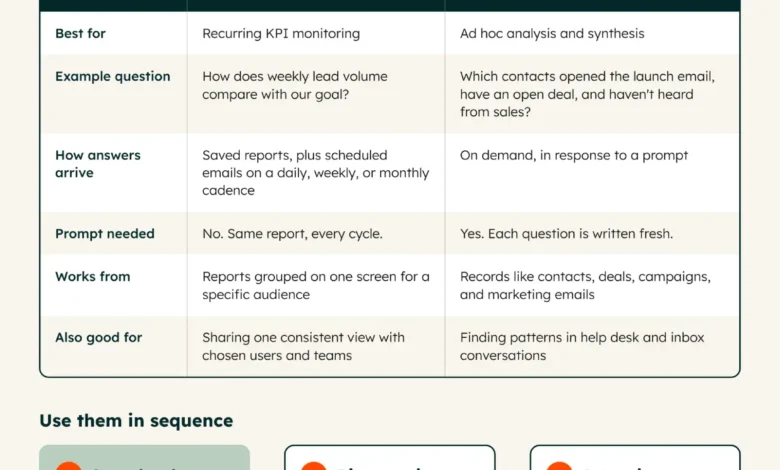
A common misconception in the adoption of these tools is that AI should replace traditional reporting. In reality, dashboards and AI serve distinct functions. HubSpot dashboards are optimized for recurring, high-frequency monitoring—such as tracking weekly lead volume or monthly recurring revenue (MRR). These are static, reliable snapshots of business health that do not require conversational interpretation.

Claude, conversely, is best utilized for ad-hoc, complex, and multi-variable inquiries that have not been accounted for in pre-built dashboards. For instance, while a dashboard can show the total number of contacts in a segment, Claude can analyze the qualitative themes found in support desk tickets or help-desk conversations to explain why those contacts are stagnating in the sales funnel. By running these two systems in tandem, organizations can achieve a holistic view of their marketing ecosystem: dashboards for "what" is happening, and AI for "why" it is happening.
Implications for the Marketing Industry
The broader implication of this integration is the professionalization of AI as a strategic partner. As LLMs gain the ability to navigate complex enterprise databases, the role of the marketer is shifting from a manual creator of assets to an architect of AI-driven processes. This shift requires a new set of competencies: prompt engineering, data literacy, and a rigorous approach to system auditing.
Industry analysts suggest that the next phase of this evolution will likely involve more sophisticated "agentic" behaviors, where AI can manage entire campaign lifecycles from ideation to post-mortem analysis with minimal human intervention, provided the parameters are clearly defined. For now, the focus remains on reliability and the integration of disparate data streams.

As businesses continue to scale their use of these tools, the focus on data hygiene will become paramount. Because the quality of Claude’s output is directly tied to the quality of the data in the CRM, companies that invest in cleaning their contact lists, accurately tagging their campaigns, and maintaining comprehensive engagement histories will derive the most value from these integrations.
In summary, the connection between HubSpot and Claude represents a maturation of marketing technology. By moving beyond the novelty of generative text and into the realm of data-integrated reasoning, marketing teams are better equipped to handle the complexities of modern buyer journeys. The combination of structural CRM data and the generative capabilities of Claude allows for a level of personalization and operational efficiency that was previously unattainable for teams without significant engineering resources. As these tools continue to evolve, the distinction between "marketing" and "marketing technology" will likely continue to blur, necessitating a workforce that is as comfortable with logic and data as it is with creativity and communication.