Astronomers observe a star spiraling to its death inside a giant companion in the Andromeda Galaxy

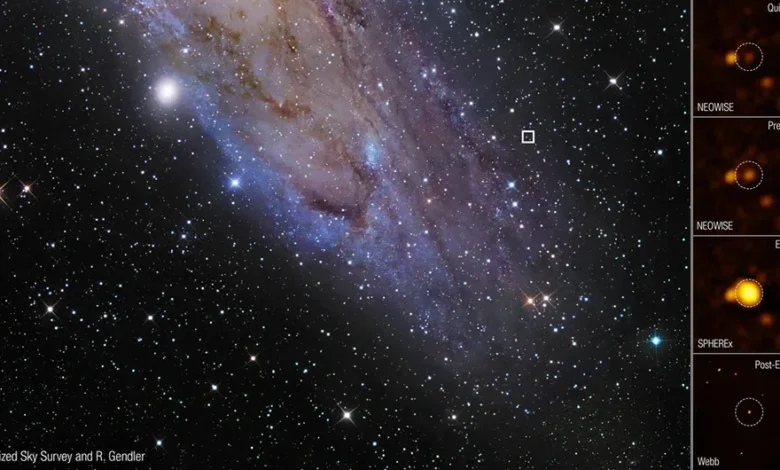
In a landmark astronomical discovery that confirms long-standing theoretical models of stellar evolution, researchers have documented the complete lifecycle of a "common envelope" event. Located in the Andromeda Galaxy (M31), the system designated AT 2025abao has provided scientists with the first-ever real-time observation of a massive star gradually engulfing its smaller stellar companion. This rare cosmic spectacle, which culminated in a violent eruption in late 2025, offers a definitive look at the process that dictates the formation of the universe’s most tightly bound binary star systems.
The study, published in the journal Nature, was led by astrophysicist Viraj Karambelkar of Columbia University. By synthesizing decades of observational data, the team managed to capture a phenomenon that astronomers have theorized since the 1970s but had never witnessed in its entirety. The event represents a critical "blip" on the cosmic timescale, occurring over a period of just a few years, compared to the millions of years typically required for stellar evolution.
The Mechanism of Common Envelope Evolution
Binary star systems are common throughout the universe, but some exist in configurations so tight that they defy standard formation models. Theoretical astrophysics suggests that these tight orbits are the result of common envelope evolution. This process begins when one star—typically the more massive or more evolved of the pair—expands into a giant, creating an outer atmosphere so vast that it encompasses its companion.
Once inside the giant’s envelope, the smaller star begins to orbit through the dense gas. This movement creates friction, which drags on the smaller star, siphoning away its orbital energy and forcing it to spiral inward toward the core of the larger star. The fate of this pair depends on the energy budget of the system: if enough of the envelope is ejected, the pair may survive in a significantly tightened orbit. If not, the stars merge into a single, highly energetic object. AT 2025abao has provided the most detailed evidence yet of this terminal spiral.
A Chronology of the Engulfment
The history of the AT 2025abao system is a testament to the power of archival data and modern transient surveys. By analyzing photographic sky plates dating back to 1989, the research team established that the system remained remarkably stable for nearly three decades. During this period, the primary star was identified as a giant approximately 350 times the diameter of our Sun, outshining its unseen companion by a factor of 18,000.
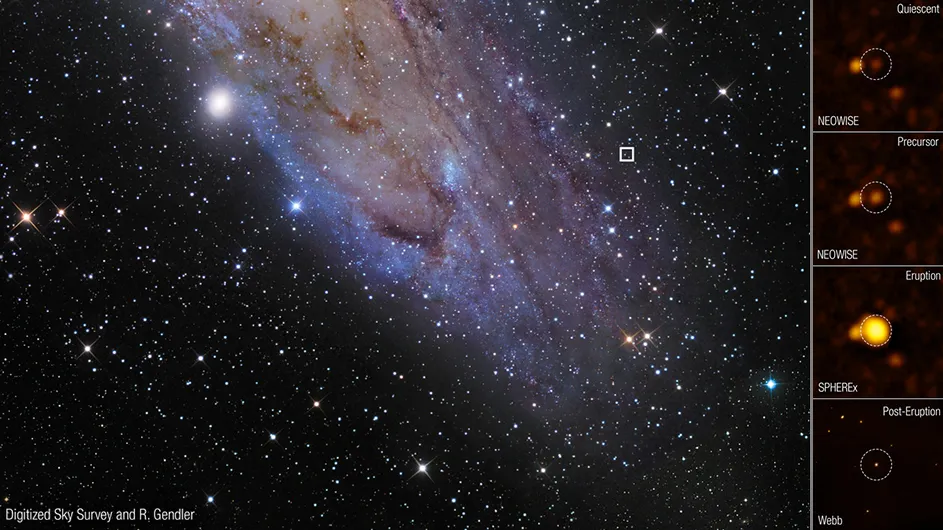
The first signs of trouble appeared around 2018. Using data from the Wide-field Infrared Transient Explorer (WINTER) at Palomar Observatory and NASA’s NEOWISE mission, astronomers noted a steady, subtle brightening. This increase in infrared luminosity was the tell-tale signature of the companion star beginning its descent into the giant’s outer layers.
By April 2025, the research team identified the system as a primary candidate for an active engulfment. As the companion skimmed through the giant’s atmosphere, the friction generated immense heat, causing the giant to swell and brighten by two to three times its visible-light baseline. By July 2025, observations from NASA’s SPHEREx space telescope revealed that the giant had expanded to 860 times the diameter of the Sun, cocooned in a fresh shroud of dust shed during the process.
The climax arrived in October 2025. In a span of just 25 days, the system brightened 100-fold, reaching a peak luminosity equivalent to 1.5 million Suns. Researchers described this moment as the "final plunge," where the companion, no longer able to maintain its orbit, crashed into the core of the giant. This catastrophic collision acted like a bomb detonating within the star, ejecting a significant portion of the stellar material and resulting in an outburst characteristic of a luminous red nova.
Quantitative Analysis and Energy Budgets
The data harvested from AT 2025abao has allowed scientists to refine the "energy budget" equations used to predict the outcomes of stellar mergers. The research team calculated that during the initial, slow phase of the spiral, the energy lost by the companion was primarily radiated away as light. However, during the final, violent crash, the physics changed significantly.
Only about 1 percent of the energy released in the final plunge was radiated as light. The remaining 99 percent was channeled into kinetic energy, propelling a tenth of the giant’s envelope outward at speeds ten times higher than the escape velocity of the star. This high-speed ejection suggests that the companion did not survive as a partner but rather merged completely with the primary’s core.
This observation also provides an answer to a long-standing question in stellar morphology: the origin of hourglass-shaped nebulae. The team observed that the material shed during the slow-spiral phase formed a disk-like structure in the orbital plane. When the final, high-energy explosion occurred, this disk acted as a nozzle, forcing the ejecta to expand outward toward the poles. This effectively confirms the hypothesis that binary interactions are the primary drivers of the complex, bipolar shapes observed in many dying stars.

Scientific Implications and Future Outlook
The findings represent a significant shift in our understanding of stellar death. Previously, all known luminous red novae were associated with younger, more compact stars. The AT 2025abao event demonstrates that even older, loosely bound giants can undergo these cataclysmic transitions.
The implications for galactic evolution are profound. By confirming the mechanism of common envelope evolution, astronomers can better predict the frequency of binary mergers, which are essential precursors to other exotic phenomena, including certain types of supernovae and gravitational wave events.
"This was a once-in-a-career observation," the team noted in their assessment, emphasizing that the "blown-away" state of their scientific understanding regarding this specific system is a direct result of the unexpected nature of the eruption. While the team remains cautious—noting that the dense dust clouds currently obscuring the core make it impossible to definitively confirm the merger versus a surviving, ultra-tight binary—they intend to continue monitoring the system for years to come.
As the dust eventually dissipates, the true nature of the remaining object will be revealed. Meanwhile, the astronomical community is looking forward to the deployment of the Vera Rubin Observatory and the Nancy Grace Roman Space Telescope. These next-generation instruments are expected to increase the detection rate of such events, moving from rare, accidental discoveries to a steady influx of data. Experts estimate that these telescopes could detect several similar engulfment events annually within a 50-million-light-year radius, providing a statistically significant sample size to further map the final, turbulent stages of stellar life.
For now, the AT 2025abao event stands as a definitive reference point—a rare glimpse into the chaotic, violent, and beautiful reality of how stars reach their final, combined destiny. The study serves as a reminder that even the most stable-looking points of light in the night sky are subject to dynamic, evolving processes that fundamentally reshape the architecture of galaxies.
Related posts: