Critical Ghostscript Vulnerability Allows Sandbox Escape and Arbitrary Command Execution Across Popular Linux Applications

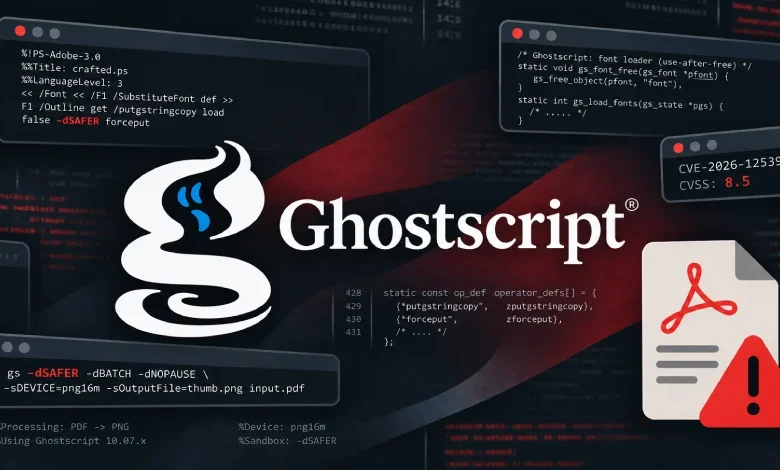
A severe, now-patched security flaw affecting Ghostscript—the widely utilized PostScript and PDF interpreter integrated into numerous Linux distributions and software environments—has been brought to light by security researchers, demonstrating how standard file-upload, preview, and print functionalities can be weaponized to execute arbitrary commands on underlying servers. Tracked under the identifier CVE-2026-125396 and carrying a high severity score of 8.5 out of 10, the vulnerability highlights the pervasive risks inherent in multi-layered document processing pipelines. Although Artifex, the organization behind Ghostscript, swiftly released a patch in early September, the discovery has triggered an urgent industry-wide scramble to update localized renderers, container images, and dependent enterprise libraries.
Understanding the Mechanics of the Vulnerability
At its core, the security flaw resides in a memory management weakness—specifically, a use-after-free condition—within the font-loading subsystem of Ghostscript. Ghostscript is routinely employed by modern operating systems and application frameworks to interpret, convert, and render complex vector and raster formats, including PDFs, PostScript files, and encapsulated PostScript (EPS) graphics. To mitigate the obvious security dangers of executing arbitrary code embedded within untrusted documents, Ghostscript relies on a built-in security sandbox known as -dSAFER. This protective wrapper is explicitly designed to restrict the interpreter from accessing local files on the host system or issuing system-level commands.

However, security firm pwn.ai demonstrated that a meticulously crafted, malicious document can exploit the use-after-free vulnerability during the font-parsing phase. By manipulating pointers in memory, the weaponized file effectively dismantles the security checks enforced by -dSAFER. Once these restrictions are disabled, the document can break out of its operational sandbox and execute commands directly on the host server.
What makes this vulnerability particularly insidious is that applications rarely invoke Ghostscript directly. Instead, common graphics and document-processing libraries—such as ImageMagick, Pillow, libvips, and various Qt plugins—automatically hand off PostScript or EPS data streams to Ghostscript for rendering, regardless of whether the file extension has been deliberately masked as a benign .png, .jpg, or .pdf. Routine, background administrative actions such as generating automated image thumbnails, cropping pictures, or processing print queues can inadvertently trigger the vulnerable interpreter.
Chronology and Attack Vector Analysis
The discovery of CVE-2026-125396 stems from extensive, systematic research conducted by pwn.ai, which evaluated approximately ten common applications and enterprise software packages. The researchers proved that attackers could leverage network-facing vectors to reach Ghostscript without requiring prior authentication in several standard configurations:

- Network Print Queues: Anonymous print jobs submitted to shared network environments running systems like Debian 13 successfully triggered the vulnerability and executed low-privilege shell commands.
- Webmail Clients: Email attachments processed by platforms like Roundcube webmail executed commands instantaneously upon the recipient opening the malicious message, bypassing any user interaction beyond viewing the email.
- Public Upload Portals: Unauthenticated public file upload forms embedded within popular WordPress plugins, such as Forminator and Essential Addons for Elementor, served as direct conduits for the exploit payload.
- Core Content Management Systems: Standard installations of WordPress required authenticated access with file-upload privileges (assigned by default to Author roles and above), representing a localized entry point that could still be chained with other vulnerabilities.
Subsequent technical analysis of the published proof-of-concept file revealed that the foundational exploit payload manipulates internal memory values within the running interpreter. By safely toggling memory registers up and down without invoking external shell scripts during initial testing phases, the proof-of-concept demonstrated how deep memory corruption can be achieved silently before failing gracefully on fully patched systems.
Timeline of Disclosures, Patches, and Software Responses
The path to remediation has required coordinated efforts across multiple open-source projects, vendors, and maintainers due to the decentralized way software dependencies are packaged:
- August 12, 2026: WordPress proactively addressed a portion of the attack chain within its core ecosystem by closing a related file upload vulnerability in WordPress version 7.0.4, tracked under CVE-2026-65640. While this update restricted specific web-based attack vectors, it did not resolve the underlying Ghostscript interpreter flaw.
- September 8, 2026: Artifex officially released Ghostscript version 10.08.0, containing a comprehensive fix for CVE-2026-125396. Ken Sharp, the lead developer managing the remediation, acknowledged in official bug tracking reports that the vulnerable component was "an ancient piece of code well known to be a vulnerability, but difficult to eradicate." The patch effectively refactored the legacy font-loading subsystem into a modernized, memory-safe architecture.
- Mid-September 2026: Security advisories were formally published, including a detailed vulnerability assessment by VulnCheck scoring the flaw at 8.5, alongside comprehensive impact mapping provided by pwn.ai outlining affected frameworks, container builds, and enterprise services such as Google, which successfully remediated its internal processing pathways.
The Challenge of Distributed Dependencies and Containerization
A significant hurdle in neutralizing CVE-2026-125396 across enterprise networks involves the fragmented nature of modern software packaging. Updating the base operating system’s package manager does not automatically patch independent copies of Ghostscript bundled directly within container images, microservices, or proprietary application runtimes. Consequently, many document-processing workers have continued to execute vulnerable versions of the interpreter even after host systems received upstream patches.

Furthermore, security audits revealed uneven patch adoption rates across major Linux distributions. While enterprise-grade Linux distributions and rolling-release platforms evaluated their package repositories, administrators were forced to audit complex container topologies manually.
Mitigation Strategies and Defensive Recommendations
Because full remediation depends on updating the underlying rendering engine across every localized instance, security experts recommend implementing a defense-in-depth strategy to minimize exposure while updates are deployed:
- Enforce Strict Authentication: Restrict network print queues and shared printing services to authenticated users only, eliminating anonymous submission vectors.
- Validate and Sanitize Input Types: Implement rigorous file validation checks that inspect the actual magic bytes of uploaded documents rather than relying solely on file extensions or metadata headers, rejecting unexpected PostScript or EPS streams.
- Harden System Policies: Utilize mandatory access control frameworks such as AppArmor or SELinux profiles to restrict the operational boundaries of document processors. Testing has shown that well-configured AppArmor profiles can successfully prevent a compromised Ghostscript interpreter from spawning external shell processes, even when a sandbox escape is achieved.
- Isolate Processing Workers: Run document conversion and rendering tasks inside ephemeral, isolated containers with minimal privilege levels, ensuring that a successful sandbox breach cannot propagate to core system files or internal corporate networks.
As threat intelligence teams continue to monitor exploitation attempts in the wild, the incident serves as a stark reminder of the systemic risks posed by legacy code dependencies embedded deep within modern software supply chains.