A critical security vulnerability identified as CVE-2026-51990 has exposed hundreds of millions of users of the Sogou Input Method for Windows to a sophisticated espionage campaign. Cybersecurity researchers at Gen Threat Labs have confirmed that a China-aligned threat actor, tracked as UNC3569, is actively exploiting a one-click remote code execution (RCE) flaw within the popular software to facilitate the deployment of the GrayRabbit backdoor. This incident highlights the significant risks posed by the integration of outdated third-party software components—specifically legacy browser engines—into widely used desktop applications.
The Mechanism of the Attack Chain
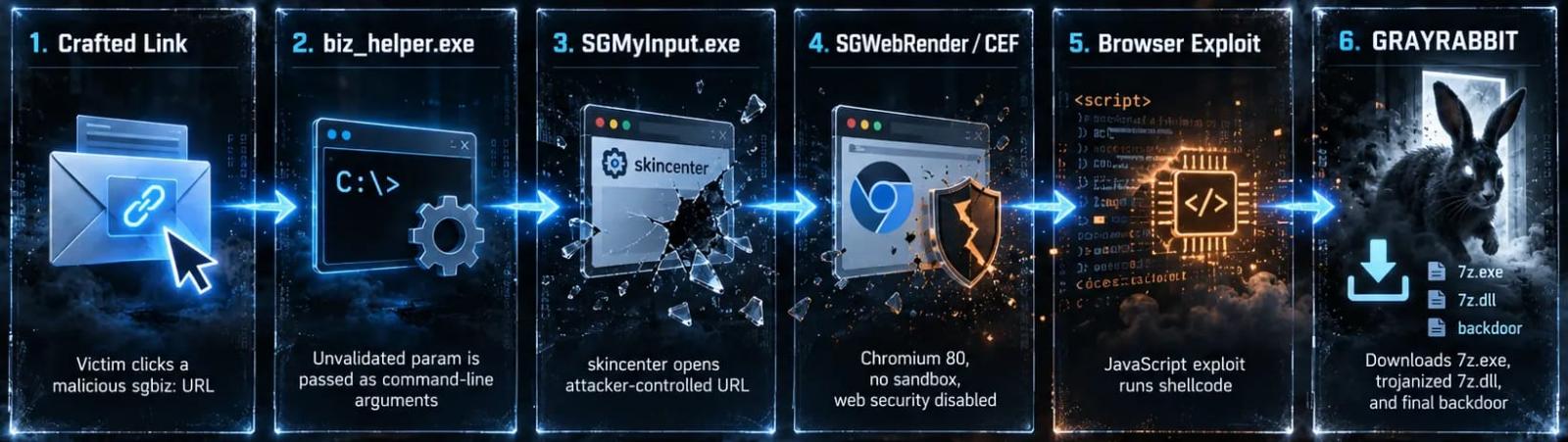
The vulnerability centers on the Sogou Input Method, a ubiquitous tool for Chinese-language text input developed by Tencent. The attack chain utilized by UNC3569 is remarkably efficient, requiring only a single interaction from the victim to compromise the host system. The process relies on the exploitation of a custom URI handler, "sgbiz:", which is designed to integrate the application with web-based features.
When a user clicks a malicious link embedded with the "sgbiz:" protocol, the Windows operating system triggers the application’s "biz_helper.exe" protocol handler. This component, acting as a gateway for incoming commands, fails to perform adequate validation on the command-line arguments it receives. Consequently, the handler passes attacker-controlled input directly to the legitimate "SGMyInput.exe" executable.
The second stage of the infection involves the manipulation of Sogou’s internal "skincenter" component. By injecting specific arguments, the attackers force the embedded Chromium webview to navigate to a URL of their choosing. Because the Sogou implementation lacks restrictive filters on URL schemes or destination domains, the application becomes a vehicle for delivering malicious content.
The final stage leverages the inherent insecurity of the application’s environment. The Sogou Input Method utilizes an outdated version of the Chromium 80 engine, which is riddled with known vulnerabilities. Because this webview operates without the standard security "sandbox" and has critical browser protections disabled, the attackers can execute arbitrary code upon the page load, ultimately dropping the GrayRabbit backdoor onto the victim’s machine.

Chronology of Discovery and Remediation
The timeline of this vulnerability reveals a critical window of exposure. Gen Threat Labs first identified the malicious activity associated with UNC3569 and traced the infection vector back to the Sogou application. Recognizing the potential for widespread damage, the researchers initiated a responsible disclosure process on April 9, 2026, alerting Tencent to the flaw and providing detailed evidence of the exploit chain.
Tencent responded to the disclosure by developing and deploying a patch within twelve days. The fix, released on April 21, 2026, in Sogou Input Method version 16.3.0.3498, addresses the primary entry point by validating URL arguments accepted through the protocol handler. Furthermore, the update restricts navigation to HTTPS and limits permissible domains to those officially associated with Tencent and Sogou services.
However, security analysts remain concerned. While the patch mitigates the immediate "one-click" exploit, the fundamental issue of the application running an antiquated, non-sandboxed Chromium engine remains unresolved. This leaves the door open for future, potentially more complex, exploits that could bypass the new URL validation checks.
Profile of the UNC3569 Actor and GrayRabbit Malware
The threat actor behind this campaign, UNC3569, has been a subject of intense scrutiny within the intelligence community since 2024. Often categorized as a "contractor-for-hire" group, UNC3569 demonstrates a high level of operational maturity. Their focus typically aligns with espionage activities, often targeting specific individuals or organizations of interest to their state sponsors.
The GrayRabbit malware, which serves as the primary payload in this campaign, is a modular backdoor that has evolved significantly over the past two years. The 64-bit variant analyzed by Gen Threat Labs exhibits advanced features, including an expanded command set and a sophisticated communication protocol. By utilizing RC4-encoded configurations for command-and-control (C2) communication, the malware attempts to evade signature-based detection.
Once established on a target system, GrayRabbit provides the attackers with a comprehensive suite of tools. Its capabilities include:
- Interactive Reverse Shells: Allowing attackers to execute commands manually on the compromised host.
- Data Exfiltration: Enabling the theft of sensitive documents, system configuration files, and user information.
- Process Execution: Running additional malicious payloads or system utilities.
- Memory-Only Plugins: A stealthy technique that allows the malware to load new functionalities directly into the system’s RAM, minimizing its footprint on the hard drive.
Broader Implications for Software Security
The Sogou incident serves as a poignant case study on the "supply chain" risk inherent in modern software development. Applications that bundle third-party browsers or rendering engines often fail to maintain those components at the same security cadence as the primary software. By embedding an obsolete browser engine—Chromium 80, which is several years behind current industry standards—the developers effectively introduced a legacy attack surface into a modern, widely used application.
Industry experts emphasize that "browser-in-an-app" implementations often neglect the layered security model that browsers like Chrome or Edge take for granted. The absence of sandboxing in the Sogou implementation effectively removes the most critical line of defense against web-based attacks. When a process runs with elevated privileges and lacks a sandbox, a successful exploit of the rendering engine is almost certain to result in full system compromise.
For enterprise environments, this underscores the importance of application whitelisting and network segmentation. Because the Sogou Input Method is a standard tool for millions of employees, blocking its use entirely is often not a practical solution. Instead, organizations must focus on robust endpoint detection and response (EDR) solutions that can monitor for anomalous behavior triggered by legitimate processes, such as "SGMyInput.exe" launching unexpected child processes or initiating unauthorized network connections to unknown C2 servers.
The Challenge of Legacy Code in Modern Ecosystems
The persistence of legacy code is not unique to Tencent. Many global software vendors rely on "frozen" versions of open-source projects to maintain compatibility with older systems or to avoid the resource-heavy process of refactoring code when new versions of dependencies are released. However, as the GrayRabbit campaign demonstrates, this technical debt carries a high security cost.
The remediation steps taken by Tencent—validating protocols and restricting URLs—are standard defensive practices, yet they act as "band-aid" solutions. As long as the underlying rendering engine remains outdated and un-sandboxed, the attack surface persists. The incident serves as a warning to software developers: modularity must be paired with continuous lifecycle management. If a component is no longer maintained by its upstream developer, it must be replaced or isolated in a highly restrictive environment to prevent it from becoming a liability.
As the digital landscape becomes increasingly hostile, the reliance on automated security updates and rigorous vulnerability management is no longer optional. Users of the Sogou Input Method are strongly encouraged to verify that they are running version 16.3.0.3498 or later. Nevertheless, the security community continues to watch the situation closely, anticipating that the actors behind UNC3569 will likely pivot their strategies to find new avenues into the millions of systems that continue to rely on the software.