The Evolution of Information Retrieval
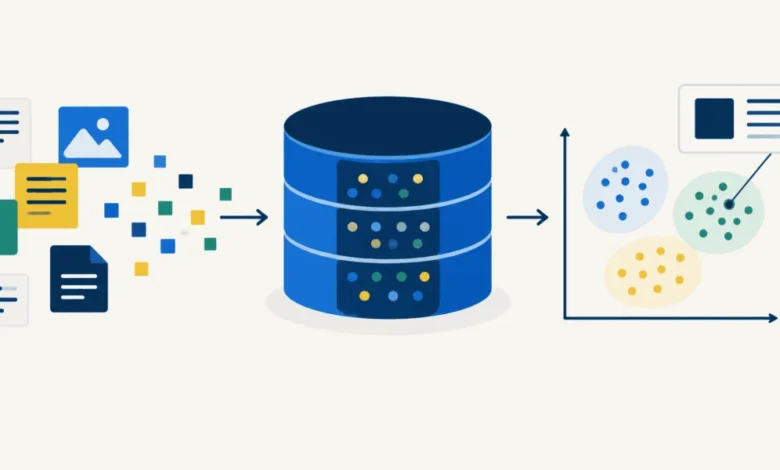
In the landscape of modern data management, traditional relational databases and keyword-based search engines often struggle with the nuance of human language. A standard database looks for exact matches of strings; if a user searches for "cellular power," but the document only contains "mitochondria," the search engine may return zero results. Vector databases represent a paradigm shift in this domain. By converting text into high-dimensional vectors—arrays of numbers that capture the semantic essence of the content—these databases enable computers to understand "meaning" rather than just syntax.
The rise of Large Language Models (LLMs) and Retrieval-Augmented Generation (RAG) has propelled vector databases into the spotlight. As enterprises seek to ground their AI models in proprietary data, the ability to store, index, and retrieve information based on conceptual similarity has become a critical skill for software engineers and data scientists alike.
Decoding the Mechanism
At the core of a vector database is the concept of an embedding—a dense vector representation of data. When a document is processed, an embedding model maps it into a vector space. Similar concepts are placed in proximity to one another within this mathematical space. The process of searching becomes a geometric problem: calculating the "distance" between the query vector and the document vectors.
As detailed in the 10-step implementation guide, the process relies on three primary components: the document corpus, the embedding model, and the index. By utilizing sentence-transformers, a library built on PyTorch, developers can transform raw text into 384-dimensional vectors. Once these vectors are stored in a NumPy array, a simple dot product operation determines the cosine similarity, ranking the most relevant documents by how closely their vectors align with the query.
A Chronology of Implementation
The development process follows a logical progression designed to build competence without the need for specialized hardware like GPUs.
- Environmental Setup: The initial phase involves preparing the workspace, installing necessary dependencies such as
numpyandsentence-transformers, and initializing helper functions to format search results. - Indexing Strategy: The second step demonstrates how to batch-process documents. Crucially, this step reveals that vector index size is fixed based on the model’s dimensions, not the length of the document, ensuring predictable memory usage.
- Semantic Querying: Subsequent steps introduce the search functionality. Developers quickly observe that, unlike traditional Boolean search, vector databases successfully identify relevant documents even when no words are shared between the query and the text.
- Metadata Filtering: To replicate real-world enterprise requirements, the implementation introduces metadata tagging. This allows for "pre-filtering," where the database narrows the search space by category (e.g., "bio" or "music") before performing the computationally expensive vector scan.
- Robustness and Persistence: The later stages focus on software engineering best practices, such as implementing guard rails to prevent data corruption during the indexing process and building serialization methods to save the database state to local storage.
Data-Driven Performance and Scalability
A common concern for developers adopting vector databases is performance at scale. The tutorial addresses this by benchmarking search times across different corpus sizes. The empirical data shows that even as the database grows to 100,000 documents, the scan time remains remarkably low, typically staying under 10 milliseconds.
| Number of Documents | Memory Usage | Scan Latency | Rank Latency |
|---|---|---|---|
| 1,000 | 1.5 MB | 0.01 ms | 0.04 ms |
| 10,000 | 14.6 MB | 0.36 ms | 0.55 ms |
| 100,000 | 146.5 MB | 3.73 ms | 8.90 ms |
These figures demonstrate that for many mid-sized applications, the bottleneck is not the vector search itself, but the embedding process and the overhead of managing the index. For massive datasets containing millions of items, professional managed databases implement "Approximate Nearest Neighbor" (ANN) algorithms—such as HNSW (Hierarchical Navigable Small World) or IVF (Inverted File Index)—which sacrifice a negligible amount of accuracy for a massive increase in search speed.
Implications for the AI Ecosystem
The accessibility of this tutorial signals a broader shift in the tech industry: the commoditization of AI infrastructure. By demonstrating that the "magic" of a vector database can be distilled into a few hundred lines of Python code, the project highlights that the complexity of modern AI is often in the abstraction layers rather than the core mathematical operations.
For organizations, this implies that building custom, lightweight search solutions is becoming increasingly feasible. While hyperscale enterprises will continue to rely on robust, managed services like Pinecone, Milvus, or Weaviate for production-grade, distributed systems, the underlying principles remain constant. Understanding the mechanics of vector math and cosine similarity allows developers to troubleshoot performance issues, optimize storage, and better evaluate which managed service best fits their specific data architecture.
Industry Perspective
Industry analysts observe that the "vectorization" of data is one of the most significant architectural changes in data engineering since the adoption of NoSQL. By treating unstructured data—images, audio, and text—as numerical vectors, companies can finally query the semantic relationships within their data silos.
"The transition from keyword to semantic search is not just a feature upgrade; it is a foundational change in how we interact with information," noted one lead data engineer involved in enterprise AI integration. "When you can build a working model in 10 steps, you remove the barrier to entry that has historically kept this technology in the hands of a few specialized firms."
Looking Forward
The final lesson from this technical breakdown is the importance of "bookkeeping." While the dot product is the engine, the ability to manage metadata, ensure data consistency, and handle serialization is what differentiates a prototype from a production system. As AI continues to integrate into every facet of software development, the ability to architect these systems—starting from the raw vector math—will remain an essential skill for the next generation of engineers.
By deconstructing the vector database, this tutorial provides a roadmap for those looking to move beyond the surface level of AI tools and understand the logical foundation upon which the next decade of information retrieval will be built. Whether for simple document indexing or the complex demands of generative AI agents, the principles remain the same: align, index, and retrieve.