Speculative Decoding Explained: Achieving 3x Faster Inference for Large Language Models

The deployment of Large Language Models (LLMs) has transformed the landscape of artificial intelligence, yet a persistent architectural bottleneck continues to challenge engineers and developers: the autoregressive nature of token generation. As organizations scale AI applications from research prototypes to production-grade environments, the latency associated with generating responses token-by-token has emerged as a significant barrier. Speculative decoding has surfaced as a sophisticated solution to this challenge, enabling inference speedups of 2x to 3x without requiring model retraining or compromising output fidelity. By decoupling the generation of candidate tokens from the verification of those tokens, this technique effectively optimizes the utilization of GPU hardware, moving the industry toward more responsive and efficient real-time AI agents.
The Architectural Bottleneck: Memory-Bandwidth Constraints
To understand the necessity of speculative decoding, one must first examine the mechanics of standard LLM inference. Modern transformers process text autoregressively, meaning the model predicts the next token based on all preceding ones. For each individual token generated, the entire model—often consisting of tens or hundreds of billions of parameters—must be accessed from the GPU’s high-bandwidth memory (HBM) and loaded into the compute cores.
This process is fundamentally memory-bandwidth bound rather than compute-bound. While modern hardware, such as the NVIDIA H100 Tensor Core GPU, possesses massive theoretical floating-point performance, that compute capacity remains largely idle while the system waits for the transfer of model weights. Every single token requires a full memory read, effectively capping the speed of generation by the bandwidth of the memory bus. As models grow in size, this constraint becomes more acute, creating a "memory wall" that forces users to wait seconds for long-form outputs, such as code generation or complex technical documentation.
Historical Context and the Evolution of Inference
The challenge of token latency has been a central focus of the machine learning community since the widespread adoption of GPT-style architectures. Early attempts to mitigate latency involved techniques such as model distillation, which compresses knowledge into smaller models, or quantization, which reduces the precision of weights. While effective, these methods often necessitate a trade-off in reasoning capability or accuracy.
Speculative decoding represents a paradigm shift because it preserves the mathematical integrity of the original "target" model. First popularized in research papers such as "Fast Inference from Transformers via Speculative Decoding" (Chen et al., 2023), the technique gained traction as practitioners sought to maintain the precision of state-of-the-art models like Llama 3 or Mistral while meeting the demands of low-latency applications. Since its introduction, the methodology has evolved from simple two-model setups to more complex, integrated architectures like Medusa and Eagle, reflecting an industry-wide push to optimize inference at the framework level.
The Mechanism of Speculative Decoding
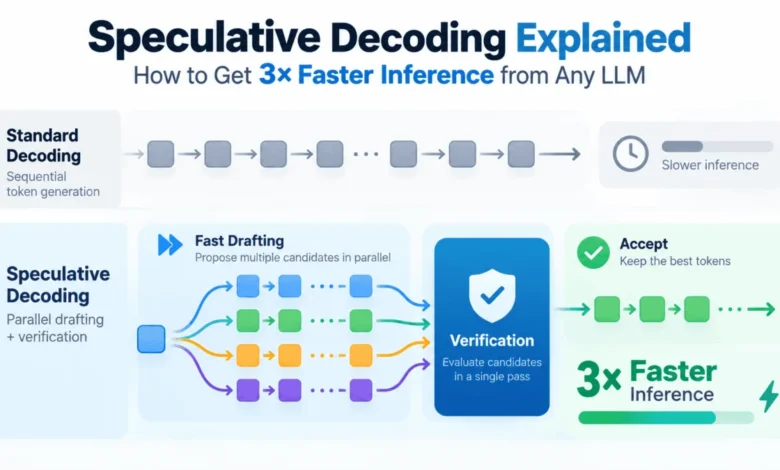
The speculative decoding workflow operates through a dual-model interaction. The primary, high-capacity model (the "target") is paired with a significantly smaller, faster model (the "draft"). The process can be broken down into a specific iterative cycle:
- Drafting Phase: The lightweight draft model generates a sequence of $K$ tokens in a rapid, autoregressive fashion. Because the draft model is small, these tokens are produced in a fraction of the time required by the target model.
- Verification Phase: The target model receives this sequence of $K$ candidate tokens. Crucially, the target model processes these tokens in a single parallel batch operation. By evaluating the sequence at once, the target model performs its intensive matrix calculations while loading its weights into the GPU memory only once, rather than $K$ times.
- Probabilistic Rejection/Acceptance: The target model compares the draft tokens against its own probability distribution. Tokens that align with the target model’s internal logic are accepted; tokens that deviate are rejected and corrected.
- Mathematical Guarantee: Through a process of rejection sampling, the final output remains statistically indistinguishable from a standard autoregressive run. The method ensures that even if the draft model guesses incorrectly, the final probability distribution of the output is identical to that of the target model alone.
Data-Driven Performance and Benchmarking
Industry benchmarks consistently show that the effectiveness of speculative decoding is heavily dependent on the "acceptance rate"—the frequency at which the draft model’s suggestions match the target model’s requirements.
In controlled environments, models such as a 70B parameter target paired with a 7B parameter draft have demonstrated speedups of 2.5x in tasks involving structured text. For instance, when generating source code, where syntax is often predictable and repetitive, acceptance rates frequently climb above 80%. Conversely, in highly creative or "high-entropy" tasks—such as open-ended brainstorming or poetry generation—the draft model may struggle to anticipate the target model, leading to lower acceptance rates and reduced performance gains.
Engineers generally observe that the optimal balance is achieved when the draft model is roughly 1/10th the size of the target model. If the draft model is too large, the overhead of generating the draft becomes a burden; if it is too small, the low acceptance rate negates the efficiency gains of the parallel verification pass.
Modern Implementations: Beyond Two-Model Systems
As the technique has matured, developers have moved toward more streamlined implementations that reduce the overhead of running two concurrent models.
- Medusa (Multi-Head Decoding): Developed by researchers at UC San Diego, Medusa introduces multiple "heads" on the target model itself. These heads predict future tokens simultaneously, allowing the model to draft its own candidates without the need for a separate, secondary model. This minimizes memory overhead and simplifies deployment.
- Eagle: This iteration refines the drafting process by utilizing the target model’s hidden states, which encode deeper semantic context. By using these internal representations, Eagle achieves significantly higher acceptance rates than traditional speculative methods, particularly in domain-specific tasks like legal or medical document analysis.
- Prompt Lookup Decoding: This is a zero-model approach that exploits the recurring nature of prompts. By identifying long sequences in the input that are likely to appear in the output, the system can "look up" these phrases and verify them instantly. This is particularly effective for RAG (Retrieval-Augmented Generation) systems where the model is tasked with citing or summarizing source documents.
Strategic Implications for Production
For organizations deploying LLMs at scale, the implications of speculative decoding are profound. It transforms the cost-benefit analysis of infrastructure. By increasing tokens-per-second, companies can achieve higher throughput on existing hardware, effectively lowering the cost-per-request.
However, practitioners must weigh these benefits against the complexity of the deployment stack. In high-density environments—where a server handles hundreds of concurrent users—speculative decoding can lead to "resource contention." Because speculative decoding uses extra GPU cycles to draft and verify, it may reduce the total number of requests a server can process simultaneously. Therefore, the technique is best suited for "latency-sensitive" applications, such as real-time customer support bots or interactive coding copilots, rather than massive batch-processing tasks.
Conclusion
Speculative decoding stands as a critical milestone in the maturation of LLM technology. By addressing the fundamental memory-bandwidth limitations of modern hardware, it provides a pathway to faster, more efficient AI without sacrificing the quality or reliability of the output. As frameworks like vLLM and llama.cpp continue to integrate these techniques natively, the barrier to implementation is falling. For developers, the transition from standard autoregressive generation to speculative approaches is no longer a niche research endeavor but a standard optimization strategy, ensuring that the next generation of AI applications can meet the speed requirements of a modern digital workforce.