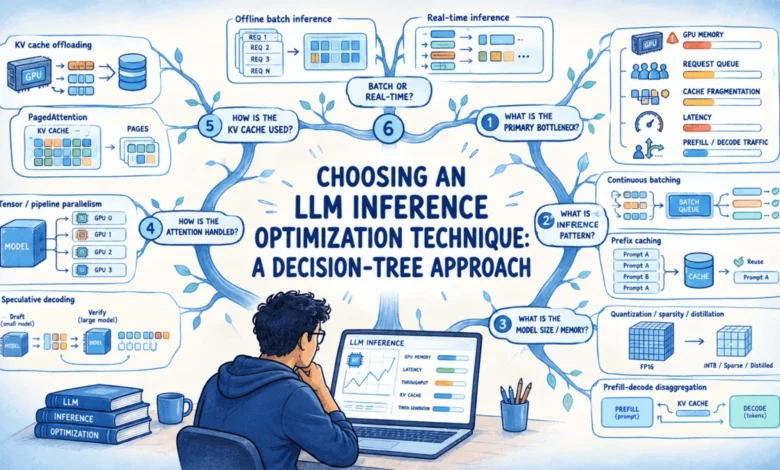
The Engineering Imperative for Inference Efficiency
The rapid proliferation of transformer-based architectures has brought about a significant shift in computational infrastructure requirements. Unlike traditional software, LLM inference is characterized by memory-intensive operations where the GPU spends a substantial portion of its time waiting for data to be moved from high-bandwidth memory (HBM) to compute units. This phenomenon, often referred to as being "memory-bound," is exacerbated by the KV (Key-Value) cache—a storage buffer that maintains context for ongoing generations. As requests queue behind long generations, the hardware becomes saturated, leading to the "long tail" latency issues that plague user experience.
Inference optimization is not a monolithic field; it is a specialized discipline comprising diverse techniques that target specific stages of the model execution lifecycle. Some methods, such as quantization, address the memory footprint of the model weights, while others, like continuous batching, optimize the scheduling of incoming requests. Selecting the incorrect technique can lead to "over-engineering," where the complexity of the system outpaces the performance gains. To navigate this landscape, engineers must diagnose their specific bottleneck through a rigorous, question-based diagnostic framework.
Diagnostic Phase: The Six-Question Decision Tree
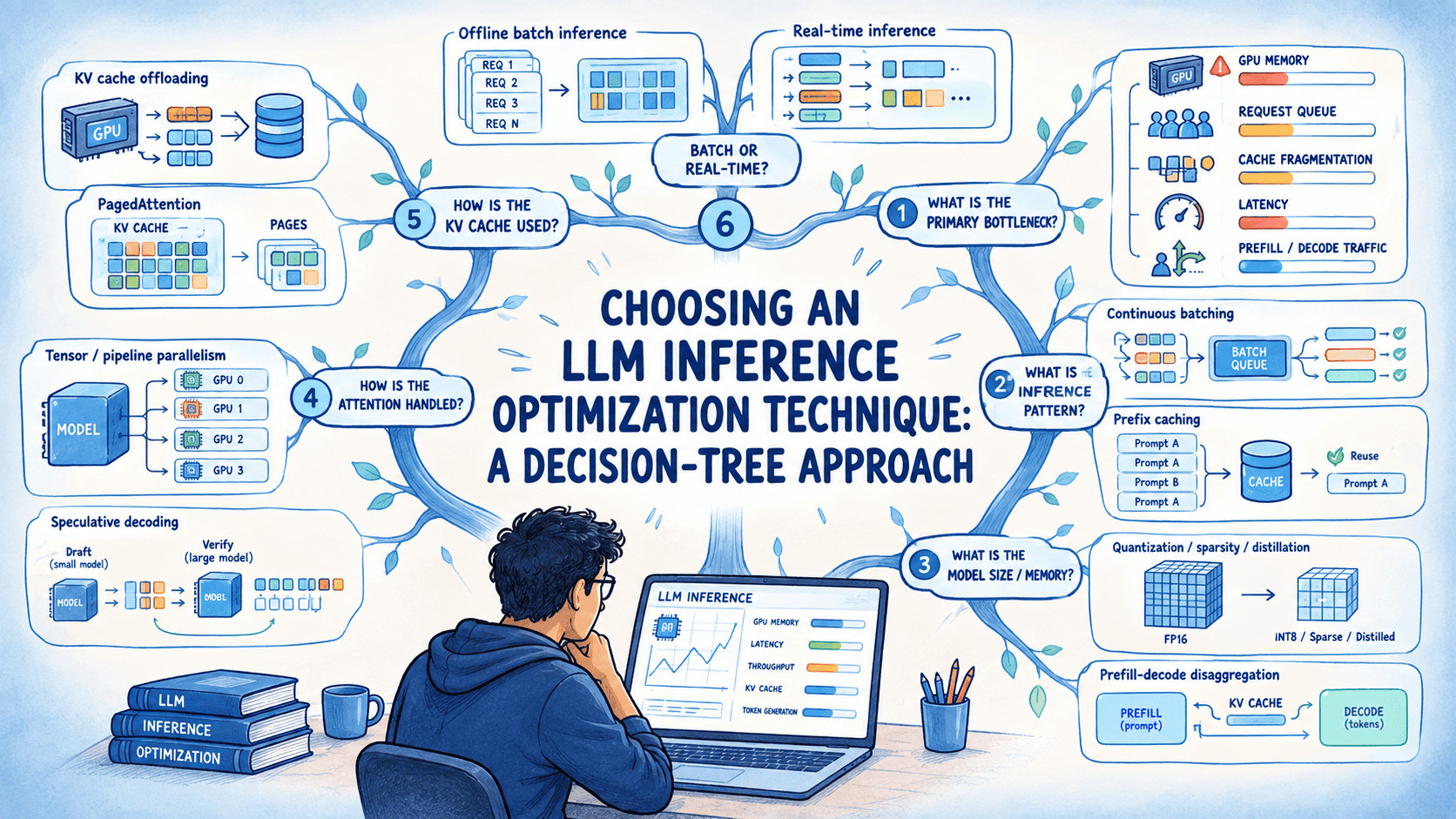
Determining the appropriate optimization strategy requires a systematic audit of the workload. By moving through a six-question decision tree, technical teams can isolate the primary constraint preventing optimal performance.
1. Assessing Model Hardware Fit
The baseline for any optimization effort is determining whether the model architecture fits within the physical constraints of the available GPU hardware. If a model consumes the majority of available VRAM, the remaining overhead for the KV cache is insufficient, leading to reduced batch sizes and higher costs per request. If the model is too large, techniques such as weight quantization (reducing precision from FP16 to INT8 or INT4), model distillation (training a smaller "student" model to mimic a larger "teacher"), or structural sparsity are the necessary first steps. These model-level interventions are foundational; they dictate the available headroom for subsequent serving optimizations.
2. Evaluating Prompt Redundancy
In many modern AI applications, particularly those utilizing Retrieval-Augmented Generation (RAG) or multi-turn chat interfaces, the prompt contains a significant amount of static data. For instance, a system prompt or a shared knowledge base preamble may be resent thousands of times per hour. Prefix caching allows the inference engine to bypass the re-computation of these static tokens. By identifying the exact character-level overlap in incoming requests, engineers can realize massive gains in time-to-first-token (TTFT) and overall system throughput.
3. Analyzing Traffic Concurrency and Burst Patterns
Standard batching techniques often fail when traffic is heterogeneous. If a short request (e.g., a simple sentiment classification) is queued behind a long-form document summarization, the entire batch remains blocked until the longest sequence completes. Continuous batching addresses this by allowing finished sequences to be replaced by new requests dynamically, even mid-generation. This ensures the GPU remains utilized rather than sitting idle waiting for a single, slow-moving sequence to finish.
4. Managing Memory Fragmentation
The KV cache can often become fragmented, with large, reserved blocks of memory sitting empty because the actual length of a generated response is less than the pre-allocated maximum. PagedAttention, a technique popularized by research into efficient memory management, mitigates this by partitioning the cache into smaller, fixed-size pages. This allows for more granular memory allocation, enabling larger batch sizes and higher total throughput without the need for additional hardware.
5. Optimizing Per-Token Latency
For interactive applications where user experience is tied to the speed of text streaming, speculative decoding has emerged as a high-value strategy. By utilizing a small, high-speed "draft" model to predict tokens and a larger "target" model to verify them, the system can output multiple tokens in a single iteration. This is highly effective when the draft model exhibits a high acceptance rate, drastically reducing inter-token latency.
6. Addressing Scaling Contention
At enterprise scale, the prefill phase (processing the input prompt) and the decode phase (generating the output) may begin to contend for the same GPU resources. If prefill operations are delaying decode tasks, leading to erratic latency spikes, the architectural shift toward prefill-decode disaggregation becomes necessary. By separating these workloads onto dedicated hardware, teams can optimize for throughput and latency independently.
Strategic Implications and Industry Standards
The decision-making process described above is consistent with the strategies currently employed by leading AI infrastructure providers. Industry data suggests that a hybrid approach—combining, for instance, PagedAttention with continuous batching—is the standard configuration for modern inference engines like vLLM, TGI, or TensorRT-LLM.
Recent benchmarks indicate that failing to implement these optimizations can result in a 3x to 5x decrease in cost-efficiency. For an organization processing millions of tokens per day, this represents a massive operational expense. Conversely, the "pitfalls" of over-optimization must be noted: applying techniques like disaggregation to a small-scale workload adds unnecessary network latency and infrastructure complexity, which can result in worse performance than a simple, monolithic deployment.
Fact-Based Analysis of Performance Pitfalls
Engineers should remain vigilant for common failure modes that indicate an optimization has been misapplied:
- The Zero-Hit Problem: If prefix caching shows a near-zero hit rate, it is frequently due to non-deterministic serialization or the placement of dynamic content at the beginning of the prompt. The fix is strictly operational: front-loading static system instructions and standardizing prompt templates.
- The Quantization Paradox: A common error is quantizing model weights while leaving activations at full precision. If the hardware is not configured to handle the mixed-precision math, the system will perform "de-quantization" on the fly, negating any throughput gains.
- The Draft Model Mismatch: Speculative decoding can actually increase latency if the draft model is too dissimilar from the target model. If the draft predictions are consistently rejected, the overhead of the verification pass exceeds the time saved by the accelerated generation.
Conclusion: A Disciplined Approach to Scaling
As the landscape of LLM inference evolves, the ability to match technical solutions to workload-specific bottlenecks remains the primary differentiator for high-performing AI engineering teams. There is no "silver bullet" for inference optimization; rather, it is a process of continuous profiling and iterative adjustment. By systematically assessing model size, prompt structure, traffic patterns, and memory utilization, teams can build robust, cost-effective inference pipelines that scale alongside user demand. The path forward requires a shift from viewing optimization as a one-time configuration task to treating it as a dynamic, data-driven component of the application lifecycle.