Google Labs Unveils Tabletop: A New Collaborative Workspace Experiment for Real-Time Group Planning and Decision-Making

Google has officially introduced Tabletop, a novel experimental platform developed under its Google Labs umbrella designed to streamline collaborative group planning, decision-making, and project execution. The announcement marks the latest initiative by the technology giant to harness artificial intelligence and real-time co-authoring capabilities, bridging the gap between casual group coordination and structured digital workspaces. As modern social, recreational, and organizational activities increasingly rely on fragmented digital communication tools, Tabletop aims to consolidate links, files, brainstorming notes, and interactive tools into a single, unified digital canvas where multiple users can collaborate simultaneously.
The platform officially rolled out its waitlist phase in the United States for users aged 18 and older, inviting early adopters to test its capabilities via the Google Labs portal. By integrating generative AI features with multi-user accessibility reminiscent of Google Docs, Tabletop represents a calculated step toward reducing the administrative friction inherent in group coordination.
Core Features and Functional Mechanics of Tabletop
At its technological core, Tabletop is engineered to serve as a customizable, collaborative digital space where groups can organize events, manage community projects, and execute collective decisions. Whether users are organizing a complex cross-country family vacation, managing a local recreational sports league, or coordinating a neighborhood potluck, the platform provides a centralized environment designed to eliminate endless message threads and disjointed spreadsheets.
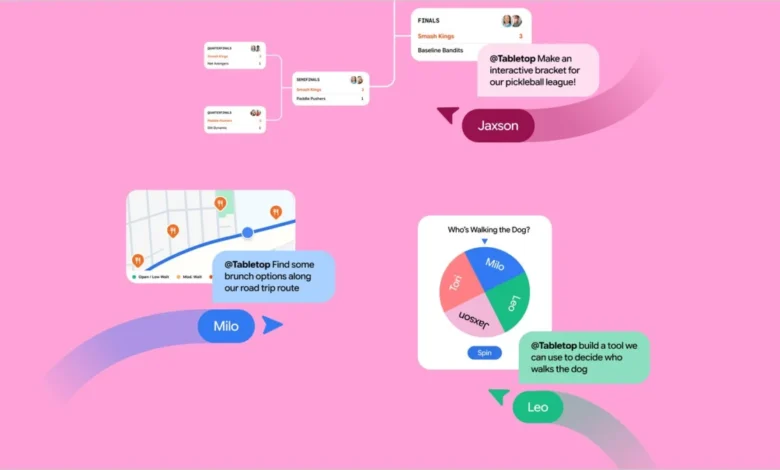
The workflow within Tabletop begins with data ingestion. Users can populate their designated space by uploading relevant files, embedding hyperlinks, and dropping raw ideas into the interface. Once the foundational materials are provided, users can leverage the platform’s integrated artificial intelligence by prompting "@tabletop" or by selecting from a pre-designed library of starter templates.
These templates and prompt-driven commands are capable of autonomously generating a wide array of custom interactive modules. For instance, inputting travel dates and destination links can prompt the system to generate a fully customized, interactive trip itinerary complete with time blocks and location data. Similarly, organizing a social gathering can yield automated dinner polls to gauge dietary preferences and constraints, while organizing a community sports event can result in dynamically generated expense splitters and tournament brackets.
Once the digital space is structured and populated, collaboration transitions into real-time execution. The platform utilizes a multi-user interface framework comparable to Google Docs, allowing participants to access the space concurrently. Group members can drop an invite link directly into existing messaging applications, enabling participants to jump into the workspace, vote on options, edit schedules, and build upon ideas simultaneously without version control conflicts.
Background Context and the Evolution of Google Labs
The launch of Tabletop must be understood within the broader operational framework of Google Labs, the division historically responsible for incubating early-stage prototypes, experimental applications, and cutting-edge user experiences. Google Labs functions as an innovation incubator where engineers and designers test concepts that stretch the boundaries of traditional software suites like Google Workspace, Android, and Search.
In recent years, the mandate of Google Labs has pivoted heavily toward integrating generative artificial intelligence into everyday workflows. Following the widespread commercialization of large language models and multimodal AI systems, the tech industry has experienced a paradigm shift. Consumers and professionals alike now expect intelligent assistance not only in document creation and software coding, but also in logistics, event planning, and unstructured problem-solving.
Historically, group coordination has suffered from tool fragmentation. Planning a simple group trip often requires a disparate collection of applications: a group chat for brainstorming, a shared document for notes, a separate spreadsheet for tracking shared expenses, a mapping service for itinerary routing, and an external polling tool for scheduling conflicts. This fragmentation frequently leads to communication silos, overlooked details, and organizational fatigue among participants. Tabletop emerges as a direct response to this systemic inefficiency, attempting to synthesize these disjointed functions into a cohesive, AI-augmented ecosystem.
Timeline of Development and Strategic Rollout
The rollout of Tabletop follows a deliberate chronology characteristic of modern software incubation strategies. While initial conceptualization and internal prototyping took place within Google’s engineering facilities over the preceding months, the public debut represents the transition from closed-loop testing to open-beta validation.
Phase one of the public lifecycle began with the opening of the U.S.-based waitlist for individuals aged 18 and older. By limiting the initial geographic and demographic scope, Google aims to monitor server load, gather qualitative user feedback, and refine the AI prompting mechanics associated with the "@tabletop" command structure.
Industry analysts anticipate that feedback gathered during this initial experimental phase will dictate the platform’s feature roadmap, including potential expansions into international markets, enterprise-tier deployments, and deeper integrations with existing Google Workspace applications such as Google Calendar, Google Maps, and Google Drive. However, Google has not yet released a definitive timeline for a general commercial release or potential integration into standard consumer accounts outside of the Google Labs ecosystem.
Industry Implications and Competitive Landscape
The introduction of Tabletop highlights a growing competitive battleground within the productivity and consumer software sectors. As artificial intelligence transforms how humans interact with digital tools, technology companies are racing to capture the burgeoning market for collaborative, AI-driven organization platforms.
While enterprise collaboration tools like Slack, Microsoft Teams, and Notion have long catered to corporate environments, the consumer and informal group planning market has remained comparatively underserved by unified AI solutions. Traditional productivity suites often prove overly rigid or complex for casual use cases, such as organizing a weekend camping trip or managing a local book club. Tabletop attempts to bridge this gap by offering enterprise-grade real-time collaboration wrapped in an accessible, template-driven consumer interface.
From an economic and technological perspective, the success of Tabletop will likely depend on three critical factors: user adoption rates during the experimental phase, the reliability and accuracy of its generative AI integrations, and the seamlessness of its sharing mechanisms. If users find that prompting "@tabletop" significantly reduces the manual labor required to build itineraries, polls, and brackets, the platform could establish a new benchmark for informal project management.
Conversely, challenges remain regarding data privacy, user onboarding friction, and the risk of feature bloat. As consumers become increasingly selective about the applications they integrate into their daily communication loops, experimental tools must demonstrate clear, undeniable utility over established habits like traditional group chats and shared spreadsheets.
Access and Participation
For users interested in participating in the initial rollout, Google has established an active registration portal. Eligible individuals located in the United States who are 18 years of age or older can request access to the experimental platform by visiting labs.google/tabletop. As the experiment progresses, further updates regarding feature expansions, expanded regional availability, and broader technological integrations are expected to be announced through official Google Labs communication channels.