IFixit Teardown of MacBook Pro with PROLED XDR Display Reveals Secrets Behind the Illuminated Logo, Tandem OLED, and Improved Repairability

The landscape of professional portable computing shifted once again following the release of Apple’s latest hardware iteration, prompting the renowned right-to-repair advocates at iFixit to publish their comprehensive teardown of the MacBook Pro equipped with the PROLED XDR Display. This latest architectural breakdown offers a granular look into some of Apple’s most ambitious engineering undertakings in recent years, shedding light on how the company successfully resurrected the iconic illuminated Apple logo on the lid, engineered an advanced tandem OLED panel, and managed to drastically reduce the overall physical weight of the machine without sacrificing structural integrity or computational muscle.
For industry watchers, hardware enthusiasts, and everyday consumers alike, the teardown serves as a mechanical blueprint of Apple’s current design philosophy. By dissecting the device down to its individual screws, ribbon cables, and microscopic diode layers, iFixit has provided invaluable insight into the manufacturing hurdles, component layouts, and repairability metrics that define this new generation of portable workstations.
Unpacking the Architecture: Main Facts of the iFixit Teardown

At the core of the iFixit analysis are three primary hardware milestones: the introduction of a dual-layer tandem OLED screen, the complex mechanical engineering required to bring back the glowing lid logo, and a notable shift in modular component recognition that marginally improves the device’s repair score.
The teardown begins with an examination of the display assembly, which utilizes a tandem OLED architecture. Unlike conventional single-layer configurations, this setup stacks two distinct light-emitting layers on top of one another. According to microscopic analysis conducted during the teardown, this design allows the panel to achieve significantly higher peak brightness levels while mitigating the rapid degradation typically associated with high-output organic light-emitting diodes. Furthermore, technicians discovered that the blue subpixels within the matrix are constructed noticeably larger than their red and green counterparts. This deliberate geometric adjustment is engineered to distribute electrical stress more evenly across the subpixel materials, substantially extending the operational lifespan of the display panel.
Moving past the screen, the investigation targeted the chassis internals. Despite the inclusion of new hardware features—such as touchscreen capabilities and the hardware necessary to illuminate the exterior logo—Apple engineers successfully trimmed the weight of the standard 14-inch model from 3.4 pounds (1.55 kg) down to an agile 3.0 pounds (1.38 kg). According to component weight breakdowns, this mass reduction was achieved by shaving 92 grams off the aluminum chassis structure and 101 grams off the display assembly housing. Minor weight savings were also found in a slightly smaller trackpad design, which saved an additional 8 grams, while the internal battery assembly remained virtually identical, weighing just 2 grams less than its predecessor.
Chronology of the Disassembly Process

The methodical process of dismantling the MacBook Pro with PROLED XDR Display followed a familiar trajectory for technicians accustomed to modern Apple laptops, though several unique hurdles quickly emerged. The initial steps involved removing the proprietary pentalobe screws securing the lower aluminum case, granting immediate access to the internal battery cells, cooling fans, and logic board architecture.
As the teardown progressed, technicians encountered traditional layout roadblocks. Much like previous iterations, replacing vulnerable components such as the USB-C ports, the internal cooling fans, or the auxiliary headphone jack continues to require the complete removal of the primary logic board, despite these components being functionally modular. Meanwhile, high-value components including the HDMI port, the SDXC card slot, and the integrated RAM and storage modules remain permanently soldered directly onto the logic board, limiting deep-level customizability for end-users.
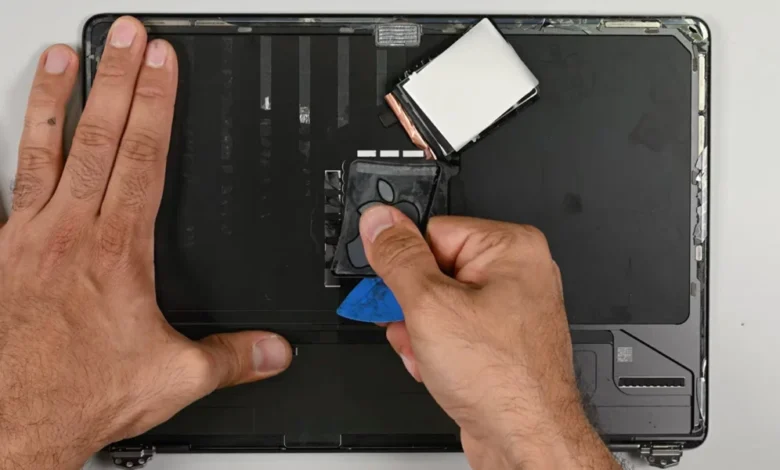
The most physically demanding phase of the teardown centered on the lid assembly and the newly reinstated illuminated Apple logo. In their initial attempts to access the internal lighting elements, iFixit technicians inadvertently destroyed the delicate tandem OLED panel, highlighting just how tightly integrated and fragile the modern laptop display stack has become. Once inside the housing, however, the mechanics of the glowing logo were laid bare. The system relies on a strip of four discrete LEDs working in tandem with a specialized reflective layer and an optical diffuser to disperse light uniformly across the cavity. The exterior logo itself features a sophisticated two-way mirror coating, which reflects ambient light to maintain a sleek, metallic appearance when the internal LEDs are powered down, yet seamlessly permits internal illumination to shine through when activated.
Modular Recognition and Parts Pairing Breakthroughs

One of the most significant discoveries in the iFixit report involves Apple’s software-level restrictions regarding parts pairing and modular component swaps. In previous generations—notably with the M5 MacBook Pro released the prior year—swapping core hardware components between identical machines frequently triggered security blocks or failed calibrations via Apple’s official Repair Assistant software, rendering features like Touch ID unusable without corporate authorization.
However, the latest MacBook Pro with PROLED XDR Display demonstrates a meaningful shift toward improved software flexibility. During testing, iFixit swapped the primary logic boards between two distinct units of the new laptop. To the surprise of the technicians, the device successfully recognized the foreign battery, display assembly, and Touch ID biometric sensor without triggering catastrophic failure protocols. Essential features, including True Tone color calibration, display brightness controls, and the newly integrated touchscreen functionality, operated normally right out of the box. Furthermore, technicians were successfully able to enroll a fresh fingerprint using a donor logic board sourced from a completely separate machine, signaling a potential softening of strict lockdown protocols that have historically plagued independent repair shops and DIY enthusiasts.
Supporting Data and Repairability Scoring
Following the complete dismantling of the device, iFixit assigned the MacBook Pro with PROLED XDR Display an official repairability score of 5 out of 10. This metric represents a modest one-point improvement over the score earned by the M5 MacBook Pro from the previous hardware cycle, though it remains one point shy of the more accessible, budget-oriented MacBook Neo.

The rationale behind the 5 out of 10 score stems from a balancing act between improved software pairing leniency and persistent hardware design constraints. On the positive side, the ability to swap major modular assemblies without crippling system software significantly aids professional technicians who rely on component harvesting or localized refurbishments. Conversely, the continued use of soldered-on memory and storage, coupled with the labyrinthine routing required to replace basic ports like the headphone jack and USB-C controllers, prevents the device from achieving a higher, more consumer-friendly rating.
Broader Industry Impact and Technical Implications
The architectural choices revealed in this teardown carry significant implications for the broader laptop market and Apple’s ongoing product strategy. For years, critics of modern consumer electronics have decried the industry-wide race toward extreme thinness at the expense of reparability and component longevity. By successfully shedding nearly half a pound of weight while simultaneously introducing complex structural enhancements—such as a tandem OLED matrix and an active logo illumination system—Apple has proven that high-performance engineering does not inherently preclude structural refinement.
The implementation of the tandem OLED panel is viewed by display analysts as a bellwether for the wider computing industry. As professional creatives increasingly demand reference-grade color accuracy, extreme contrast ratios, and high sustained brightness levels in mobile form factors, single-layer OLED displays have frequently struggled with thermal management and long-term pixel burnout. By validating the commercial viability of stacked organic light-emitting diode layers in a mainstream pro laptop, Apple has likely accelerated the adoption curve for tandem displays across competing hardware manufacturers.

Furthermore, the relaxation of parts-pairing restrictions—as demonstrated by the successful Touch ID and display swaps—may represent a calculated response to mounting global legislative pressure. With numerous jurisdictions enacting strict "Right to Repair" laws that penalize manufacturers for using software locks to stifle independent repairs, Apple’s quiet concession in recognizing donor logic boards could signal a new operational baseline for future hardware releases. While critical components like soldered RAM and unserviceable storage modules remain locked to the motherboard, the newfound willingness to let core peripherals communicate seamlessly across device swaps marks a welcome, albeit incremental, victory for the global repair community.