Navigating the Volatility of AI Search and Answer Engine Optimization in the 2026 Digital Landscape

For SEO managers, the digital landscape has long been defined by the erratic nature of search engine updates. However, the rise of artificial intelligence as a primary discovery tool has introduced a new, more opaque dimension of instability: AI search volatility. As of Q1 2026, 58% of marketers reported that their organizations are actively optimizing content specifically for answer engines, according to HubSpot’s State of AEO report. This shift marks a transition from traditional keyword-based ranking to a landscape where brand visibility is determined by the non-deterministic outputs of Large Language Models (LLMs) such as ChatGPT, Gemini, and Perplexity.
Unlike traditional Google search, where a rank tracker provides a concrete position for a URL, AI answers are fluid. A single model update or a shift in training data can fundamentally alter which businesses are cited, how they are described, and whether a link is provided at all. This lack of a "stable position" creates significant challenges for marketing teams tasked with proving the ROI of their content strategies to leadership.
Defining the Nature of AI Search Instability
AI search volatility refers to the fluctuations in which brands, pages, and sources are cited by answer engines from one query to the next. While traditional SEO volatility is tied to algorithmic ranking adjustments and seasonal consumer demand, AI volatility is inherent to the technology itself. LLMs are non-deterministic; they are designed to generate original, context-aware responses rather than retrieve a static list of pages.
Research from SparkToro and Gumshoe.ai in late 2025 underscored this randomness. When the same recommendation prompts were run repeatedly, these engines had less than a 1-in-100 chance of returning the same brand list twice. This means that a sudden dip in brand visibility or referral traffic is not necessarily a reflection of poor content quality or a failing SEO strategy, but rather a byproduct of the way these models function.

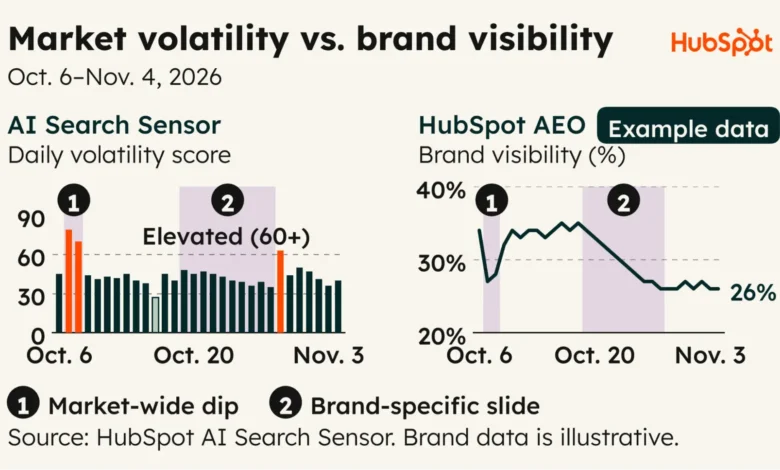
To distinguish between everyday "noise" and a genuine, market-wide shift in how brands are perceived, industry professionals are increasingly relying on tools like the AI Search Sensor. By tracking metrics such as mention rates, citation frequency, and AI-referred traffic, organizations can determine whether a visibility drop is localized to their own domain or part of a broader, systemic movement within the answer engine ecosystem.
The Divergence of Ranking and AEO Metrics
It is vital for digital strategists to recognize that ranking volatility and AI search volatility are distinct, though related, phenomena. Traditional rank trackers, such as the Semrush Sensor, measure day-to-day fluctuations in Google search results across a fixed set of keywords. While high-ranking pages are statistically more likely to be cited by AI, the correlation is not a guarantee of causality.
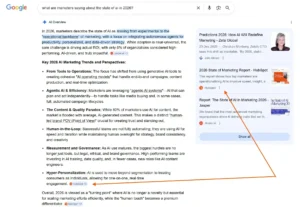
Recent data from the Pew Research Center suggests that the impact of AI on traffic is profound. A 2025 analysis of user behavior indicated that when an AI summary appears in search results, users click on a traditional link only 8% of the time, compared to 15% when no AI summary is present. Consequently, a company could theoretically maintain its top position in organic search results while simultaneously suffering a significant decline in traffic due to the presence of an AI-generated answer.
This necessitates a change in how performance is measured. Because Google Search Console and similar legacy tools often fold AI-driven impressions into general organic search data, marketers are turning to generative AI-specific reports and broader AEO metrics, including share-of-voice and citation volume, to gain a clearer picture of their digital footprint.
Establishing a Diagnostic Framework
When visibility metrics decline, the immediate instinct is often to overhaul content or adjust technical SEO parameters. However, experts warn that reacting to individual, short-term fluctuations can be counterproductive. A more robust approach involves a structured diagnostic process:

- Establish a Market Baseline: Compare internal brand performance against an industry-wide benchmark. If the industry average for your sector has also declined, the issue is likely an engine-level adjustment.
- Monitor Multiple Signals: Evaluate whether the volatility is consistent across all engines or isolated to one. For instance, if citations for blog content are holding steady in ChatGPT but dropping in Gemini, the issue may be related to how specific models prioritize different content formats.
- Evaluate Timing: Review model release notes. Significant shifts in AI visibility often correspond with major updates from OpenAI, Google, or Perplexity.
- Wait for Stabilization: A new daily volatility score often requires at least 72 hours to settle. Taking action based on a single day of data is rarely advisable.
Reporting to Leadership in an Era of Uncertainty
For CMOs and marketing directors, the primary concern remains the bottom line: Does this volatility affect the sales pipeline or total revenue? Bridging the gap between AI visibility and financial performance remains the top challenge for 2026, as noted by 23% of B2B marketers.
To report effectively, teams should move away from purely technical metrics and adopt a five-part reporting structure:
- Executive Summary: A high-level overview of whether current volatility is impacting revenue-generating channels.
- Contextual Data: A comparison chart showing your brand’s performance against the broader industry benchmark.
- Diagnostic Findings: Clear evidence of whether the shift was market-wide (due to engine updates) or specific to the brand (due to content strategy).
- Business Impact: A breakdown of AI-sourced pipeline using CRM data, such as "How did you hear about us?" fields on lead forms.
- Strategic Outlook: A summary of planned adjustments, if any, based on long-term trends rather than short-term spikes.
By tracking AI referrals through original and latest traffic source properties in their CRM, teams can better map the customer journey from an AI-generated mention to a closed deal.
Broader Implications and Future Outlook
The volatility of AI search is not a temporary hurdle; it is a permanent feature of the modern internet. As AI becomes the interface through which consumers interact with information, brands must shift from "owning" a search position to "earning" a citation.
The data indicates that there is a distinct preference for different content types across various platforms. For example, industry reports from late 2025 through early 2026 showed that while blog posts performed well for citations in Google’s AI Overviews (42%), comparison-based content was significantly more effective in ChatGPT (95%). This suggests that "one-size-fits-all" SEO is dead. Future success will require a multi-modal content strategy tailored to the unique logic and formatting preferences of individual AI models.

Furthermore, as these models continue to evolve, the "hallucination" and "inconsistency" issues currently plaguing the industry are likely to be addressed. However, the move toward a more personalized, intent-driven web means that visibility will likely become more fragmented. Brands that focus on building domain authority, establishing a strong reputation that precedes the search, and diversifying their presence across multiple answer engines will be better positioned to weather the storms of volatility.
Ultimately, the goal of AEO is not to eliminate volatility, but to understand it. By embracing the data-driven diagnostic methods now available, organizations can stop chasing the daily shifts of the algorithms and start focusing on the fundamental goal of marketing: being the most relevant and trusted resource when the user—or the machine—asks for an answer.