The global business landscape is currently undergoing a seismic shift driven by the rapid integration of artificial intelligence into daily operations. Recent market data indicates that 35% of companies have already adopted AI in their core processes, while 90% of organizational leaders now believe that AI assistance represents a critical competitive advantage in an increasingly saturated digital marketplace. As the technology matures, it is no longer a luxury for tech giants; approximately 77% of modern consumer and professional devices now utilize some form of artificial intelligence in their functionalities. For entrepreneurs, e-commerce operators, and digital marketers, understanding the nuances of these tools is no longer optional—it is a prerequisite for survival and growth.
The current surge in AI utility follows a decade of incremental progress that reached a tipping point in late 2022 with the public release of advanced large language models. What began as simple automation and predictive text has evolved into sophisticated generative systems capable of designing websites, managing complex project timelines, and producing high-fidelity video content. This evolution has democratized access to high-end production capabilities, allowing small-scale online stores to compete with multinational corporations in terms of marketing output and operational efficiency.
The Evolution of Artificial Intelligence in Commerce: A Chronology
To understand the current state of AI tools, one must look at the timeline of their integration into the commercial sector. The early 2010s were defined by basic machine learning algorithms primarily used for recommendation engines—the "customers who bought this also bought that" feature popularized by Amazon. By 2015, natural language processing (NLP) began to power basic customer service chatbots, though their capabilities remained limited to scripted responses.
The landscape shifted dramatically between 2018 and 2021 with the introduction of transformer models, which allowed machines to understand context more effectively. This period saw the rise of specialized AI for SEO and data analytics. However, the most significant disruption occurred in 2022 and 2023, as generative AI became accessible to the general public. This allowed for the creation of original images, code, and long-form text, leading to the current era of "AI-first" business strategies. Today, in 2024, the focus has moved from simple content generation to "agentic" AI—tools that can perform multi-step tasks with minimal human supervision.
Building and Optimizing Digital Infrastructure
For any online business, the website serves as the primary storefront and the first point of contact for potential customers. Traditionally, building a high-quality website required significant capital or specialized coding knowledge. AI has dismantled these barriers.
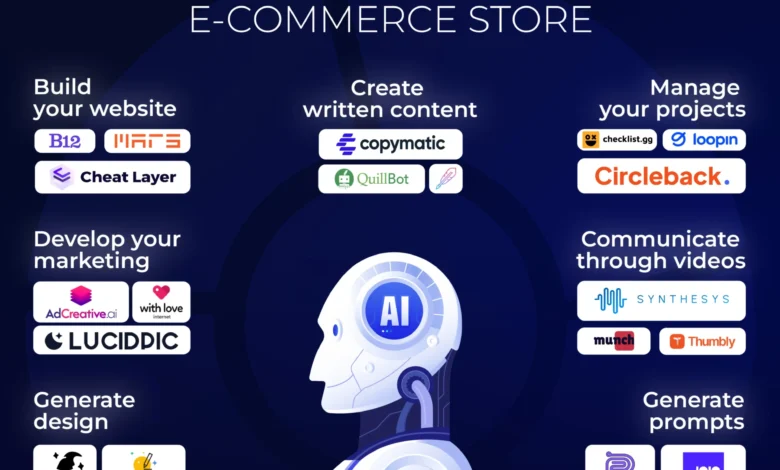
Tools such as 10Web and Wix ADI (Artificial Design Intelligence) have transformed web development. 10Web, for instance, uses AI to recreate any existing website layout into a customizable WordPress format, optimizing it for speed and performance automatically. Similarly, Framer AI allows users to generate fully functional, aesthetically pleasing landing pages from a simple text prompt. These tools do not just build the structure; they optimize the user experience (UX) by analyzing heatmaps and user behavior patterns to suggest the most effective layouts for conversion.
Industry analysts note that the use of AI in web development has reduced the "time-to-market" for new e-commerce brands by up to 70%. By automating the technical backend, business owners can focus their energy on product development and customer relationship management.
The New Frontier of Marketing and Brand Development
Marketing has historically been one of the most resource-intensive departments in any company. AI is now being used to hyper-personalize the customer journey. Tools like Albert.ai and AdCreative.ai allow businesses to automate the creation and distribution of advertisements across multiple platforms. Albert.ai acts as a digital marketing ally, managing entire campaigns by analyzing vast amounts of data to determine which creative assets perform best with specific demographics.
Furthermore, platforms like Mutiny allow online stores to implement "no-code" web personalization. By using AI to identify the source of a visitor—whether they came from a specific LinkedIn post or a Google search—Mutiny can change the website’s headlines and calls-to-action in real-time to match the visitor’s intent. This level of personalization was previously only available to companies with massive data science teams.
Multimedia Communication and Video Production
Video content remains the most engaging form of digital communication, yet it is often the most expensive and difficult to produce. AI-powered video tools are solving this bottleneck. Synthesia and HeyGen allow businesses to create professional-grade videos using AI avatars. By simply typing a script, a user can generate a video of a "human" spokesperson delivering the message in over 120 languages, eliminating the need for cameras, actors, or recording studios.
For editing, tools like Descript have revolutionized the workflow. Descript allows users to edit video by editing text. It transcribes the audio, and if the user deletes a word from the transcript, the corresponding video frame is removed. This "text-based video editing" has made high-quality content creation accessible to staff members who may have no formal training in video production.
Streamlining Operations through Intelligent Project Management
As businesses grow, complexity often leads to inefficiency. AI in project management acts as a cognitive layer that helps teams stay organized. Motion is a prime example of this, using AI to automatically build a daily schedule for team members based on task priority and deadlines. If a meeting is added or a task takes longer than expected, the AI reshuffles the entire team’s calendar to ensure the most critical work is still completed.
Similarly, Asana and Monday.com have integrated AI features that summarize long comment threads, predict potential project bottlenecks, and automate repetitive administrative tasks. This shift from manual tracking to automated orchestration allows teams to maintain a high velocity without the typical burnout associated with "busy work."
The Art of the Prompt: Maximizing AI Output
The effectiveness of any AI tool is largely dependent on the quality of the instructions it receives. This has given rise to the field of prompt engineering. To assist those who are not experts in communicating with LLMs (Large Language Models), tools like AIPRM and PromptBase have emerged.
AIPRM provides a curated library of prompt templates for ChatGPT, specifically designed for SEO, marketing, and sales. By using these engineered prompts, business owners can ensure they receive high-quality, actionable outputs rather than generic responses. This layer of "prompt assistance" ensures that even novice users can extract maximum value from sophisticated AI systems.
Content Creation and SEO Strategy
Written content remains the backbone of SEO and organic growth. However, the sheer volume of content required to rank on search engines can be overwhelming. Jasper and Copy.ai have become industry standards for generating blog posts, product descriptions, and email newsletters. These tools are trained on marketing best practices, ensuring that the content is not only grammatically correct but also persuasive.
In the realm of SEO, MarketMuse uses AI to analyze top-ranking content for any given keyword. It then provides a "content brief" that tells the writer exactly which topics and subtopics need to be covered to compete for the top spot on Google. This data-driven approach to writing removes the guesswork from content marketing.
Visual Design and Brand Identity
Visual identity is crucial for brand recall. AI design tools like Midjourney and DALL-E 3 have enabled creators to generate stunning, high-resolution imagery from simple descriptions. For e-commerce stores, this means the ability to create lifestyle images for products without a physical photoshoot.
Canva has also integrated "Magic Studio," an AI suite that allows users to remove backgrounds, expand images beyond their original borders, and generate custom graphics instantly. For logo design, Looka uses AI to generate hundreds of branding options based on a user’s style preferences, providing a professional identity at a fraction of the cost of a design agency.
Broader Implications and Industry Analysis
The rapid adoption of these tools is not without its challenges. Industry experts emphasize that while AI can handle the "execution" of tasks, the "strategy" must remain human. There are also significant discussions regarding the ethics of AI, particularly concerning data privacy and the copyright of AI-generated content.
"The goal of AI in the online store ecosystem is not to replace the entrepreneur, but to augment their capabilities," says a leading digital transformation consultant. "We are seeing a shift where a single individual can now operate a business that would have required a team of ten people just five years ago."
From an economic perspective, the integration of AI is expected to contribute trillions of dollars to the global economy by 2030. For the individual business owner, the implication is clear: those who master these AI tools will benefit from reduced overhead and increased speed, while those who ignore them risk obsolescence.
Conclusion: Navigating the AI-Driven Future
As evidenced by the 77% of devices already utilizing AI, the technology is no longer a futuristic concept—it is the current standard. Whether it is through building more responsive websites, creating personalized marketing campaigns, or streamlining project management, AI provides the tools necessary to thrive in a digital-first economy. The selection of tools mentioned—from 10Web for web development to Jasper for content and Synthesia for video—represents the current vanguard of this technological revolution. For any business looking to optimize its processes in 2024, the integration of these AI-powered solutions is a logical and necessary step toward long-term viability.